


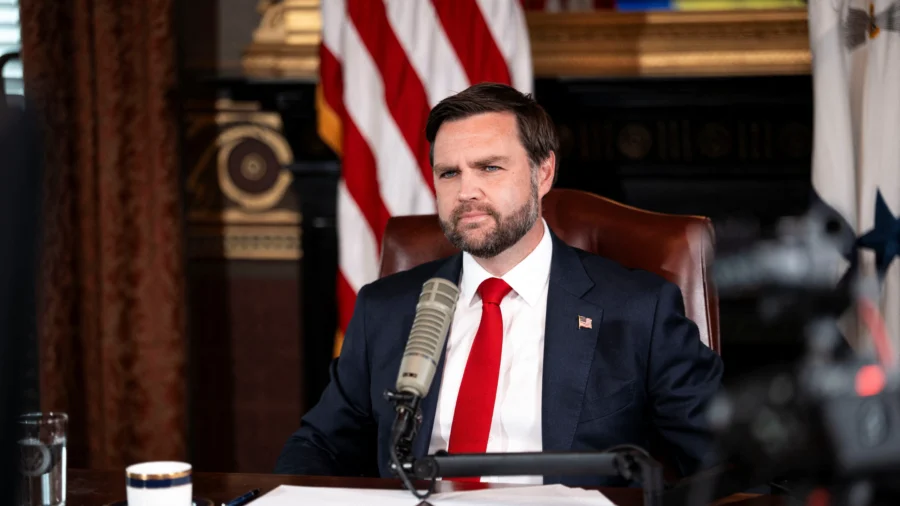
Opening the broadcast, Vance described Kirk as a beloved friend, calling him an immortal American hero and Christian martyr. A tribute featured clips of Kirk with family, at events, and speaking to audiences, concluding with "Amazing Grace" on bagpipes.
“Filling in for somebody who cannot be filled in for, but I’m gonna try to do my best—my dear friend, the great Charlie Kirk,” Vance said. “The last several days have been extremely hard for our country … and of course they've been hardest most of all for his darling wife Erika, and their two beautiful children.”
Lasting a little over two hours, guests included Stephen Miller, White House Deputy Chief of Staff for Communications Taylor Budowich, Deputy Communications Director Kaelan Dorr, executive producer of The Charlie Kirk Show Andrew Kolvet, White House press secretary Caroline Levitt, Tucker Carlson, Susie Wiles, and Secretary of Health and Human Services Robert F. Kennedy Jr.
Vance recalled Kirk’s dedication to young Americans, especially students afraid to speak up, saying he gave them the courage to be courageous and bold. Kirk built a network through Turning Point USA that connected an entire generation, helping many find lifelong friends or even spouses. Vance described him as a “joyful warrior for our country,” crediting him with key roles in winning President Donald Trump’s election and Vance’s own rise to the vice presidency.
Speaking with Miller, Vance addressed the ongoing investigation. "I want to be respectful to the FBI's process, but just know that we are on top of this," Vance said. Miller described the assassination as part of an organized campaign of dehumanization, ideological violence, and a terrorist network. “We are gonna use every resource we have at the Department of Justice, Homeland Security, and throughout this government, to identify, disrupt, dismantle, and destroy these networks and make America safe again for the American people," Miller said.
Vance and guests remembered Kirk as “everyone’s best cheerleader,” motivating and supporting others, offering guidance during difficult moments, including prayer and reassurance. “The left wins when you feel alone and when you feel like you’re the only one who thinks, eats, breathes, lives the way that you do. Charlie was so great at connecting those dots and connecting human beings,” one guest said.
Levitt remembered Kirk as a skilled communicator and a compassionate mentor. She noted that most of his interactions were grounded in kindness, recalling how Kirk would confront opponents with a smile, counter any falsehoods with facts, and was always approachable.
Kennedy recalled how Kirk’s guidance helped him accept his role in the Trump administration. He shared how Kirk had the ability to foster dialogue, especially with opponents. “He thought conversation was the only thing that could heal our country,” Kennedy said. “We have all these forces, particularly the algorithms on social media that are driving us apart ... there seems to be nothing that can stop it. He understood that the only thing that could bridge that gap ... was open debate, and censorship was the enemy of that.”
Carlson recalled how Kirk treated everybody with respect. “He genuinely loved people and genuinely wanted their salvation. He wanted them to have a relationship with God, and he wanted them to know the truth,” adding that Kirk always treated them with respect, especially when they disagreed. Wiles shared how Kirk is irreplaceable, stressing that his torch, mantle, and message will continue.
In his strongest tone, Vance addressed the false reporting and propaganda that targeted Kirk—citing a “well-funded, well-respected magazine whose history goes back to the American Civil War,” backed by the George Soros Open Society Foundation, the Ford Foundation, and other progressive donors that he accused of falsely attributing racist remarks to Kirk. He also described the harassment his children faced at Disneyland, illustrating the real-world consequences of political violence and left-wing extremism.
Vance stated that the reporting made false claims about Kirk, attributing words to him that he had never said. “If you go and watch the clip … he never uttered those words,” he added. “Even if Charlie had uttered those words, it wouldn’t mean that he deserved his fate, but consider the level of propaganda at work … well-funded institutions of the left lied about what he said to justify his murder.”
“I was struck not just by the dishonesty of the smear ... the glee over a young husband’s and young father‘s death.”
Vance said that he's grateful for Democratic friends and colleagues who offered condolences, calling for unity and the condemnation of political violence, adding that the truth needs to be told first. "It’s the only way to honor Charlie,” Vance said, recalling Kirk’s faith: “the most important truth Charlie told is this that long ago, a man begotten, not made, came down from heaven.”
Vance stressed that real unity comes only after confronting hard truths, noting that 24 percent of "very liberal" believe it is acceptable to celebrate in a political opponent’s death, and 26 percent of young liberals think political violence is justified, compared with 3 percent and 7 percent of conservatives.
He described the broader environment of political violence as a “pyramid” of foundations, donors, activists, journalists, and social media influencers. Sharing a personal example of the violence and derangement, he recalled taking his children to Disneyland, where middle-aged women shouted at his 5-year-old: “You should disown your dad, you little [expletive].”
He emphasized that unity is only possible with those who reject political violence and work to dismantle institutions that promote it, urging the public to act: “When you see someone celebrating Charlie’s murder, call them out and ... their employer. We don’t believe in political violence, but we do believe in civility.”
The vice president encouraged civic engagement—joining Turning Point USA, writing to local papers, or running for office—and concluded, “The way to honor him is to shine the light of truth like a torch in the very darkest places … commit ourselves to that cause for which Charlie gave his life to rebuild a united United States of America, and to do it by telling the truth.”