


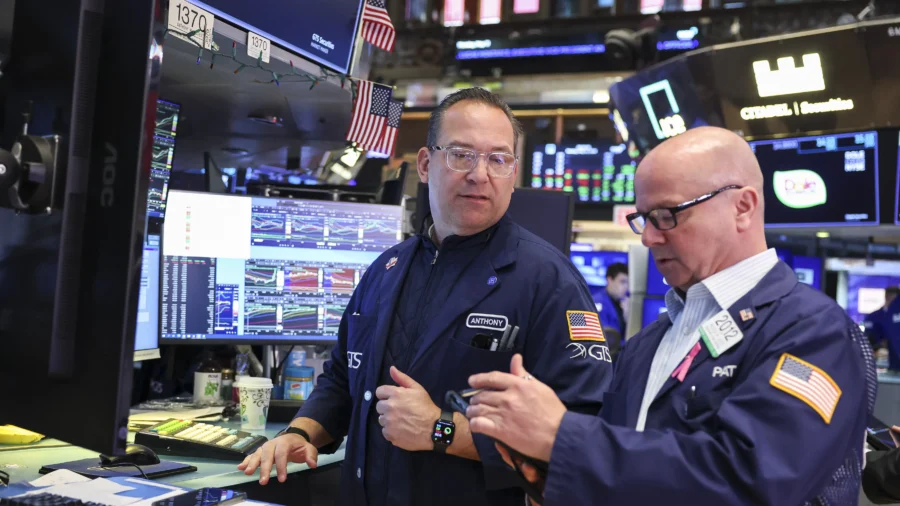
Rising global Treasury bond yields weighed on investor enthusiasm for U.S. equities late in the week, pulling major indexes back from record highs reached earlier after strong earnings reports from tech giants.
Higher oil prices, elevated inflation readings, and political instability in the UK contributed to the sell-off in bonds toward the end of the week.
For the week, the blue-chip Dow Jones Industrial Average slipped by 0.17 percent to close at 49,526 after crossing the 50,000 mark on May 14. The S&P 500 rose by 0.13 percent to 7,408, retreating from the 7,500 level reached on May 14. The Nasdaq Composite finished nearly unchanged for the week, while the Russell 2000 posted the steepest losses, falling by 2.37 percent.
The Chicago Board Options Exchange Volatility Index closed the week at 18.43, up by 7.21 percent.
Stocks opened mixed on May 11 amid mild profit taking after another record close for the S&P 500 and Nasdaq the previous week. Markets quickly turned higher as investors resumed buying dips, particularly in semiconductor shares.
The iShares Semiconductor Index (SOXX) gained 2.39 percent, helping lift the tech-heavy Nasdaq and the S&P 500 by 0.10 percent and 0.19 percent, respectively, to another record close.
The Dow Jones and Russell 2000 also ended higher, gaining 0.19 percent and 0.33 percent, respectively.
Among technology stocks, Lumentum Holdings jumped by 16.52 percent after news it would join the Nasdaq 100 index. Intel gained 3.64 percent, Nvidia added 1.96 percent, and Qualcomm rose by 8.42 percent.
Equities advanced despite rising oil prices and Treasury yields. West Texas Intermediate crude futures resumed their climb toward $98 per barrel on the day after President Donald Trump described the current ceasefire between the United States and Iran as fragile.
The yield on the benchmark 10-year Treasury note rose by 5 basis points to 4.4 percent on the day as higher oil prices revived inflation concerns.
Robert Edwards, chief investment officer at Naples, Florida-based Edwards Asset Management, said the rally reflects a “capitulation-to-FOMO [fear of missing out]” dynamic as investors who pulled money from markets amid Iran-related fears and rising oil prices rush back into equities.
He said strong earnings and solid macroeconomic fundamentals continue to support the market.
“Big tech has regained its leadership, backed by solid and growing revenue and earnings. These names sit at the center of every major secular theme, and as mega-cap IPO activity heats up this summer, expect further earnings growth and multiple expansion. The strong are pulling away, and we’re not done yet,” Edwards told The Epoch Times.
Markets opened May 12 amid another inflation surprise. April consumer inflation rose to 3.8 percent from 3.3 percent in March, above market expectations.
The headline figure, the highest since May 2023, reflected higher energy costs, which increased by 17.9 percent, the largest annual gain since September 2022, compared with 12.5 percent in March, driven primarily by gasoline and fuel oil prices.
“Tuesday's CPI marks the second consecutive reading above 3 percent, suggesting that inflation is roaring back largely driven by stubbornly high oil prices, which will dominate the inflation story for the rest of the year as the conflict continues to unfold in the Middle East,” Skyler Weinand, chief investment officer at Dallas-based Regan Capital, told The Epoch Times.
Core inflation, which excludes food and energy, also edged higher to 2.8 percent from 2.6 percent in March, above forecasts of 2.7 percent. Month over month, core consumer prices rose 0.4 percent.
“Inflation pressure isn’t just at the pump, it’s showing up across the household budget,” eToro U.S. investment analyst Bret Kenwell told The Epoch Times.
The hotter-than-expected inflation report cooled enthusiasm in equities, sending all major indexes sharply lower early in the session, led by a sell-off in semiconductor shares.
Markets also came under pressure from rising oil prices and Treasury yields, with the 10-year Treasury yield nearing the psychologically important 4.5 percent level.
Markets stabilized later in the afternoon as dip buyers returned, helping indexes finish mixed. The S&P 500, Nasdaq, and Russell 2000 closed up by 0.16 percent, 0.71 percent, and 0.97 percent, respectively, while the Dow Jones gained 0.11 percent.
Health care shares also helped stabilize the broader market, with the Direxion Daily Healthcare Bull 3X Shares (CURE) advancing by 5.82 percent.
Markets faced another inflation surprise on the morning of May 13 after the release of the April Producer Price Index (PPI), which measures wholesale prices. PPI accelerated to an annual rate of 6.0 percent from an upwardly revised 4.3 percent in March.
The April PPI reading exceeded expectations of 4.9 percent and marked the highest level since December 2022 amid rising transportation, warehousing, and energy costs.
“Wednesday's PPI was strikingly elevated as producers are feeling the ripple effects of $100 per barrel oil, which is raising the cost of production across the board, as energy is arguably the most critical input cost,” Clark Bellin, president and chief investment officer of Lincoln, Nebraska-based Bellwether Wealth, told The Epoch Times.
Bellin said the hotter inflation data complicates monetary policy at a time when the labor market has slowed, and the Federal Reserve prepares for a leadership transition.
Technology investors continued buying AI-related shares ahead of the incoming Federal Reserve chair, Kevin Warsh, helping the Nasdaq gain another 1.20 percent and close at another record high.
The broader market finished mixed. The S&P 500 rose by 0.58 percent, the Russell 2000 gained 0.04 percent, while the Dow Jones slipped by 0.14 percent.
“The stock market is trading at record highs, and as earnings have easily cleared expectations, it's clear that corporate America has become very skilled at adapting to a wide range of economic environments,” Bellin said.
Investor attention shifted back to earnings on May 14 following Cisco’s financial results released after the market closed the previous day.
The networking equipment company beat expectations on both revenue and earnings while issuing strong guidance for the remainder of the year.
Cisco shares surged by 13 percent, helping boost the Nasdaq and S&P 500 by 0.9 percent and 0.8 percent, respectively.
Technology sentiment also received a boost from the Cerebras IPO, which soared by 70 percent.
Meanwhile, the Dow Jones climbed back above the 50,000 mark for the first time since February.
Investor appetite for equities weakened on May 15 as oil prices and Treasury yields climbed again. The benchmark 30-year Treasury bond yield rose above the key 5 percent level in a delayed reaction to the week’s inflation reports, continued gains in oil prices, and growing political instability in the UK that pushed global bond yields higher.
All major indexes ended sharply lower, led by the Russell 2000, which fell by 2.33 percent, followed by the Nasdaq, down by 1.54 percent. The S&P 500 and Dow Jones fell by 1.24 percent and 1.07 percent, respectively.
Rick Gardner, chief investment officer at Raleigh, North Carolina-based RGA Investments, remains optimistic about U.S. equities.
“Uncertainty continues to be lifted from stocks driven by Warsh's confirmation as Fed Chair, stable Iran headlines, and progress on the U.S.-China relationship, and this is giving investors the green light to put new money to work,” he told The Epoch Times.