


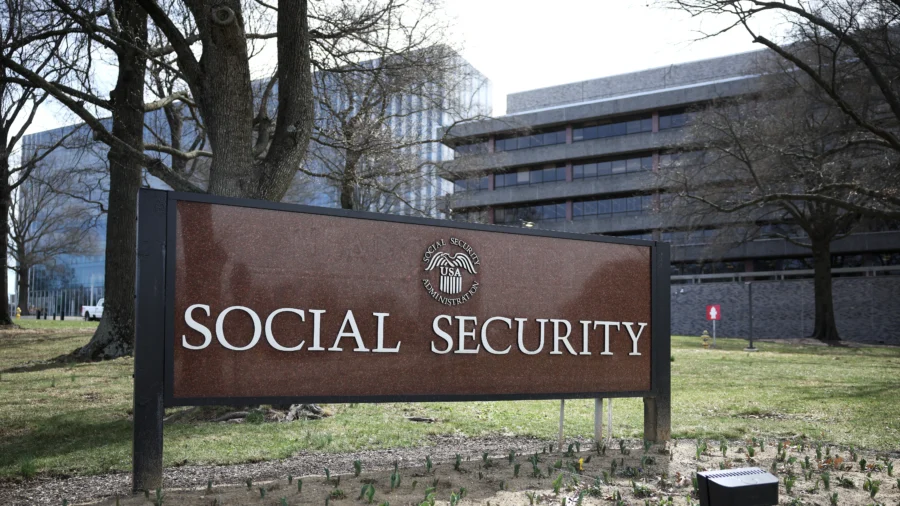
Social Security is a life saver for millions of Americans and, in some cases, working while collecting the benefit can provide double the income. Experts weigh in on what to know about working while receiving monthly Social Security payments and how a Republican proposal to end Social Security taxation will factor, if approved.
Designated SSA Income Limits
There is no hard or fast rule against working while benefiting from Social Security income, but the Social Security Administration (SSA) will deduct $1 for every $2 earned over the 2025 limit of $23,400, whether that’s through part-time or full-time work.“It’s not gone forever but you won’t see it right away,” MDRN Capital founder and CEO Aaron Cirksena told NTD.
For example, earning $33,400 in one year is $10,000 over the $23,400 limit and, as a result, SSA will withhold $5,000 in annual income.
If earnings are below the annual limit, there’s no impact on benefits, according to SSA.
“It’s a great strategy for those who want to stay active, earn some income, and still collect full Social Security benefits,” Melissa Murphy Pavone, a CFP, fiduciary, and founder of Mindful Financial Partners, told NTD.
Income Withheld Is Only Temporarily Lost
Americans are permitted to claim Social Security benefits as early as 62 years old.However, SSA dictates that the full retirement age (FRA) in the United States is 67 for Americans born in 1960 or after and 66 for those born before 1960 based on legislation passed in the 1980s that gradually raised the FRA.
Benefits that are withheld due to the income limit are only a temporary loss for those who collect Social Security early and live to see their FRA.
“Once you reach your full retirement age, the SSA recalculates your benefit and gradually increases your monthly payment to make up for what was withheld,” Pavone added. “You won’t lose the money—it’s just deferred.”
Age Matters
Another benefit of living to a ripe old age is that the income limit stops applying to retirees who are still working at 70 and and beyond or when outside earnings drop below the income threshold limits, according to Future Focused Wealth Certified Financial Planner Melissa Cox.“You can earn as much as you want after FRA without it affecting your Social Security check,” Cox told NTD. “So, if you plan to keep working full time, it may be worth waiting to claim until FRA so you don’t have to worry about income limits cutting into your benefit.”
However, if earnings after 70 are higher than a retiree’s previous 35 years of income, the SSA may recalculate their benefit to reflect the boost.
“In that case, your monthly check could increase slightly,” Cox added. “So working after 70 won’t reduce your benefit. It helps retirees delay drawing down on their savings, which can make their money last longer in retirement.”
The Proposed Senior Citizens Tax Elimination Act's Impact
Rep. Thomas Massie (R-Ky.) introduced the Senior Citizens Tax Elimination Act last month, and if approved, the measure would amend the Internal Revenue Code of 1986 to terminate the inclusion of Social Security benefits in an individual’s gross income. The bill is currently pending in the House Committee on Ways and Means, chaired by Reps. Jason Smith (R-Mo.) and Richard Neal (D-Mass.).Retirees earning between $25,000 and $34,000, or $32,000 to $44,000 for joint filers, pay taxes on up to 50 percent of benefits, while retirees receiving more pay taxes on up to 85 percent of benefits.
If taxation is lifted, Cirksena predicts that retirees, especially middle and higher income earners, could see thousands of dollars in tax savings each year.
"For many, this would increase net retirement income and may even shift strategies around when to claim benefits or how to draw from other accounts like IRAs or 401(k)s," he added.
The views and opinions expressed are those of the interviewees. They are meant for general informational purposes only and should not be construed or interpreted as a recommendation or solicitation. NTD does not provide investment, tax, legal, financial planning, estate planning, or any other personal finance advice. NTD holds no liability for the accuracy or timeliness of the information provided.