


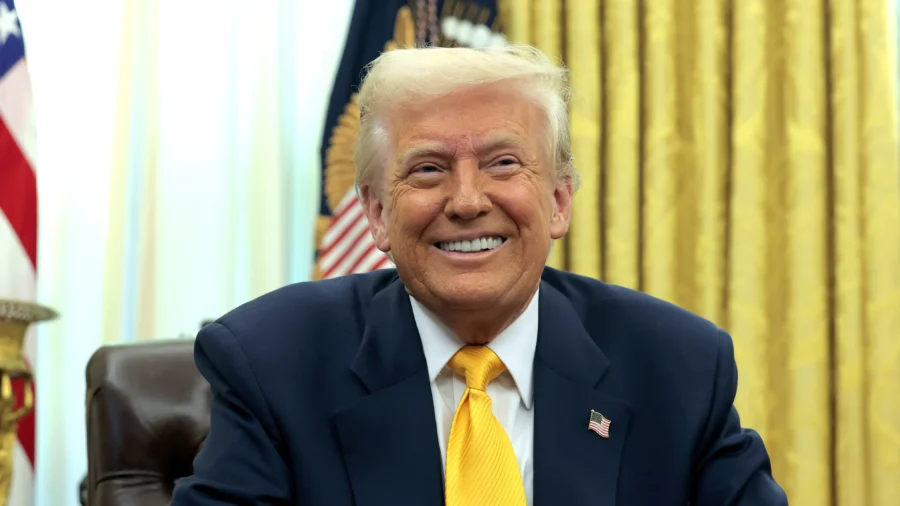
President Donald Trump announced plans on Feb. 25 to introduce a "Gold Card" visa program with a potential pathway to citizenship. The proposed initiative, which would ask applicants to pay $5 million, aims to replace the existing 35-year-old EB-5 investor visa program.
"I happen to think it'll sell like crazy. It's a market," Trump said of the new Gold Card during the first Cabinet meeting of his second term on Feb. 26
He said he was optimistic the program could help address the nation’s debt. "If we sell a million, that's $5 trillion dollars," Trump said.
Commerce Secretary Howard Lutnick explained that the new program would supersede the EB-5 program.
He said the existing program "has been around for many years for investment in projects," but "was poorly overseen, poorly executed."
According to advisory firm Henley & Partners, more than 100 nations worldwide similarly offer "golden visas" to investors or wealthy individuals, including the United Kingdom, Spain, Greece, Canada, Australia, Malta, and Italy.
"They'll be wealthy and they'll be successful and they'll be spending a lot of money and paying a lot of taxes and employing a lot of people, and we think it's going to be extremely successful," Trump said. He also suggested that companies could purchase Gold Cards to obtain visas for hiring talented new employees.
The proposed Gold Card program would be at least 6.25 times more expensive for foreign individuals than the current EB-5 program.
Trump said that the Gold Card program would not require congressional approval, despite Congress traditionally determining qualifications for U.S. citizenship. He indicated that the vetting process for potential Gold Card recipients is still being developed, with the possibility of restrictions based on individuals rather than which country they are from.
Immigration and the Workforce
George Carrillo, CEO of the Hispanic Construction Council, shared his perspective on the plan in an interview with NTD. "I believe that this is a good plan. It's going to bring in new revenue into our tax system, so I do support the president on this," Carrillo stated.However, Carrillo also urged the administration not to overlook other opportunities within the existing immigrant workforce.
He highlighted the current workforce shortages in a number of sectors, such as in construction. "When we look at the construction workforce—the people paving our roads, building our homes—the Hispanic community accounts for over 50 percent of that working population. And we still have a workforce shortage, about 500,000 people that we're short," he said.
Carrillo expressed concern about the potential impact of the current immigration narrative on ongoing projects and infrastructure development. "We're going to start seeing projects being delayed. We won't be able to meet the needs and demands of the American people when it comes to basic infrastructure—maintenance, clean water, sewage, building more homes, or maintaining our current homes," he said.
While supportive of initiatives to increase tax revenue, he also emphasized the need for comprehensive immigration reform, advocating for solutions that address both the country's financial needs and the stability of the workforce.
EB-5 Visas and Fraud
The proposed Gold Card program comes after the existing EB-5 program has faced scrutiny. The Congressional Research Service reported in 2021 that EB-5 visas pose a high risk of fraud, including challenges in verifying the legal source of funds. In response to such concerns, then-President Joe Biden signed a 2022 law implementing significant changes to the EB-5 program, which included measures to investigate and sanction individuals or entities committing fraud.According to eb5investors.com, the EB-5 program allows foreign investors, their spouses, and their children under 21 to obtain permanent residency green cards once all requirements have been successfully met and approved by the United States Citizenship and Immigration Services (USCIS). The proposed Gold Card program, as outlined by Trump, would aim to attract "wonderful, world-class global citizens" with significantly deeper pockets, Lutnick said.