


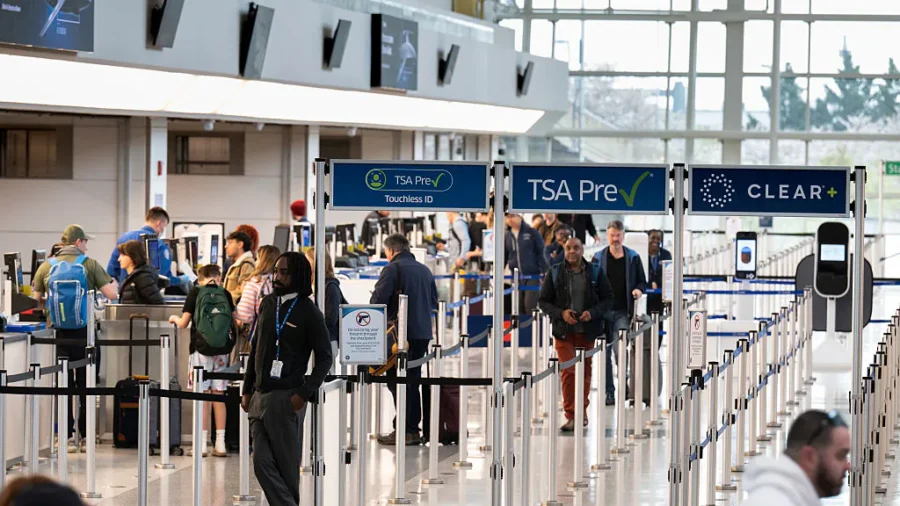
The Trump administration has proposed privatizing some airport security operations currently handled by the Transportation Security Administration (TSA), as the agency recovers from the impact of a partial government shutdown.
The proposal is part of the White House’s 92-page budget request for fiscal 2027, released Friday. It calls for moving smaller airports into the existing Screening Partnership Program, under which TSA pays private contractors to carry out passenger screening at designated airports.
The White House said the change would save $52 million, citing lower costs at airports already using the program.
Broader DHS Budget Changes
The budget also calls for consolidating several Department of Homeland Security (DHS) headquarters functions into a single office, including the department’s intelligence arm, the secretary’s office, the management directorate, and a situational-awareness office. The White House said that change would save $53 million.In addition, the proposal would eliminate or reduce some Federal Emergency Management Agency grant programs not directly tied to disaster response. Those include the Targeted Violence and Terrorism Prevention program and the National Domestic Preparedness Consortium, which the administration described as wasteful spending.
Debate Over Privatizing Airport Screening
If approved by Congress, the plan would significantly reduce TSA's footprint, moving away from the TSA-dominated airport screening model put in place after the Sept. 11, 2001, terrorist attacks. TSA currently employs about 50,000 federal workers to handle screening at nearly all U.S. airports.Supporters of privatization have long argued that TSA is overly bureaucratic and that private contractors could deliver a more efficient system. Among the most vocal proponents are Sens. Mike Lee (R-Utah) and Tommy Tuberville (R-Ala.), who introduced a bill last year to abolish TSA and replace it with privatized airport screening under federal oversight.
"The TSA should be eliminated and replaced with privatized solutions that are more targeted, streamlined, and where appropriate accountable to limited government oversight,” Tuberville said at the time.
The recent TSA funding crisis has added weight to another argument made by privatization advocates: that the agency is vulnerable to political fights unrelated to its core mission of keeping air travel safe.
“It makes no sense for all of this unrelated political squabbling to ruin so many Americans’ travel plans,” Chris Edwards, a tax scholar at pro-free market think tank Cato Institute, wrote in an op-ed.
Critics, however, argue that shifting responsibility for airport screening to private contractors could weaken accountability and threaten safety, while also jeopardizing the jobs of unionized federal workers.
The American Federation of Government Employees, which represents TSA officers, has long opposed broader privatization efforts. In a post on its website, the union said privatizing screening would hand a core public-safety responsibility to for-profit companies and urged Congress to reject such proposals.
"Unlike TSA, private screening companies are in this business to make money," it said. "Their main concern is profit, not the security of the flying public or the well-being of workers."