


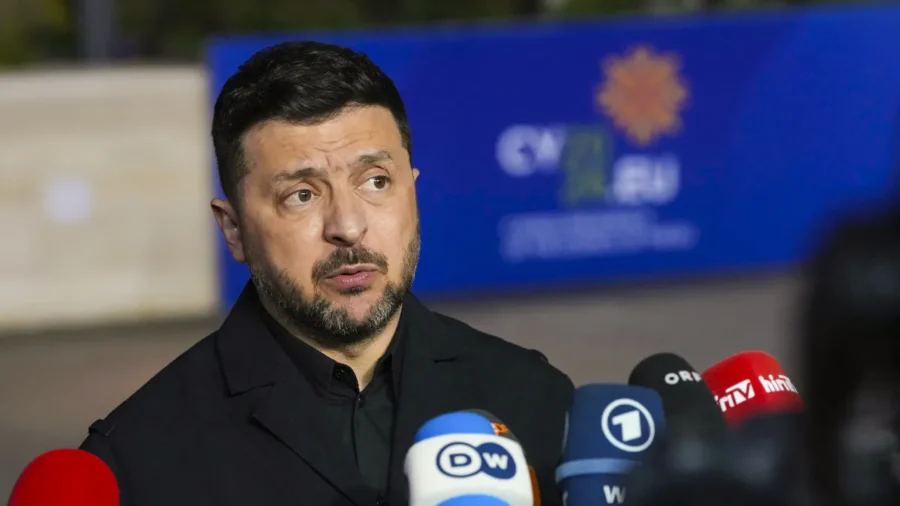
Ukrainian President Volodymyr Zelenskyy has called for a fast-tracked European Union (EU) membership process for his country, saying it was the best security guarantee for the bloc’s future.
Zelenskyy told an EU summit on June 18 that Ukraine was “working as actively as possible” toward membership and that Kyiv was ready to make the necessary reforms.
“The future of Europe—free, united, of course, in peace—is being decided in our defense,” Zelenskyy said, according to a transcript of his speech.
He said he was grateful to those members who recognize Ukraine’s situation and are taking “the necessary steps to show that Europe truly values and supports it.”
“The most important such step could be a fast-track … path for Ukraine to join the EU,” he said.
Kyiv sees EU membership as an important security guarantee for national stability once the war with Russia is over, and has positioned Ukraine’s accession to the bloc as key to Europe’s security.
“If Ukraine gets real membership, and gets it quickly—I hope—Russia will lose one of its main reasons for trying to destabilize both Ukraine and Europe,” Zelenskyy said.
“That is why this fast way path for Ukraine is very needed.”
On June 15, the EU agreed to open membership talks with Ukraine and Moldova.
Hungary Opposes Fast Track
During his speech, Zelenskyy acknowledged that not everyone in the EU would back Ukraine’s fast-tracking into the bloc.Hungary, under former Prime Minister Viktor Orban, said it would not support Ukraine’s accession.
However, after Orban lost the April election, Budapest, under the new prime minister, Peter Magyar, became more open to Ukraine’s entry into the bloc but remained firmly opposed to accelerated membership.
“Hungary continues to oppose accelerated EU accession. If Ukraine succeeds in closing all 33 accession chapters within the next 10 to 15 years, Hungary will support Ukraine’s accession, subject to a legally binding referendum,” Magyar said in a June 3 post on X.
Recently, Budapest also demanded the removal of language on fast-track membership from a European Council statement released after the June 18 summit.
Magyar said in a post on X that “regarding Ukraine’s EU accession process, at my initiative, a clause referring to accelerating accession was removed from the text at the very last moment. It wasn’t easy.”
The European Council said in its conclusions on Ukraine and on European defense and security that it “reaffirms its continued firm and unwavering support for Ukraine’s independence, sovereignty and territorial integrity within its internationally recognized borders.”
G7 Affirms Support for Ukraine
Early this week, during a summit in Évian-les-Bains, France, the G7 leaders affirmed their support for Ukraine and committed to further sanctioning Russia.They said they “stand united” in their “unwavering support for Ukraine in defending its freedom, sovereignty, and territorial integrity.”
“We reaffirm our solidarity with the Ukrainian population suffering from attacks on their critical infrastructure and cultural heritage,” they said.
They noted that they are committed to increasing pressure on Moscow’s war economy by strengthening sanctions, including those in the gas and oil sectors.
On June 17, Zelenskyy said that the summit “delivered important results for Ukraine.”
He said that “the most crucial outcome is that we have agreed on additional strengthening of Ukraine’s air defence.”
“There will be new steps to pressure Russia for the war, pressure for the sake of peace,” he wrote on X.