


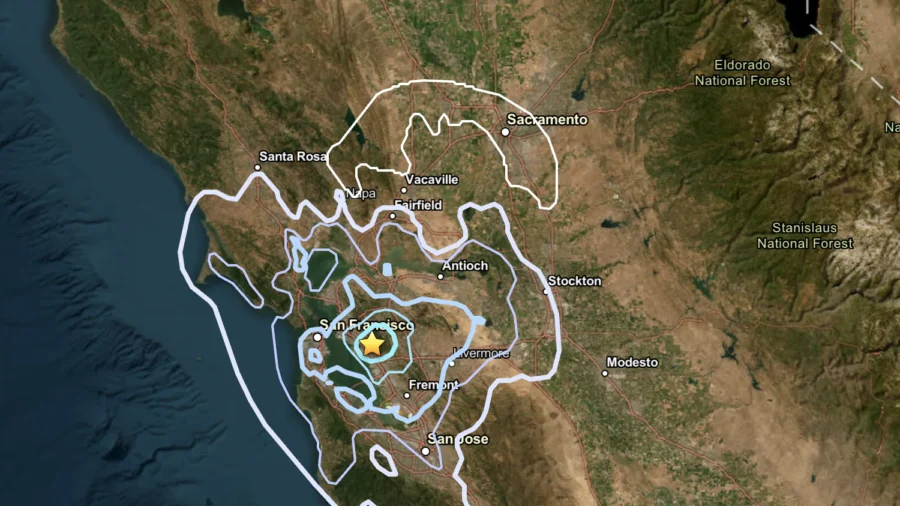
A magnitude-3.8 earthquake rattled the San Francisco Bay Area on Thursday morning, shaking homes and temporarily slowing public transit trains.
The U.S. Geological Survey (USGS) initially reported the quake as a magnitude 4.1, later downgrading it to 3.9 and then 3.8 after reviewing additional data. There were no immediate reports of damage or injuries.
The earthquake struck at 8:30 a.m. about two miles north of San Leandro, near Oakland and the Hayward Fault, according to the USGS. It originated at a depth of about 3.4 miles, according to data from the California Institute of Technology.
Two aftershocks followed near San Leandro at 9:07 a.m. A magnitude 3.0 earthquake was followed four seconds later by a magnitude 2.8 earthquake, according to USGS records.
The earthquake was felt across a broad stretch of Northern California.
By midday Thursday, more than 7,600 people submitted reports to the USGS, including residents from the North Bay to Santa Cruz and east toward the Sacramento and Stockton areas. The strongest reported shaking reached intensity level IV, classified as light and not expected to cause damage.
Jenny Stevens, who was in downtown San Leandro, described the earthquake in an interview with KTVU as a real hard shake followed by a quick “bang."
The San Francisco Bay Area Rapid Transit District (BART) temporarily reduced train speeds so crews could inspect tracks after the earthquake.
“Trains are running at reduced speeds while we complete safety track inspections. Please expect residual delays of up to 20 minutes systemwide,” BART stated.
The Oakland Zoo, located near the epicenter and directly on the Hayward Fault, shared video of chimpanzees and parrots vocalizing as Thursday morning’s earthquake shook the area. Zoo President and CEO Nik Dehejia said in an interview with ABC7 that animals can sense low-frequency vibrations differently than humans.
The USGS said Wireless Emergency Alerts were not sent because ShakeAlert’s estimated peak magnitude was below the required 5.0 threshold.
The USGS recommends the following actions during an earthquake:
- Indoors: Stay inside, drop under a sturdy desk or table, cover yourself and hold on. Keep away from windows, chimneys, and heavy objects.
- Outside: Move into an open area away from buildings, power lines, and anything that could fall.
- Driving: Pull safely out of traffic, avoiding going over or under bridges, trees, and power lines. Remain inside the vehicle until the shaking stops.