


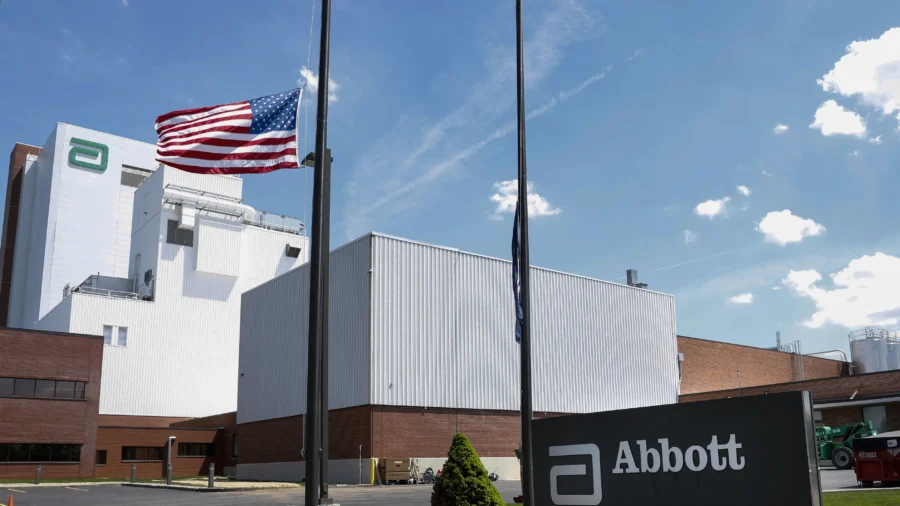
Health care company Abbott Laboratories agreed to settle certain lawsuits that accused the company of knowingly distributing specialty infant formulas that increased the risk of necrotizing enterocolitis (NEC) in preterm babies, a claim the company denies. In order to resolve a portion of the litigation against the firm, it agreed to pay three law firms approximately $670 million to resolve roughly 2,000 cases.
The settlement was made in the Margo Gill vs. Abbott Laboratories case in which a jury had awarded $495 million in damages in July 2024. Abbott’s appeal of the ruling was denied. Instead of continuing the appeal or paying around $600 million in the case, inclusive of accrued interest, the company has decided to settle the issue, Abbott said in an Aug. 20 statement. In addition to the Gill case, Abbott will also settle roughly 2,000 similar cases.
“While Abbott remains confident in the safety of these products and the science supporting them, the company believes these agreements are in its best long-term interest and represent a constructive step toward substantially resolving the overall litigation,” the company said.
According to an Aug. 13 update from TorHoerman Law, the law firm representing Margo Gill and her daughter in the case, the lawsuit centered on a claim that Abbott’s infant formula increased the risk of NEC among infants.
NEC is a gastrointestinal disease mainly affecting premature infants that can result in bacterial infections and inflammation in the intestines. In severe cases, the illness can be life-threatening.
Margo’s daughter developed NEC after taking Abbott’s infant formula when the child was a premature infant. The child, now 3 years old, has roughly 75 percent of her intestines removed and suffers brain damage. She will require intensive care for life, according to the law firm.
Internal documents from Abbott, revealed at the trial, showed the company knew about NEC risks posed by its formula and yet failed to inform parents about the threat, the law firm said.
Commenting on the July 2024 verdict that awarded $495 million to Margo, Attorney Tor Hoerman said in the statement, “Justice was served for Margo Gill and her daughter Robynn, who suffered severe, irreversible brain damage due to Abbott’s misconduct.”
“Abbott has known for years that its cow’s milk-based formula significantly increases the risk of necrotizing enterocolitis (NEC) in premature babies, and families like the Gills had their lives changed forever due to the company’s refusal to warn families and physicians,” Hoerman said.
In its latest statement, Abbott clarified that settlements made with Margo and in roughly 2,000 other lawsuits are only a compromise of disputed claims and do not in any way form “an admission of liability.”
“Abbott stands by the safety of these products and the essential role they play in helping the medical community care for preterm infants,” the company said.
Agencies such as the Food and Drug Administration and the Centers for Disease Control and Prevention, as well as other experts, “recognize that these products are safe and necessary, and that there is no reliable scientific evidence that they cause NEC,” Abbott said.
In an October 2024 joint consensus statement, the FDA, CDC, and the National Institutes of Health said there was “no conclusive evidence that preterm infant formula causes NEC.”
There are around 1,700 more lawsuits pending in state and federal courts with claims against Abbott, and in some cases against another infant formula manufacturer, Mead Johnson. These were filed on behalf of roughly 12,700 individual infants, according to Abbott.
According to a post by the UPMC Children’s Hospital of Pittsburgh, NEC mostly occurs in premature infants, with newborns weighing less than 4.5 pounds making up roughly 80 percent of cases.
NEC typically develops in the first two weeks of the baby’s life, usually after milk feeding has started. The bowels of newborns are immature, making them prone to infections. Internal tissue damage can create holes in the intestines, enabling bacteria in the intestinal tracts to enter the abdomen, resulting in an infection, according to the post.
Meanwhile, Abbott’s infant formula has also come under scrutiny over the presence of heavy metals and other contaminants.
The advocacy group tested the products for heavy metals such as lead and arsenic, and chemicals including cadmium, mercury, acrylamide, and bisphenols. Among Abbott’s offerings, multiple infant formula products, including Similac Pro-Total Comfort, Similac Alimentum, and Similac NeoSure, were deemed to be problematic.
An Abbott spokesperson justified the safety of the company’s products, highlighting the infant formulas “meet existing regulations for heavy metals set by the European Commission and Health Canada.” Moreover, the items “also meet FDA current limits for heavy metals in (non-formula) baby foods, children’s juices, and drinking water.”