


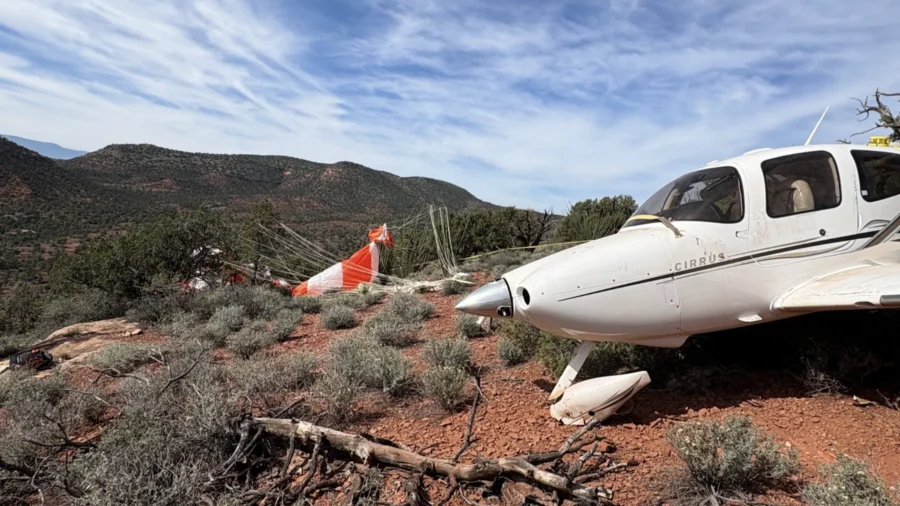
A husband and wife walked away without injuries Monday morning after their small plane crashed near Cathedral Rock in Sedona, Arizona, a survival officials credit to the aircraft’s rocket-powered parachute system.
“After confirming the crash, deputies learned that the two occupants, a husband and wife, were unharmed,” the sheriff’s office said.
“They had successfully deployed the ‘Cirrus CAPS System’—a parachute for the entire aircraft, helping the plane land on the side of the mountain—allowing the couple to walk away from the crash.”
“The rocket ensures that the parachute deploys successfully despite altitude, spin, or inversion, while a slow inflation rate and reefed risers allow for rapid transition to stable altitude under canopy,” according to the company’s website.
The company states that tests showed that once the parachute is deployed, the plane slows to a stop in about eight seconds and then descends gently at roughly 20 miles per hour.
As of Monday, the Sedona incident marked “CAPS Save Number 140,” bringing the total number of survivors to 283, according to COPA’s database.
The previous time CAPS was used before the Sedona crash was on Sept. 11. A Cirrus SR22T lost oil pressure and power while flying about 7,000 feet over Lake Michigan.
“The pilot activated CAPS and landed in Lake Michigan under parachute. The aircraft sank and the three aboard were rescued by the US Coast Guard after about 45 minutes in the water floating in their life jackets,” according to the company’s database. The survivors suffered a few minor injuries.
A Wright State University safety study found that pilots who use CAPS are 13 times more likely to survive a Cirrus plane accident. The company also stated that no person has died when CAPS was deployed at altitudes above 1,000 feet above ground and below the maximum airspeed of 200 knots.