


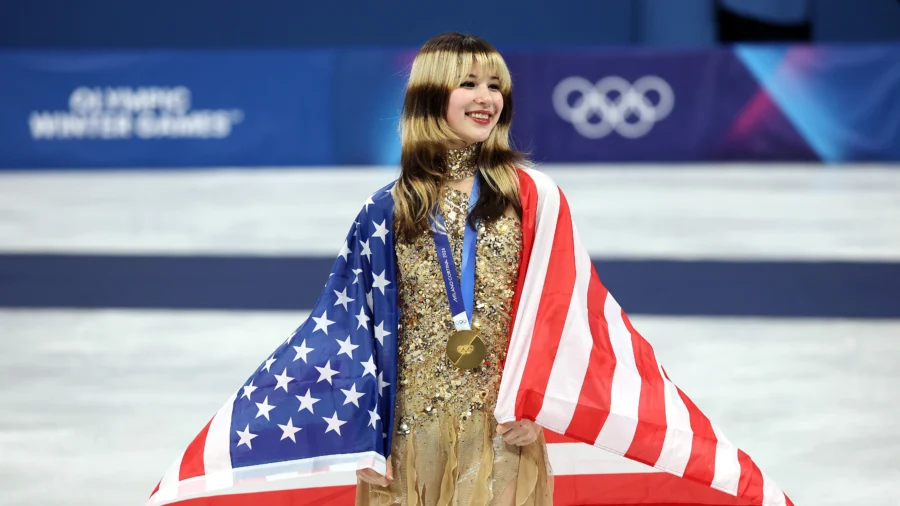
When Alysa Liu stepped onto the Olympic ice, she carried the weight of expectation. When she stepped off, she carried gold.
At just 20, the California native, representing the United States, secured Olympic gold in women’s figure skating at the Milan Winter Olympics, completing one of the sport’s most improbable comebacks after briefly retiring as a teenager.
But Liu’s victory is more than athletic redemption. It is the culmination of a journey set in motion decades earlier, when her father, Liu Jun, fled China after taking part in pro-democracy protests in 1989, one of the most sensitive and consequential events in modern China.
His decision to leave China would shape the course of his family’s future.
A Father’s Escape—and a New Life
In the spring of 1989, Liu was a young man swept up in a nationwide movement demanding political reform.Student-led demonstrations had spread across China, with thousands gathering in Beijing’s Tiananmen Square. The protests ended in June, when Chinese troops moved in to clear the square, opening fire on civilians in a crackdown that shocked the world.
Liu has said he participated in the demonstrations and left China soon afterward, fearing arrest.
He arrived in San Francisco with just a few hundred dollars, according to publicly available biographical information, working restaurant jobs while studying English and pursuing a legal career. In 1996, he passed the California bar exam and became an attorney.
China’s Communist Party (CCP) has long defended its actions in 1989 and continues to tightly restrict public discussion of the protests.
For Liu, the United States became a place to rebuild.
A Family Story China Won’t Tell
In the days after Alysa Liu’s victory, discussion surged across Chinese social media platforms.Some users compared her to Eileen Gu, the U.S.-born freestyle skier who chose to compete for China in 2022, and asked why Liu had not done the same.
Others searched for information about her father.
According to screenshots shared on overseas platforms, some online posts described Liu as a “traitor,” “defector,” or “criminal,” but provided little detail. Other users wrote that searches returned almost no background information.
“All over the internet, I can’t find what he actually did,” one user wrote in a now-deleted post, according to archived images circulating outside China.
China’s internet is among the most tightly controlled in the world, and references to the Tiananmen Square protests are routinely filtered.
Others who fled China after the 1989 protests say their stories are similarly difficult to find inside the country.
Jiang Pinchao, a U.S.-based writer and editor of a poetry collection documenting the Tiananmen protests, told The Epoch Times’ Chinese-language edition that many former activists have seen their personal histories effectively erased from China’s internet.
“We are witnesses to that history,” Jiang said. “The authorities fear that if our names and stories resurface, people will begin to revisit what happened. In the minds of many, there is still an unresolved account of that time.”
“If the public learns the truth,” he added, “it could shake the foundations of the [CCP’s] rule.”
Liu said he believes the pressure he faced did not end after he fled China.
“They sent spies to the U.S., the spy actually became friends with me,” Liu said. “I befriended him, I helped him a lot with settling down in the San Francisco Bay Area. I treated him as my friend. And many years later, he confessed that he was actually a spy for the Chinese government [spying] on me.”
Beijing has consistently described the 1989 protests as a necessary response to political instability and has sharply restricted public discussion of the crackdown.
A Legacy Fulfilled
Liu said his daughter has long been deeply curious about his life story.“She really appreciates my life story. In some ways, she’s fascinated by it,” he said, referring to his early years in China, the protests, and his decision to leave the country and rebuild his life in the United States as a political refugee.
That history, he believes, shaped the opportunities she was given.
“If I had stayed,” he said, “our lives would have been very different.”
That life, once defined by protest and exile, had led to this moment, an Olympic podium in a country where his daughter was free to choose her path.
While that history remains difficult to openly discuss in China, its legacy was visible on the ice—in her victory.