China
wants to cut tariffs on American goods in the hopes the United States will do the same and reduce the 145 percent import levy currently on most Chinese goods—a rate imposed by President Donald Trump earlier this month, marking a steep increase from prior levies of around 25 percent. Some analysts say China’s labor market might need this relief.
“Xi Jinping has millions of people employed in these factories and their largest consumer market is the United States of America,” said Shark Tank host and investor Kevin O’Leary recently on the “What’s On Your Mind”
radio show in South Dakota. “He can’t keep his people employed unless he has access to American markets,” O’Leary said.
Trump has promoted tariffs since his first time in office, calling himself “
a tariff man” in December 2018. Back then, he only targeted China and the global steel and aluminum sector. The Trump administration’s goals are to use protective tariffs to convince businesses to manufacture in the United States, and to raise revenue in order to lower income taxes on businesses and individuals.
For China, high tariffs have added pressure to a roughly 10-year “
China Plus One” strategy among many multinationals. That strategy sought to diversify supply chains out of China, to at least one other country, or “plus one.” Many companies outsourced manufacturing outside of China, often at great expense to domestic labor, said Tony Nash, CEO of Complete Intelligence, a data platform based in Texas, and co-host of the “Cloak and Dagger” geopolitics podcast.
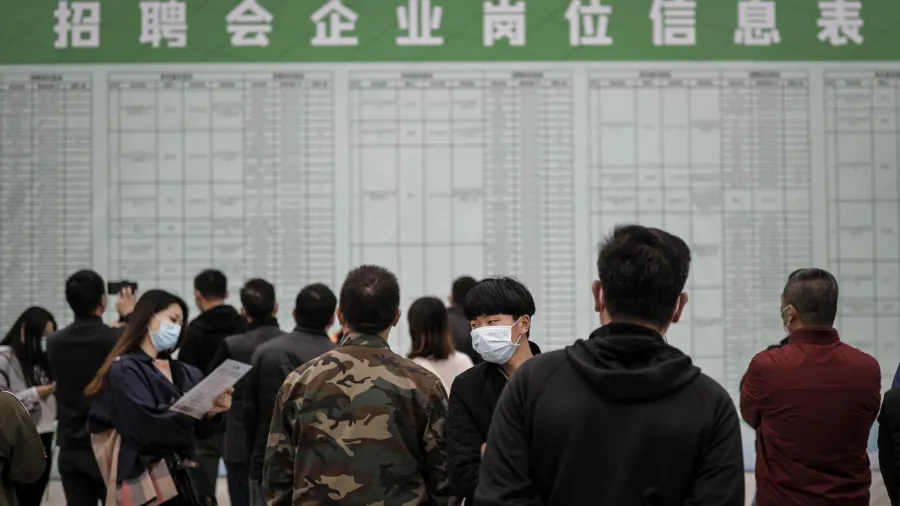
“It’s hard to know where this labor has gone and this is where the conversation gets fuzzy,” Nash said in a phone interview. CEO of Complete Intelligence, a data platform based in Texas, and co-host of the “Cloak and Dagger” geopolitics podcast. “I want China to do well. I worry about those left-behind workers. You have an anecdotal 20 percent youth unemployment rate, but who knows what the rate of unemployment is for tradesmen or those without a college degree,” he said, adding that provinces do not report accurate employment data.
“They are disincentivized to do so,” Nash said in a phone interview. “Cities aren’t going to report it, either, so we will never have an accurate picture. I worry that factory unemployment numbers are being underreported and that there are a lot of Chinese people suffering in silence.”
China was first hit with U.S. tariffs in 2018. These tariffs–eventually covering over $350 billion of Chinese exports–prompted domestic and international companies to shift investment to Southeast Asia and Mexico, such as the new
Hofusan Industrial Park, a four-hour drive from the Texas border.
Now, new much higher tariffs have made China trade even more costly. Even if tariffs fell by half, a 50 to 60 percent tariff on China juxtaposed against lower tariffs in Southeast Asia—currently at 10 percent—make it more attractive for Chinese businesses to keep market share in the United States by manufacturing there instead.
Job Losses in China
Official Chinese data does not openly attribute job losses to tariffs, but manufacturing employment growth is stalling and has been shrinking in lower-tech industries since 2018.A
study by researchers from Changzhou University, Yancheng Teachers University, and Henan University found that between 2011 and 2019, employment in 12 labor-intensive manufacturing industries in China shrank by approximately 14 percent, equating to 4 million jobs. The textile industry experienced a 40 percent reduction in employment during this period. Further
analysis by the Financial Times revealed in March that between 2019 and 2023, these two sectors lost an estimated 3.4 million jobs.
Industrial towns in Guangdong province experienced factory shutdowns in furniture that were geared towards export markets,
according to supply chain consultancy Deep Green in Hong Kong.
By redirecting production to Southeast Asia, Chinese companies could continue supplying the United States without paying high tariffs. This resulted in record high foreign direct investment in Southeast Asia by Chinese companies, led by Vietnam. China followed numerous American and South Korean companies there over the past few years.
Furniture brand LoveSac, along with Nike and Adidas, have all
moved substantial production from China to Vietnam.
When Samsung and other electronics
manufacturers closed or downsized their China operations, local layoffs followed. In aggregate, offshoring—whether due to tariffs, rising labor costs in China, political risks, or a combination of all three—has put new stress on China’s industrial labor market. Prolonged high tariffs could exacerbate the problem.
Chinese solar companies have also moved to Southeast Asia. Due to high mainland solar tariffs, Chinese companies like
JinkoSolar built new factories in Malaysia to make solar panels for the U.S. market. Chinese companies still profited, but Chinese labor lost out. It is unclear if workers are successfully moving to the new advanced manufacturing sectors, such as robotics.
A 2019 research study by the United Nations Conference on Trade and Development
said U.S. tariffs and a “trade war” caused Chinese exports to the United States valued at $35 billion and $50 billion to be diverted to other countries in the first half of 2019. Around $14 billion were lost to U.S. competitors.
There are established economic models and
empirical studies that estimate how many manufacturing jobs are created per $1 million in sales. While this depends on sectors, if $1 million in exports supports 5 to 10 manufacturing jobs, then a $40 billion reduction could imply between 200,000 and 400,000 jobs tied to those exports.
Chinese officials downplay the impact of tariffs, but local governments in export-heavy regions have rolled out support for displaced workers since the tariffs policy began in 2018, suggesting the
impacts are real. Beijing is funding t
alent training bases to upskill workers.
The original China tariffs, known as the Section 301 tariffs, were 25 percent and good for four years. The Biden administration
extended those tariffs in May 2024 and added new ones, such as
100 percent tariffs on Chinese EVs. Tariffs rose again this year, with Trump hitting China with higher tariffs due to fentanyl and to balance trade through so-called reciprocal tariffs. The White House
increased tariffs again once China retaliated with tariffs of their own.
“The under-the-hood metrics are very important—are companies investing, are they hiring, and are they borrowing? And what we have seen has been very disappointing,” Leland Miller, founder and CEO of China Beige Book,
said during the Hoover Institution podcast called “China Considered” in February. “If you're looking from the outside into China, you’re not seeing a particularly appetizing situation.”