


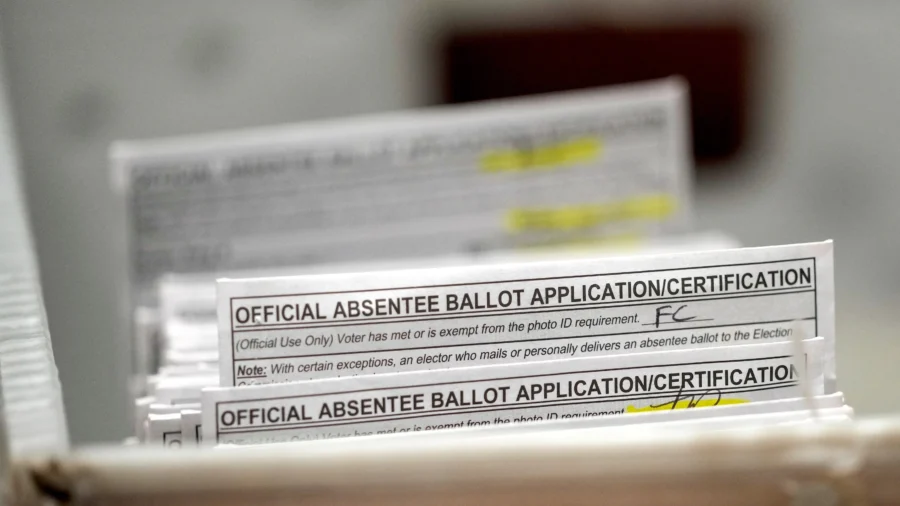
President Donald Trump’s executive order aimed at tightening mail-in voting rules in 23 states and the District of Columbia cannot be implemented, a federal appeals court ruled on July 25.
The 2–1 ruling upheld a lower judge’s decision that blocked the order, dealing a blow to Trump’s election integrity efforts ahead of the November midterms as Republicans seek to hold on to slim majorities in both chambers of Congress.
“The undisputed summary judgment record indicates that, were the [executive order] to take effect for the elections taking place in September and November, it would sow confusion and threaten disenfranchisement of many eligible voters,” the majority of judges for the U.S. Court of Appeals for the First Circuit said in the decision.
Part of the order directed the Department of Homeland Security to compile lists of confirmed U.S. citizens eligible to vote in each state.
It also required the U.S. Postal Service to send ballots only to eligible American voters on each state’s approved mail-in ballot list. The Department of Justice was authorized to investigate and prosecute state or local officials who gave ballots to individuals deemed ineligible to vote.
Department of Justice lawyers requested the federal appeals court to pause Talwani’s ruling as it pursued an appeal, arguing that federal agencies had yet to finalize their actions and policies for Trump’s order, making any lawsuit challenging them premature.
The appeals court rejected that argument.
"As the district court reasoned, the [executive order] lays out a clear set of rapidly approaching deadlines by which states must coordinate with federal officials and comply with new voting procedures—all while the states must also ensure that their officials and the public understand the evolving set of rules that would govern the upcoming September and November elections," the judges wrote.
The judges wrote that the suing states would have no choice but to act on Trump’s executive order now and that they are currently experiencing injury because the directive disrupted ongoing efforts to administer multiple elections in the coming months.
Some of the plaintiff states had already begun pulling election staff from “critical projects” to begin adopting compliance with the order, the appeals court ruled.
“Both for legal and practical reasons, the Plaintiff States could not delay these planning and compliance efforts,” the judges wrote. “For example, in several of the Plaintiff States, statutes require officials to provide mail-in ballots to individuals eligible to vote by mail weeks in advance. These state statutory obligations were ‘undisputed’ by the Government.”
A Department of Justice spokesperson told The Epoch Times via email that the agency disagrees with the appeals court's ruling, and that the department is reviewing all options.
"The Department remains confident that President Trump's order to secure federal elections will ultimately be upheld," the spokesperson said.
The presidential order updating the vote-by-mail rules is part of a larger effort by Republicans to enact bolstered election integrity measures.
“Over a period of years, starting during the 2020 election cycle, the People’s Republic of China carried out what is believed to be the largest compromise of election data in history, resulting in China’s illicit acquisition of 220 million U.S. voter files,” Trump said during a primetime address on July 16.