


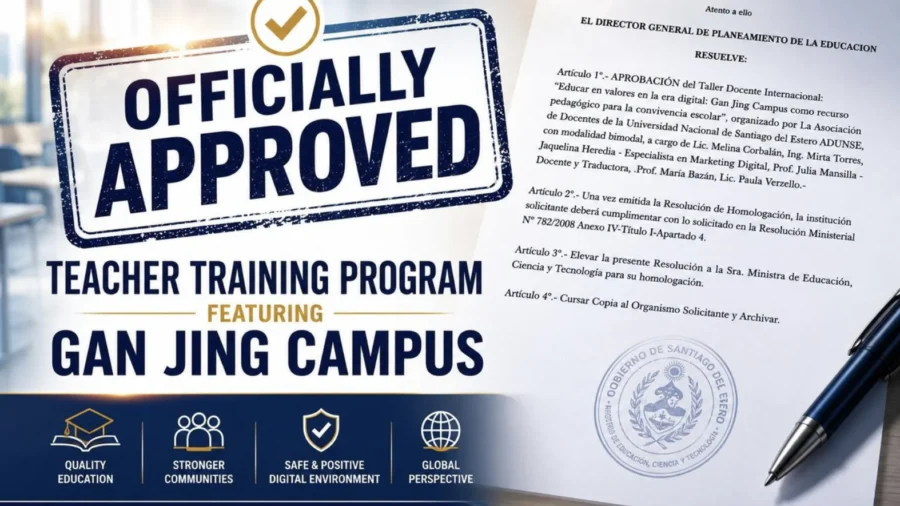
The Ministry of Education, Science, and Technology of Santiago del Estero Province issued an official resolution through its General Directorate of Educational Planning approving the workshop, titled "Teaching Values in the Digital Age: Gan Jing Campus as an Educational Resource for Positive School Climate," according to a press release from the digital platform.
NTD contacted the ministry for comment on the partnership but did not hear back before publication time.
The initiative was submitted by ADUNSE, the Teachers' Association of the National University of Santiago del Estero, in partnership with Gan Jing World volunteer ambassadors.
The program will be offered in a hybrid format—combining in-person and online sessions—and is open to educators working across preschool, primary, secondary, and non-university higher education levels.
Planned curriculum topics include the creation of educational channels, production of digital learning materials, and discussions on digital citizenship, school climate, and values-based education.
At the center of the training is Gan Jing Campus, a platform developed specifically for educational use that allows teachers and institutions to build educational channels, publish content, and share instructional materials within what the company describes as a safe, controlled online environment.
Last year, the company introduced what it calls Ethical AI technology to further reinforce those protections. The system includes three modules: a Video Quality Rating tool for image assessment, an Inappropriate Content Detection component that the company says identifies harmful material with over 90 percent accuracy, and a Textual Insights module for analyzing tone and sentiment in written content.
The company also operates Gan Jing Kids, which it markets as "the safest platform for values-based learning & fun" and describes as employing a triple-layer safety framework. That streaming service organizes programming by age group around six educational principles, including cognitive development, language skills, storytelling, and STEM learning.
The Santiago del Estero approval comes as educators and families worldwide grapple with growing concerns about children's exposure to violent or sexualized content online and the behavioral effects of engagement-maximizing algorithms. The approved workshop's guiding principle holds that 21st-century education should go beyond academic instruction and contribute to developing citizens capable of acting ethically in both the physical and digital worlds.