


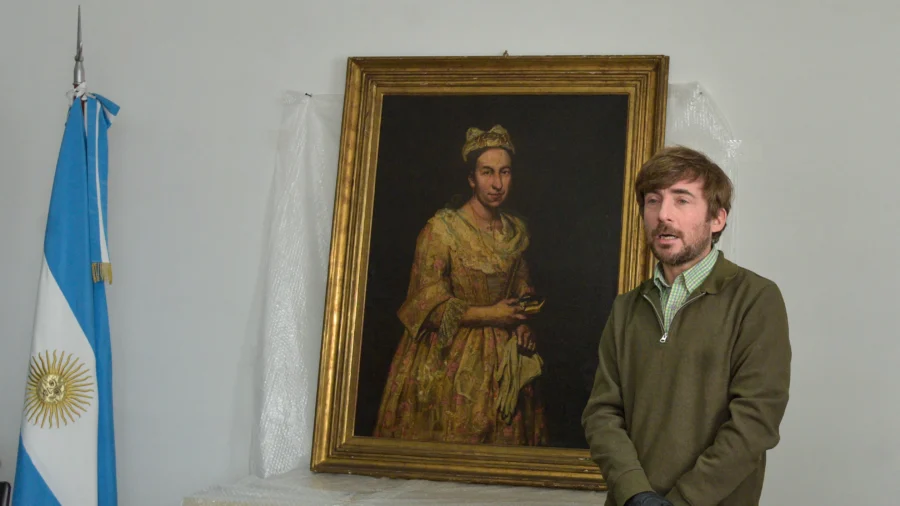
Federal prosecutors in Argentina announced Wednesday the successful recovery of an 18th-century Italian masterpiece stolen by Nazi forces during World War II, ending an eight-decade mystery that captivated historians and art restitution experts worldwide.
The "Portrait of a Lady" by Giuseppe Vittore Ghislandi, depicting Countess Colleoni with ink-black hair and a dress decorated with pastel flowers, had not been displayed publicly since its theft 80 years ago from a prominent Jewish art dealer.
Federal prosecutor Daniel Adler revealed the massive gold-framed portrait during a press conference in the coastal city of Mar del Plata, crediting community members and journalists with initiating the investigation that led to its discovery.
"We're doing this simply so that the community to whom we partly owe the discovery of the work ... can see these images," Adler said during the presentation. "It was people from the community, specifically journalists, who prompted the investigation."
The recovery followed an investigation that began when Dutch reporters from Algemeen Dagblad spotted the painting in an unexpected location: an online real estate advertisement for a $265,000 Mar del Plata home. The artwork appeared hanging above a green velvet sofa in a 3D property tour, which is the first color photograph of the portrait to surface publicly in decades.
The property belonged to descendants of Friedrich Gustav Kadgien, a high-ranking Nazi financial officer who fled to Argentina after Germany's defeat and died in Buenos Aires in 1978. Kadgien served as a financial aide to Hermann Göring, Adolf Hitler's deputy, overseeing foreign currency, precious metals, and confiscated property sales.
Dutch journalists investigating Kadgien's post-war activities in Argentina made the shocking discovery while researching stolen Netherlands artwork. Their findings excited historians globally and eventually reached the heirs of Jacques Goudstikker, the painting's original owner.
Goudstikker, a Dutch-Jewish art collector and dealer, died in a shipwreck while fleeing Amsterdam ahead of advancing German forces in May 1940. Nazi agents thereafter seized his extensive gallery inventory through coercive sales and outright theft, with approximately 1,100 works illegally sold to Göring.
The painting's reappearance didn’t last long. Within hours of the Dutch newspaper's publication last Monday, the real estate listing vanished from online platforms. Argentine police immediately raided Patricia Kadgien's rustic Mar del Plata residence, finding the Nazi officer's daughter had removed the artwork before they arrived.
Authorities conducted additional searches of properties owned by Kadgien's daughters throughout Mar del Plata, confiscating various paintings and engravings suspected of wartime theft origins. The prosecutor's office placed Patricia Kadgien and her husband under house arrest pending Thursday's court proceedings on concealment and obstruction charges.
Adler disclosed that the couple's attorney surrendered the portrait to authorities Wednesday morning, though he declined to specify the artwork's next destination. Art expert Ariel Bassano, assisting with the investigation, confirmed the painting's storage in a specialized preservation chamber.
"It's in good condition given its age," Bassano stated, dating the portrait to 1710 and estimating its value at approximately $50,000.
Under Juan Perón's government, which lasted from 1946 to 1955, German fascists brought stolen Jewish property, including gold, bank deposits, and artwork to Argentina. The nation sheltered numerous war criminals, including Holocaust architect Adolf Eichmann.
Goudstikker's sole surviving heir, 81-year-old Marei von Saher, has pursued restitution for her father-in-law's stolen collection for decades. In 2006, the Dutch government returned 202 looted paintings to von Saher following extensive legal proceedings.
While unable to authenticate the artwork without an in-person look, one of the family’s lawyers, Amelia Keuning, said the evidence made them "fairly certain it is the same painting.”
"It is about restoring justice," said Yaél M. Weitz, von Saher's other attorney.