


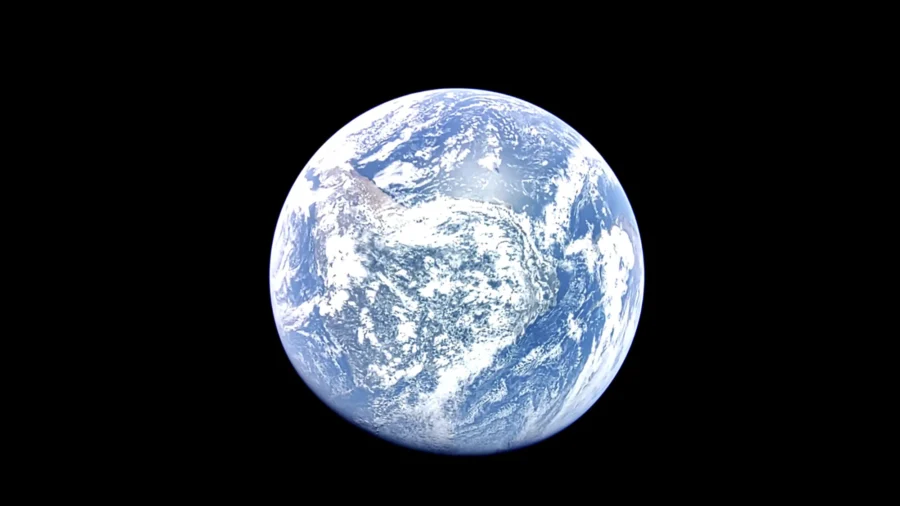
An asteroid roughly the size of a small car flew closer to Earth than nearly any space rock on record, passing over Antarctica at an altitude similar to the International Space Station's orbit.
The space rock measured between 1 and 3 meters (3.28–9.84 feet) across and traveled at an altitude comparable to that of the International Space Station, which orbits approximately 370 to 460 kilometers (230–286 miles) above Earth.
The closest known asteroid was 2020 VT4, a 5-10 meter (16.41–32.82 feet) rock that passed by the Earth’s surface at a distance of 386 kilometers (240 miles) back in November 2020.
Despite the close encounter, the small asteroid on Oct. 1 posed no threat to Earth. Objects of this size can create fireballs if they enter Earth's atmosphere and could lead to small meteorites reaching the ground.
Astronomers from ESA's Planetary Defence Office quickly moved to observe the asteroid after it had been discovered, using the Las Cumbres Observatory telescope located in Siding Spring, Australia. The quick response allowed scientists to determine the closest approach distance and timing with precision.
Threat Level Downgraded
Earlier this year, scientists successfully downgraded the threat level of another asteroid, 2024 YR4, which had initially posed a small but concerning collision risk for 2032.Asteroid 2024 YR4, discovered in December 2024 by the ATLAS telescope in northern Chile, initially had impact odds as high as 2.8 percent for December 2032. However, later observations using advanced telescopes reduced the impact probability to just 0.004 percent, according to NASA's Center for Near-Earth Object Studies.
According to the ESA, impact probabilities are often initially overestimated, with additional observations typically providing more precise trajectory calculations that reduce perceived risks.