

Bacteria-Contaminated Webcol Alcohol Prep Pads Recalled Across US, Puerto Rico, Japan

Bacterial contamination discovered in widely distributed alcohol pads raises health concerns for at-risk users.
Published: 3/27/2026, 4:37:29 PM EDT
Bacteria-Contaminated Webcol Alcohol Prep Pads Recalled Across US, Puerto Rico, Japan
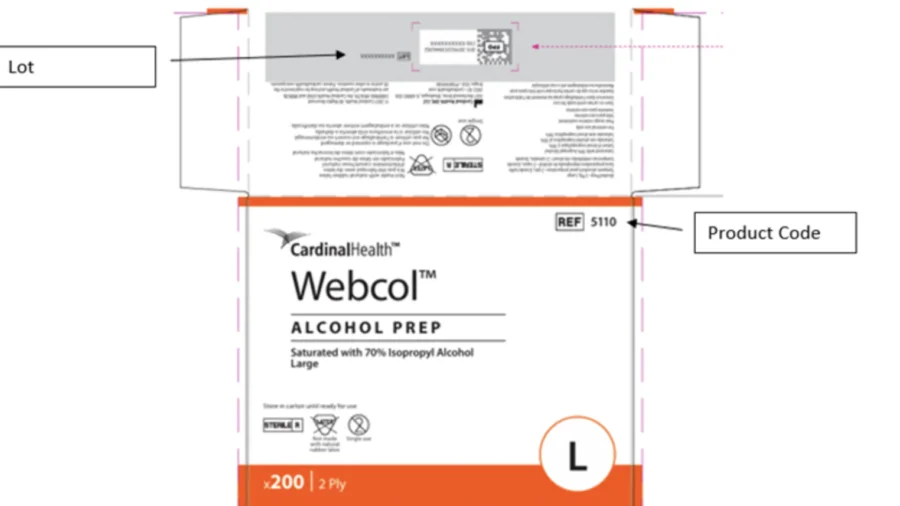
Cardinal Health recalled its Webcol Large Alcohol Prep Pads due to contamination with Paenibacillus phoenicis. (U.S. Food and Drug Administration)
Cardinal Health has recalled its Webcol Large Alcohol Prep Pads after the products were found to have a bacterial contamination of Paenibacillus phoenicis, according to the company's announcement reposted by the U.S. Food and Drug Administration (FDA).

The contaminated alcohol prep pads were sold to both businesses and individual consumers, posing a potential health risk, especially for people with weakened immune systems.

The recall was prompted by the discovery of Paenibacillus phoenicis, a bacterium that can survive in harsh and nutrient-poor environments, including sterile conditions, according to the announcement.

The affected product is the large, 70 percent isopropyl alcohol prep pad, distributed in the United States, Puerto Rico, and Japan from September 2025 to February 2026. The product is used for external skin cleansing.

“There is a reasonable probability that use of the contaminated pads may result in local and systemic infections in at-risk populations,” the recall notice states. “Patients with impaired immune response, including patients with cancer receiving chemotherapy or poorly controlled diabetes, may develop life-threatening infections such as bacteremia or central nervous system infections.”

Paenibacillus phoenicis, a spore-forming bacterium, was first discovered in NASA spacecraft assembly cleanroom facilities and Colorado mines, according to research published in the National Institutes of Health. The bacterium is known to survive in environments intended to be sterile, as NASA’s spacecraft clean rooms are ultra-sterile facilities designed to prevent dust, microbes, and contamination of space instruments.
Infections caused by Paenibacillus phoenicis could cause symptoms such as fever, sepsis, wound infections, and persistent eye redness. In severe cases, neurological problems such as confusion, seizures, or meningitis can occur, according to research published on the National Institutes of Health.

Cardinal Health alerted business customers to the recall by overnight mail in early March, instructing them to check their inventory, isolate affected products, notify downstream recipients, and confirm receipt of the notice, according to the company and FDA recall notice.

While the recall does not state how many products have been recalled or where the affected products were sold, a full list of affected lot numbers is available in the FDA recall notice.

"Consumers should contact their physician or healthcare provider if they have experienced any problems that may be related to taking or using this drug product," stated the recall.

Consumers with questions about the recall can also contact Cardinal Health customer service by email or phone, as provided on the recall notice.

When a company announces a recall, market withdrawal, or safety alert, the FDA publishes the notice as a public service.

The FDA also urges consumers to report adverse reactions to its MedWatch program at www.fda.gov/medwatch.