


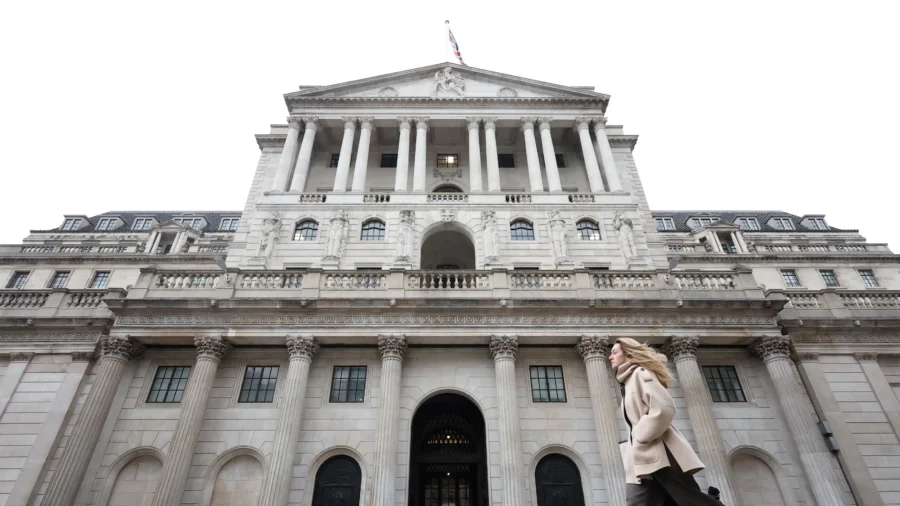
The Bank of England and the International Monetary Fund (IMF) have become the latest institutions to warn of a market correction driven in part by a potentially deflating bubble in artificial intelligence (AI).
Monetary officials say the possibility of a reevaluation of future earnings, fueled by heightened industry competition and “disappointing” AI adoption or capability, could spill over into Britain’s financial system.
The central bank also identified pressures in sovereign debt markets, geopolitical tensions, international fragmentation of financial and trade markets, and threats to the U.S. Federal Reserve’s independence as other risks to the UK economy.
“A crystallisation of such global risks could have a material impact on the UK as an open economy and global financial centre,” the minutes, released on Oct. 8, stated.
“Uncertainty around the global risk environment increases the risk that markets have not fully priced in possible adverse outcomes, and a sudden correction could occur should any of these risks crystallise.”
“Buckle up: uncertainty is the new normal and it is here to stay,” Georgieva said on Oct. 8.
The IMF chief stated that the world is experiencing “deep transformations” in an array of areas, including demographics, geopolitics, and technology.
AI-driven ebullience in global stock markets is “masking” various trends, she said.
“As for easy financial conditions—which are masking but not arresting some softening trends, including in job creation—history tells us this sentiment can turn abruptly,” Georgieva said.
Pop Open a Bubble
The dot-com bubble will forever be etched in Wall Street’s vast history.In the late 1990s, tech stock valuations surged due to investor enthusiasm for internet startups, with capital flooding into the likes of Pets.com, Boo.com, and eToys.com. Many businesses went public without profits, inflating the tech-heavy Nasdaq Composite Index. While many survived the bubble—Amazon, eBay, and Priceline, for example—others crumbled when the bubble burst.
By the end of the damage, trillions of dollars were wiped out, effectively triggering a recession.
Years later, analysts and policymakers are determining whether a similar event will unfold.
JPMorgan Chase CEO Jamie Dimon recently acknowledged that he is “far more worried than others” about a severe market correction occurring within the next two years.

“The way I look at it is AI is real; AI in total will pay off—just like cars in total paid off, and TVs in total paid off, but most people involved in them didn’t do well,” he said.
A key challenge for the AI space right now, according to Tom Essaye, president and co-founder of the Sevens Research Report, is that the real economy is not paying for artificial intelligence—for now.
“Normal businesses and people aren’t paying for it, at least, they aren’t paying for it in anything close to the numbers to justify the hundreds of billions in AI infrastructure investment set to take place over the next few years,” Essaye said in a note emailed to The Epoch Times.
Although demand may emerge in the future, adoption will continue to pose the biggest risk to AI, Essaye added.
Others observe vast differences between today’s AI-fueled enthusiasm and the dot-com era.
Jeff Buchbinder, chief equity strategist at LPL Financial, says that while heavily concentrated markets are driving the narrative of parallels with the dot-com bubble, today’s AI climate is “better capitalized” than the 1990s.
“The odds of an AI bubble that bursts are not zero, but today’s AI cycle is better capitalized than the 1990s telecom buildout and appears more durable and profitable in comparison,” Buchbinder said in a note emailed to The Epoch Times.
In addition, he says, considering all of the bubble talk, a burst may be “less likely given all of the market chatter surrounding the phenomenon.”
Even if current conditions are signaling a bubble, it is not ready to pop, says Jay Tigay, portfolio manager at Rational Equity Arm Fund.
“This isn’t a bubble ready to pop—it’s an expansion cycle in its early innings,” Tigay said in a note emailed to The Epoch Times.
At the same time, for the AI cycle to persist heading into 2026, he says, there needs to be confirmation that the trillions of dollars in AI investments are producing “real economic activity beyond the tech sector itself.”
“Banks will provide that confirmation—or sound the warning bell,” Tigay stated.
Despite the AI bubble debate traversing through Wall Street, U.S. stocks are still venturing higher, even as traders contend with the government shutdown and broader economic uncertainty.
The Nasdaq Composite Index will likely finish the trading week with a gain of about 0.8 percent, lifting its year-to-date rally to almost 20 percent and touching another all-time high. The blue-chip Dow Jones Industrial Average and the broader S&P 500 Index should post modest weekly gains of about 0.2 percent and 0.6 percent, respectively.