

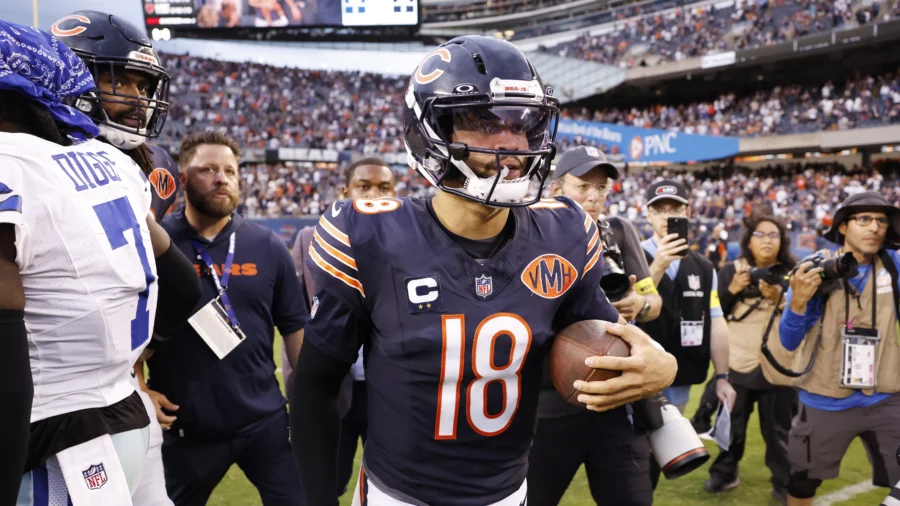
The Chicago Bears are not changing their identity despite moving out of Chicago.
A reporter asked McCaskey point blank about a possible name change.
"No, we will be the Chicago Bears, whether we're in Arlington [Heights, Ill.] or whether we're in Hammond," he said.
While Warren did not make a definitive announcement, he did say that the Bears are now putting all of their resources and energy into Hammond.
"We've been working diligently to complete all of the topographical studies, the geographical studies, environmental studies, in addition to assembling the land that's needed to build a world-class stadium project and also mixed-use development, and also working on the financing and the capital stack that's required to bring this project to life."
Warren said the Indiana government, state and local, have been "stellar to work with," and the Bears are in almost daily communication with officials. The team is also regularly communicating with the NFL. The team is currently conducting initial studies on two sites: the "Lost Marsh" site (Lost Marsh is a Golf Course in northern Hammond); and the "Wolf Lake Terminal" site (named for a nearby industrial hub). Warren said they found the Wolf Lake Terminal site while doing their due diligence on the Lost Marsh site. He added that they could possibly merge the two sites for a better mixed-use development.
The state of Illinois is still reaching out to try and court the team. McCaskey described those meetings as "minimal," and Warren said they would not move the needle.
"Even though we've had occasional meetings with the state of Illinois, our sole focus at this point in time is working on a world-class stadium and mixed-use development in Hammond, Indiana," he said.
Both executives were asked to respond to fan criticisms of the move. McCaskey noted the parallels to the Kansas City Chiefs, who are also moving across state lines from Kansas City, Missouri to Kansas City, Kansas. He empathized with the anxiety felt by fans, but emphasized that the move is not burdensome.
"It's going to require an adjustment," he said. "But when I've driven that route, other than a sign telling me so, I wouldn't know that I've just crossed the state border."
McCaskey also shut down concerns about "Bear weather": the bitter cold, bone-chilling winds, and lake-effect snow that defined late-season and postseason play at Soldier Field.
"I heard a lot about 'Bear weather' back in January," he said. "This team from Southern California [the Los Angeles Rams] is going to come in here and we're going to expose them to 'Bear weather,' and they wound up with the W. So it's fun to think about snow flurries and braving the elements. I was out there myself. But to host the number of events that we could host in a fixed-roof stadium, to be able to attract these major events which, all along, Chicagoland has lost out on, we think that will more than offset the advantages of 'Bear weather.'"
Warren in turn stressed the improvements that would be made to the gameday experience for fans themselves.
"I think what's important to recognize, this is important for the fans, is for us to build a world-class stadium," he said. "The time has come for us to do it. They deserve a much better game day experience than we have now. They deserve the opportunity for us to be able to bring world-class events here—from the Super Bowl that we'd have a chance to bid for, to the World Cup, to concerts, to College Football Playoff games, to other professional sports. And so our focus is on the fans, and it's important that we build a world-class stadium that has a mixed-use development with restaurants and hotels to have that special game day experience, with smooth ingress and egress. .. hopefully when we finish the stadium and open up and they get a chance to experience that, they'll be grateful for what we have done."