


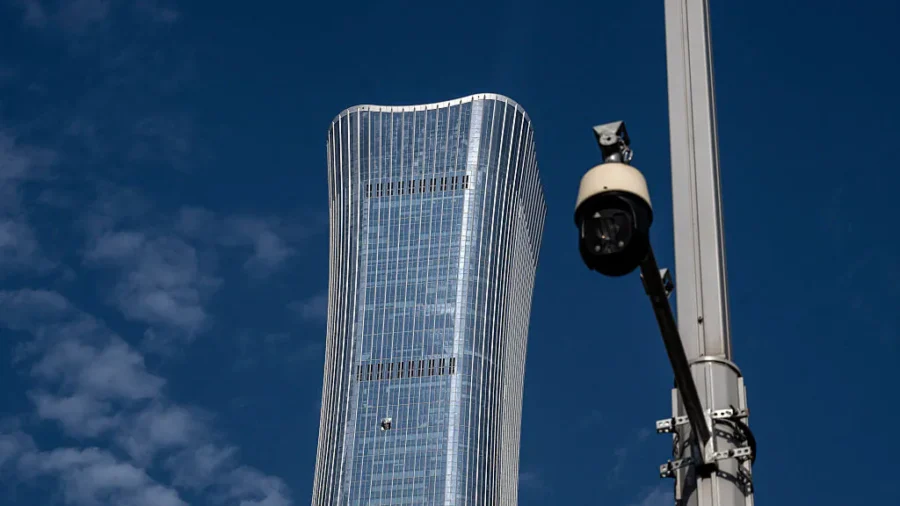
A small plane crashed into Beijing’s tallest skyscraper, killing the sole pilot on board and injuring 13 people. The incident has been heavily suppressed by Chinese media, seemingly vanishing into thin air.
Five days have passed since the crash occurred on June 26, yet information regarding why and how the accident happened, as well as the identity of the pilot, remains unknown.
On the afternoon of the incident, the light aircraft suddenly struck the CITIC Tower (also known as "China Zun"). The 528-meter-tall building is the tallest structure in Beijing and sits at the heart of the city's political center—just 3.7 miles (6 kilometers) from Zhongnanhai, where Chinese leader Xi Jinping's office is located.
Local authorities confirmed the next day that the incident resulted in one death and 13 injuries, though they made no mention of the building's name or the pilot's identity.
As of the time of writing, state-level media outlets, including Xinhua News Agency and China Central Television (CCTV), have not reported on the event.
This incident comes shortly after Beijing implemented what was dubbed the world’s strictest "drone ban" on May 1 of this year. The mandate effectively banned recreational flights and consumer drones citywide, halting sales, shipping, and transport. Even DJI products were completely pulled from shelves, making it impossible for ordinary citizens to fly drones.
A Passenger Airliner’s Near-Miss
The light aircraft also narrowly avoided a collision with a Hainan Airlines passenger jet and forced at least two other commercial flights to abort their landings, according to newly revealed tracking data.At their closest point, the two aircraft were only 1,500 feet (about 457 meters) apart. Fortunately, the Hainan Airlines jet took timely evasive action, preventing a mid-air collision.
China’s 9/11 or Red Square Incident?
Many overseas netizens have dubbed the event "China’s 9/11"—not because of the scale of casualties, but because of a stark reality: in heavily monitored and tightly secured Beijing, a plane managed to strike the tallest building near Zhongnanhai and the embassy district. The breach exposed a failure in security defenses comparable to the 9/11 attacks.The "Red Square Incident" occurred in May 1987, when Mathias Rust, a 19-year-old West German, single-handedly piloted a single-engine plane over 500 miles (800 km), penetrating the Soviet Union’s air defense system to land near the Kremlin.
The incident shocked the world. The Soviet air defense chain of command—stifled by rigidity, misjudgments, and buck-passing—issued no clear directive during the flight. Ultimately, the aircraft entered restricted airspace completely unchallenged, landing near Moscow's Red Square.
Similarly, Beijing had just enacted its harshest drone ban on May 1. The capital boasts China’s densest deployment of air defense missile batteries and radar monitoring networks. Yet, under such intensive integrated air-and-ground surveillance, a slow-moving light aircraft—with a radar cross-section far larger than a drone—remained off-track for an extended period and flew unobstructed into the core of Beijing, ultimately striking the CITIC Tower.
The military analyst page concluded that, beyond the polished image presented by state media, significant blind spots may exist in real-world defense capabilities.