


China is courting the European Union while punishing it at the same time—and the contradiction is starting to bite.
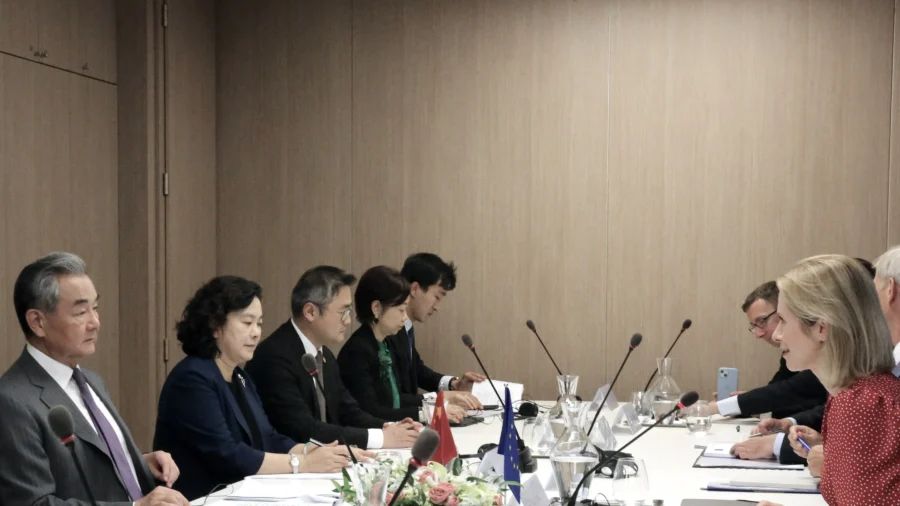
Chinese Foreign Minister Wang Yi arrived in Brussels on July 2 to prepare a summit marking 50 years of EU–China ties. Two days later, Beijing imposed tariffs of up to 34.9 percent on European brandy. On July 6, it went further, barring most EU suppliers from bidding on large Chinese medical-device contracts.
Both moves landed squarely in the middle of Wang’s charm tour of Brussels, Berlin, and Paris.
Wang is asking Europe to stand with Beijing against rising U.S. pressure. Yet Beijing is squeezing the very exports Europe cares about—an approach that analysts say is driving the two sides farther apart.
Beijing’s One–Two Punch
On July 4, China’s Commerce Ministry slapped tariffs of up to 34.9 percent on EU-made brandy, effective the next day, citing anti-dumping violations. Two days later, on July 6, the Finance Ministry said EU companies that do not already manufacture in China may no longer compete for large hospital tenders; non-EU bidders must cap EU-sourced parts at 50 percent of the contract value.The restrictions apply to Chinese medical-device contracts worth more than 45 million yuan (about $6.2 million).
The order strikes at Europe’s high-end niches—from prosthetics and surgical tools to endoscopes and artificial organs—while making a single exemption: medical equipment that European companies alone can supply.
China affairs analyst Wang He told The Epoch Times that the EU’s measures followed months of investigation, dialogue, and failed negotiations. Beijing, he argued, without finding a just cause, “retaliated immediately and signaled an all-out confrontation.”
That wolf-warrior diplomacy, he said, “is a heavy blow to China–EU relations.”
Russia in the Room
Trust was already fraying over Ukraine.Kallas pressed Beijing to “cease all material support” for Russia’s war machine.
As of early 2025, he said, 80 percent of critical electronics in Russian drones came from China, often funneled through shell companies.
The fallout has reached Chinese property.
The Limits of Beijing’s Leverage
As with the United States, China runs a lopsided trade surplus with Europe—over $300 billion in 2024—so outright retaliation could hurt Beijing more than Brussels.Europe’s security is backed by Washington through NATO, and its largest export customer is also the United States.
“Between Washington and Beijing, Europe will almost definitely lean toward the U.S.,” said Yeh Yao-Yuan, an international-studies professor at the University of St. Thomas.
“Trust is eroding fast,” he told The Epoch Times. “Beijing’s attempt to court the EU has resulted in more friction.”
By blocking hospital tenders, Beijing also risks self-inflicted pain. High-end medical devices remain one of the few sectors where China depends heavily on European technology, Wang He noted.
“China risks denying its own patients world-class equipment,” he said.
“Beijing thinks it is strong enough that others must listen,” Yeh said. “But Europe is slowly walking away.”
Frank Tian Xie, a business professor at the University of South Carolina Aiken, doubts Beijing can forge an anti-U.S. bloc.
Amid global trade negotiations, Washington is preparing fresh tariffs that will hit both Chinese and European exports, Xie said. Because Beijing is also squeezing EU trade, Europe has little to gain by lining up with China.
He said that while conflicts between nations often appear to be about land or religion, their root cause is usually economic interest; for China, battles over trade ultimately rise to national-security issues.
Chinese leader Xi Jinping had hoped the 50-year China-EU anniversary would showcase a partnership distinct from Europe’s bond with Washington. Instead, diplomats now talk of “managing differences” rather than celebrating common ground.
Fei Zhen, Ning Haizhong, and Luo Ya contributed to this report.
From The Epoch Times