


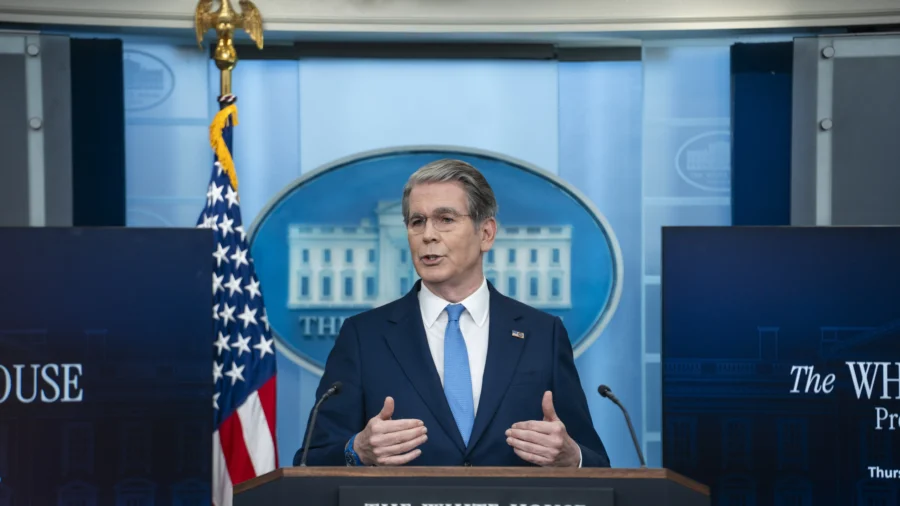
Treasury Secretary Scott Bessent said Congress will ultimately decide whether President Donald Trump’s face adorns a special $250 bill commemorating the nation’s 250th anniversary.
“Treasury is following the law,” Bessent told reporters during a White House press briefing on May 28. “And it’s up to Congress.”
The “Donald J. Trump $250 Bill Act,” introduced by Rep. Joe Wilson (R-S.C.) in February 2025, seeks to establish the note, with approximately 15 Republican cosponsors signing on to the legislation.
Wilson called it the “most valuable bill for the most valuable president,” and said it would help Americans carry fewer currency notes.
Legislative efforts stalled, with the last action coming last year when the act was referred to the House Committee on Financial Services.
If passed, the legislation would amend the Federal Reserve Act and make Trump the first living person to grace U.S. paper money since the Civil War, when Spencer M. Clark—National Currency Bureau superintendent—decided to place his own face on the five-cent fractional note issued between 1864 and 1866.
Critics accused Clark of exploiting a congressional order, and Rep. Martin Thayer (R-Penn.) subsequently added an amendment to the Treasury’s appropriations bill in 1866, outlawing “the portrait or likeness of any living person” on any paper currency instruments.
Congress strengthened and codified the amendment in 1873 with laws which remain in effect today.
Six individuals’ faces were printed on U.S. currency while they were alive, including Clark. President Abraham Lincoln was depicted on the $10 note, among others, beginning in 1861. Lincoln’s treasurer, Salmon P. Chase, adorned the first U.S. $1 bill in 1862.
General Winfield Scott, known as “Old Fuss and Feathers,” adorned $100 interest-bearing notes, and Treasury Secretary Sen. William P. Fessenden and Treasurer Francis Spinner adorned fractional currency.
The idea of Trump on the $250 note is something the secretary supports, he said, considering the timing of the semiquincentennial celebration this year.
“I don’t think there’s anything untoward about having the president of the United States, the person who was president of the United States on the 250th anniversary bill,” Bessent said.
He responded to reports that Treasury employees were working on the project to design and create the note by noting that advance efforts are always necessary to achieve objectives in government.
“We prepare for everything. We have to prepare in advance,” Bessent said. “You can’t draw something up the day before.”