


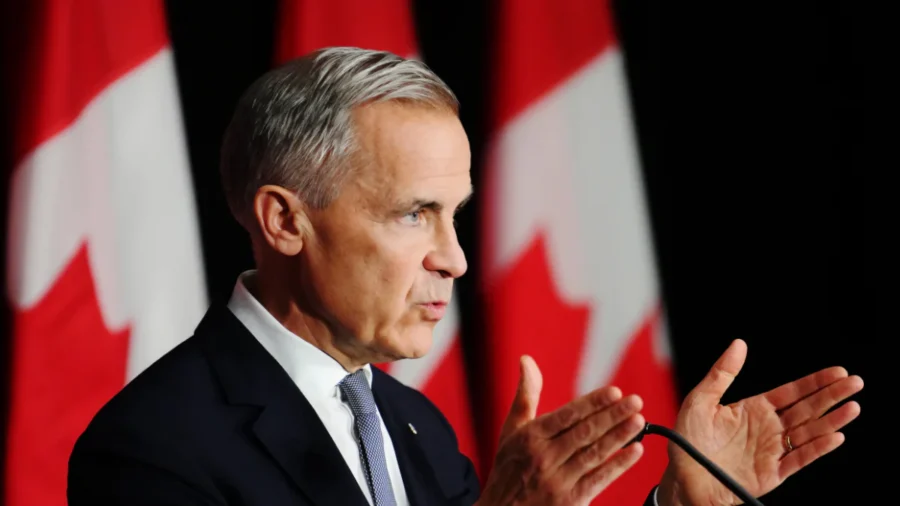
The former head of the Bank of England said that the United States had "fundamentally changed its approach to trade, raising its tariffs to levels last seen during the Great Depression," and that the scale and speed of these changes warrant that Canada's economic strategy dramatically change.
He noted that in the past decades, the Canadian economy had become steadily more integrated with that of the United States, but that process "is now over."
"Many of our former strengths—based on close ties to America—have become our vulnerabilities," Carney said.
He added that Canada can no longer rely on a single foreign partner and cited recent efforts to engage with and reach trade agreements with other nations around the world.
Trade Negotiations
Carney made the speech ahead of releasing his government's budget on Nov. 4, and amid ongoing trade deal negotiations with the United States.Earlier this month, Trump hosted Carney at the White House to discuss bilateral trade, foreign affairs, and border security.
“We’ll make some deals, and we’ll do some things that are good for both of our countries and markets,” he said.
When asked why a U.S.–Canada deal had not yet been reached, Trump said that it was a "complicated agreement."
"More complicated, maybe, than any other agreement we have on trade because we have natural conflict. We also have mutual love," Trump said.
"The problem we have is that they want a car company, and I want a car company.
"They want steel, and we want steel...in other countries, they're very far away and there's no problem. You can compete.
"We don't like to compete because we sort of hurt each other when we compete.
"It's a natural business conflict. Nothing wrong with it. I think we've come a long way over the last few months, actually, in terms of that relationship."

The United States and Canada have a long history of integrated trade. Both countries were in the 1989 Canada–U.S. Free Trade Agreement, which was superseded by the North American Free Trade Agreement (NAFTA) in 1994.
NAFTA was then followed by the USMCA in 2020, which Congress will review in July 2026 to decide whether to extend the pact.
"In 2024, Canada was the top destination for U.S. exports and the third-largest source of U.S. imports. Canada exported over three-quarters of its goods to the United States and imported almost half of its goods from the United States," the department noted.