


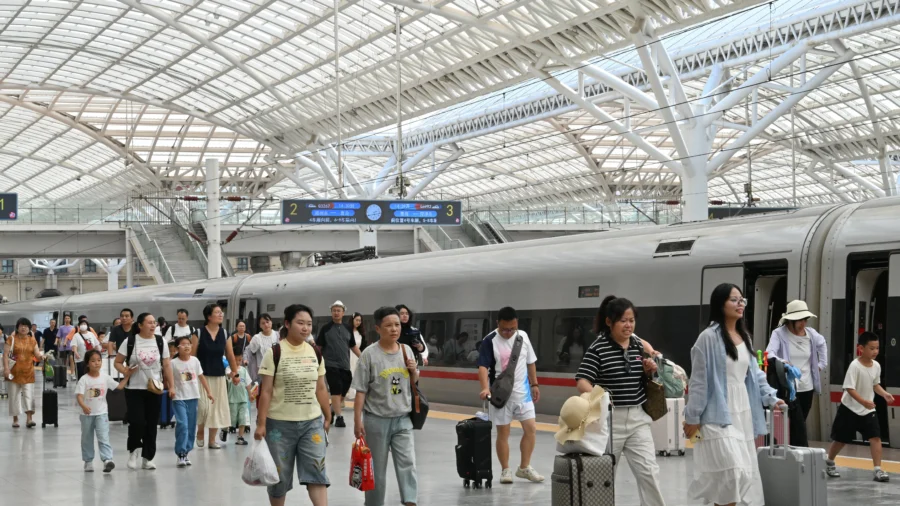
China’s busiest high-speed rail line will raise published fares by 20 percent later this month, a move that has drawn online criticism and prompted analysts to warn that rising energy costs are starting to ripple through the broader economy.
The fare hike on the Beijing-Shanghai corridor—which carries between 500,000 and 700,000 passengers a day—lands as China’s state rail operator sits on trillions of yuan in debt, oil shipments through the Persian Gulf face disruption, and Beijing’s calls to “boost consumption” collide with a steady climb in the cost of everyday public services.
Beijing-Shanghai High-Speed Railway, the listed operator, announced on May 11 that it would “optimize and adjust” published fares on the Beijing-Shanghai and Hefei-Bengbu lines starting May 26.
The 20 percent increase applies to bullet trains running at 300 to 350 kilometers per hour (about 186 to 218 mph) as well as slower services in the range of 200 to 250 kilometers per hour (about 124 to 155 mph). The company described the change as part of a “market-oriented pricing mechanism” and said discounts would still be offered depending on time of day, season, and seat class.
The published fare functions as a ceiling. Actual ticket prices will continue to vary, but they can now climb roughly a fifth higher than before. The price of a second-class Beijing-to-Shanghai seat that currently costs around 600 yuan (about $88), under the new ceiling could go up by as much as 120 yuan (about $18).
The explanation drew sharp criticism online.
“They raise prices and still say it’s to satisfy customer demand,” one commenter wrote. “High-speed rail used to feel convenient, but now it’s getting harder and harder to afford,” said another.
Several users said slower conventional trains have grown more expensive too. “Green trains already got more expensive,” one wrote. “It used to cost 34 yuan from Shanghai to Bengbu. Now it’s 62 yuan.” Another said tickets from Shanghai to Hangzhou, once “just over 40 yuan” when the line first opened, now run about 70 yuan.
Energy, Debt, Consumer Strains
Zhu, a financial scholar in Anhui Province who requested to use only his surname, told The Epoch Times that the fare hike is closely tied to rising energy pressure and that more increases could follow. Although high-speed trains run on electricity rather than oil, China generates most of its power from coal, he said, and mining, hauling and grid maintenance all rely on fuel-burning equipment.“Once costs rise at these stages, electricity prices are affected, which in turn raises the operating costs of high-speed rail,” Zhu said. “Eventually, that gets reflected in ticket prices.”
A China-based economist surnamed Chen linked the increase to the international energy situation, including disruptions in the Persian Gulf.
“Iran sells most of its oil to China,” Chen told The Epoch Times. “Now that the Strait of Hormuz is blocked, oil shipments could be disrupted. China already depends heavily on imported energy. Once transportation problems emerge, costs across logistics, power generation and the railway system all rise.”
The Strait of Hormuz—the narrow waterway through which about a quarter of the world’s seaborne oil trade passes—has been largely closed since late February, when the United States and Israel launched air strikes on Iran, and Iranian forces moved to block the passage in retaliation.
Vessel traffic is now between two and five ships a day, compared with about 70 before the war, Saudi Aramco’s chief executive Amin Nasser told investors on the company’s first-quarter earnings call this week.
According to the U.S. Energy Information Administration, Brent crude hit $138 a barrel on April 7, averaged $117 for the month, and is still trading above $100.
China is the most exposed major economy: Roughly 45 to 50 percent of its crude oil imports normally transit the strait, and China alone accounts for 37.7 percent of all crude and condensate flows through the passage—more than any other country by a wide margin.
Chen also pointed to what he described as a growing trend of Chinese households stockpiling goods, which he said indicates that many consumers expect further price increases.
“These kinds of price hikes will likely spread to more sectors,” he said.
The fare increase also comes as China’s state-run railway system carries heavy debt. China State Railway Group ended 2024 with 9.76 trillion yuan (about $1.4 trillion) in assets and 6.2 trillion yuan ($910 billion) in liabilities, according to its annual report. The company said in January that it had trimmed its debt-to-asset ratio by one percentage point to 62.5 percent by the end of 2025, leaving total debt at well over 6 trillion yuan.
The Beijing-Shanghai move follows a broader pattern. In 2024, the railway authority raised maximum fares by roughly 20 percent on the Wuhan-Guangzhou, Shanghai-Hangzhou, Shanghai-Kunming and Hangzhou-Ningbo lines, citing the cost of maintenance, vehicles, equipment and labor.
Meanwhile, the Chinese regime has repeatedly urged local governments to “expand domestic demand” and lift consumer spending—even as subway fares, utilities, gas, rail tickets, and airport charges have all crept upward.