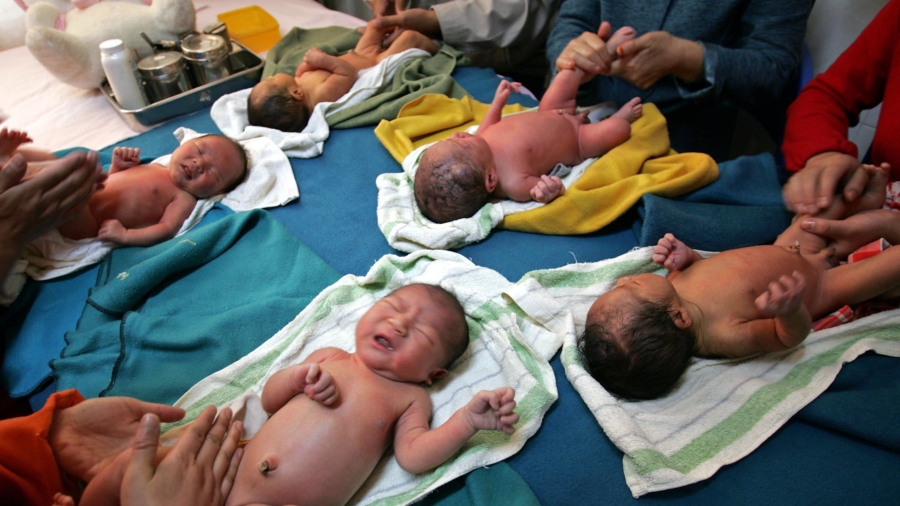
China regime has mandated that all tertiary hospitals provide "pain-free childbirth," amid a decline in China’s fertility rate for three consecutive years as of last year.
The so-called “pain-free childbirth” is known as epidural anesthesia, primarily used for pain relief during labor and surgeries.
Epidural anesthesia is not a new technology, with a history of over 100 years.
The Chinese National Health Commission (NHC) issued a
statement on June 5, declaring that by the end of 2025, all tertiary medical institutions with 500 or more beds must be able to provide labor analgesia services. By 2027, all secondary and above medical institutions with 100 or more beds must also offer these services.
According to the Chinese regime’s mouthpiece
People’s Daily overseas website, in recent years, China’s epidural anesthesia rate has increased significantly, from 27.5 percent in 2015 to 60.2 percent in 2022.
However, there is still room for improvement. The new policy will make painless delivery a standard service rather than an optional one, with tertiary hospitals taking the lead and secondary hospitals following suit.
The NHC
said, “This measure will further enhance the comfort and safety of medical services, improve people’s sense of well-being, and create a fertility-friendly environment.”
The rate of epidural anesthesia in Western countries varies but is generally high due to widespread access to advanced medical infrastructure.
The Chinese regime is struggling to maintain its population falling for a third consecutive year in 2024, with experts warning the downturn will worsen in the coming years.
According to data released by the National Bureau of Statistics of China,
in 2022, China's birth population was 9.56 million, with a birth rate of 6.77 percent; the death population was 10.41 million, with a death rate of 7.37 percent; and the natural population growth rate was -0.60 percent. This marked the first time in nearly 61 years, since the Great Famine, that China experienced negative population growth.
In
2023 and
2024, negative growth continued, reflecting an accelerating population decline in recent years.
Despite China beginning to relax its one-child policy nearly a decade ago, China's fertility rate has continued to decline, and the number of young people registering for marriage has reached new lows.
The latest
United Nations report indicates that China could lose half its population, plummeting to only
770 million in 2100.
More Than 10,000 Kindergartens Closed
As the number of newborns decreases, tens of thousands of maternity wards and kindergartens in China have closed.
According to the China Health Statistics Yearbook, the number of obstetrics and gynecology departments in Chinese hospitals dropped from 729,122 in
2019 to 718,436 in
2020, a decrease of 10,686 in just one year's time.
Kindergartens have also been heavily impacted by the declining birth rate. According to statistics from the
Chinese Ministry of Education, in 2023, China had 274,400 kindergartens, a decrease of 14,800 compared to 2022, with an average of 40 kindergartens closing daily.
Additionally, there were 143,500 regular primary schools nationwide in 2023, a reduction of 5,645 from the previous year, representing a 3.79 percent decline.