


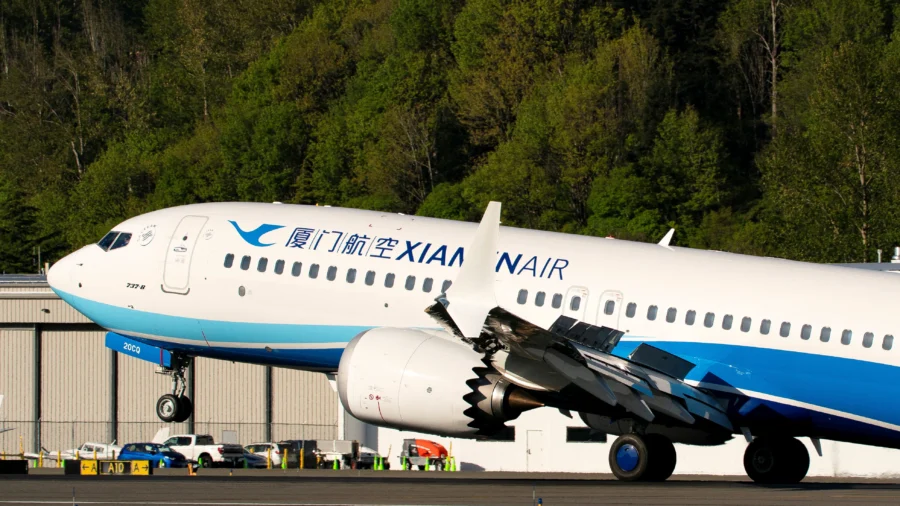
Boeing’s chief executive said this week that its customers in China have stopped accepting Boeing planes, a move he attributed to the intensifying tariff standoff between the two countries.
Kelly Ortberg, CEO of Boeing, confirmed that three planes previously prepared for Chinese customers are now being returned to the United States
Ortberg explained that Boeing had planned to send about 50 aircraft to China this year, but the company is now reevaluating those plans.
“We’re going to be pretty pragmatic with what we do here for those airplanes that haven’t been built yet, we’ll be looking to maybe redirect those to other customers. For the airplanes that have been built, we call it remarketing. There’s plenty of customers out there looking for the max aircraft,” he said.
Trade Tensions Escalate
The halt in deliveries comes as the United States and China exchange steep tariffs in a widening trade conflict. The Trump administration recently imposed tariffs as high as 245 percent on Chinese goods, while Beijing retaliated with 125 percent levies on U.S. products.Boeing’s Financial Outlook, Supply Chain Concerns
Despite the delivery freeze, Ortberg said Boeing remains on track for positive free cash flow in the second half of the year, kept afloat by better-than-expected commercial deliveries in the first quarter.“We delivered 130 airplanes, which is ahead of our plan. So as you saw, a little less cash burn this first quarter. So we’re well on track for that recovery to return to positive cash flow in the second half of the year,” Ortberg said.
Ortberg noted that tariffs on inputs from countries like Japan and Italy are being managed through a drawback system, which allows some recovery of tariff costs for aircraft delivered outside the United States.
“We think we’ll be able to manage through the input tariff environment. The bigger issue is making sure that our supply chain stays healthy,” he said, noting that Boeing hasn’t witnessed a slowdown in the supply chain due to the tariffs yet.
Market and Industry Reaction
The trade dispute has rattled financial markets, with analysts warning of possible economic effects. “The market is still fraught with uncertainty over tariffs and trade, and the potential impact on inflation and the broader economy,” said Greg McBride, chief financial analyst at Bankrate, in a statement to The Epoch Times.Despite the turbulence, Boeing has maintained a strong cash position, aided by a $24 billion capital raise at the end of last year and the recent divestiture of part of its digital business for $10.5 billion, according to Ortberg.