


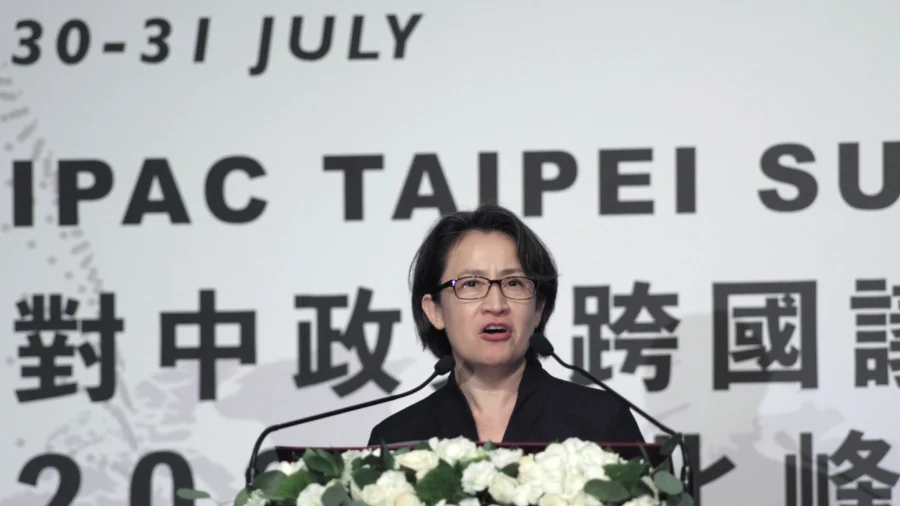
Chinese diplomats and intelligence agents trailed and attempted to intimidate Taiwan's Vice-President-elect Hsiao Bi-khim during her visit to Prague in March 2024, an action that a worldwide coalition of parliamentarians has condemned as intimidation.
They referred to Czech Military Intelligence Agency Director General Petr Bartovský, who said that the Military Section of the Chinese Embassy in Prague “sought to create conditions for demonstrative kinetic action.”
A Chinese diplomat ran through a red light while observing Taiwan’s vice-president-elect, and Czech intelligence uncovered plans to orchestrate a crash.
“This plan, if successful, would have constituted state terror,” the statement said. “Even as an attempt, this shocking episode represents the crossing of a threshold.”
They condemned the Chinese regime for not respecting international diplomatic norms, and will call their respective governments to “condemn the People's Republic of China's unacceptable actions.”
Czech Military Intelligence spokesman Jan Pejsek said, "This consisted of physically following the vice-president, gathering information on her schedule and attempts to document her meetings with important representatives of the Czech political and public scene."
"We even recorded an attempt by the Chinese civil secret service to create conditions to perform a demonstrative kinetic action against a protected person, which however did not go beyond the phase of preparation."
China's foreign ministry spokesperson refuted claims of misconduct by Chinese diplomats and accused the Czech Republic of meddling in China's domestic affairs by permitting Hsiao's visit.
The Czech Foreign Ministry reported that it had called in the Chinese ambassador to address the matter at the time.
They said in a statement that CCP has repeatedly “disregarded the will of the Taiwanese people,” “plotting violent threats against the vice national leader elected through democratic processes,” before they took office.
Asked about this incident, China Foreign ministry spokesman Guo Jiakun said, on June 27: "Chinese diplomats have always abided by the laws and regulations of the countries in which they are stationed."
Overseas Influence Operations
In recent years, China has established overseas police service stations in multiple European and American countries to threaten dissidents.Laura Harth, campaign director for Safeguard Defenders, said the stations are “a setup between public security authorities in China, in cooperation with United Front linked groups around the world,” in the report.
The United Front Work Department is responsible for coordinating the CCP’s influence operations abroad.
She also said the police stations are involved in illegal repatriation operations, such as silencing dissent overseas by coercing Chinese people to return to China.