


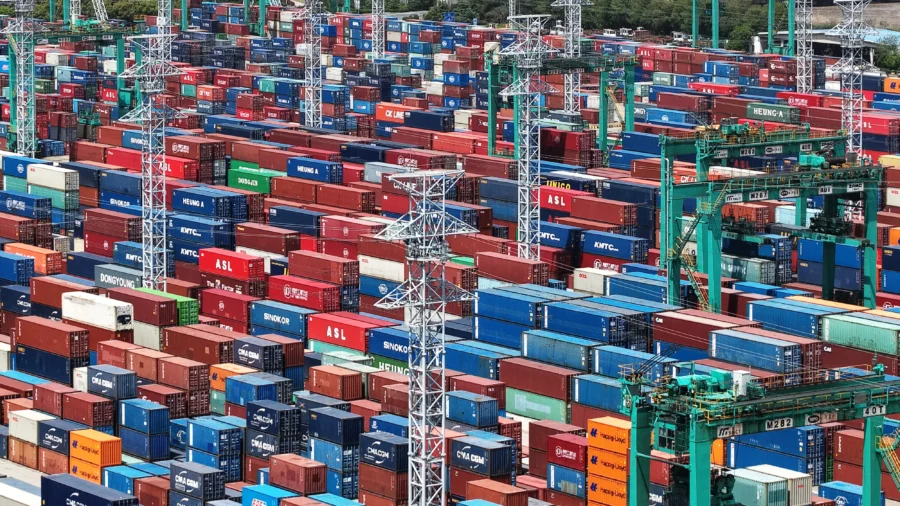
Chinese manufacturers are taking a hit from the tariffs imposed by the U.S. government, with many resorting to pushing their products on social media to sell directly to American consumers.
As the 145 percent tariff on Chinese imports keeps American businesses from placing orders, shipping companies have been forced to cancel voyages on short notice due to lack of demand.
“Most of our products were exported to the United States. But there are no orders anymore,” Mr. Fan, a factory owner in Yiwu, Zhejiang Province, told NTD.
“Nearly all the businesses are being forced to shut down. I have shut down mine already,” he said, explaining that he laid off more than 100 employees.
“Smart bosses know there’s no saving this. It’s a big issue, no hope at all—the whole system is no good.”
“This tariff issue is the last straw,” he told NTD. “Those held-up containers are a death sentence for our business.”
Facing financial collapse, Ma has turned to domestic sales, live streaming clearance events, and offering products at 80 percent discounts.
But selling domestically is hard—the Chinese economy has already suffered for several years from both the enduring property crisis and weak consumer spending. With the American market largely cut off by the tariffs, many trade companies and e-commerce firms are teetering on the edge.
Chinese suppliers have now taken to U.S. social media in droves, urging Americans to buy their goods directly from Chinese factories, which allows them to circumvent the 145 percent tariffs, for the time being anyway.
“Even though foreign trade is hard, it's still easier than domestic trade,” said Jian (pseudonym), the head of a Shandong trading firm. “The advantage of foreign trade is that you get paid in cash. The domestic market is oversaturated—supply exceeds demand, and ordinary people aren’t buying much these days.”
“The second issue is credit sales—people owe you money for three months, six months, and when business goes bad, they just disappear,” Jian added.
Some sellers on TikTok are claiming their factories are the behind-the-scenes producers for Western luxury brands, offering “the real deal” at dumping prices. With China being a notorious purveyor of fakes, such claims should be taken with a grain of salt.
But the last somewhat viable conduit to the American market is about to be cut off as well.
The “de minimis” exemption on which Chinese suppliers are now relying as a last resort is about to come to an end. That's the U.S. trade rule that allows postal shipments under $800 to be imported duty-free.
Starting May 2, shipments under $800 will be subject to a 120 percent customs duty or a “per postal item” cost of $100, increasing to $200 per item after June 1, 2025—effectively eliminating small direct sales from China.
Mr. Xu, who runs an e-commerce business in Yiwu, said the elimination of the “de minimis” rule threatens the survival of the Chinese e-commerce business, as no other market offers profit margins as high as the United States.
“[If] tariff problems still aren’t solved, the risks are huge,” he said. “Foreign trade’s been sliding every year. Being a boss now is too hard—no orders, constant stress, can’t sleep, working 12 hours a day with no holidays. I haven’t had a day off all year.”