


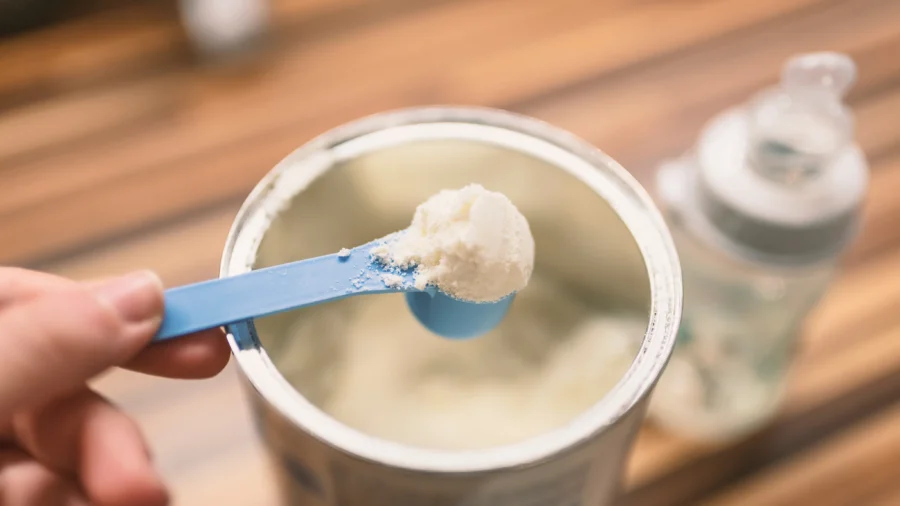
Recent testing of baby formula by independent product testing non-profit Consumer Reports immediately sparked an FDA initiative after results showed that only half of sampled baby formulas were completely free of toxic chemicals, while others contained potentially harmful levels of at least one contaminant.
Consumer Reports said it tested 41 types of powdered formula for multiple toxic chemicals, such as the heavy metals arsenic, lead, and cadmium; bisphenol A (BPA), acrylamide, and per-and polyfluoroalkyl substances (PFAS), in both well-known formulas like Enfamil and Similac, as well as newer startups like Bobbie, popular store brands, and imported brands.
Consumer Reports said that some of the results were “concerning”—most of the samples contained detectable levels of lead, and one exceeded the recommended daily exposure limits for arsenic, as well as for BPAs and acrylamides. Seven other formulas exceeded daily exposure limits for arsenic.
The heavy metals of lead and arsenic pose health risks, particularly for children during their time of development.
Rapid Federal Response
On March 17, Consumer Reports shared the test results with the Food and Drug Administration (FDA). It took only one day for the U.S. health agency to announce a new initiative to strengthen oversight of the formula industry, including increased testing for heavy metals and other contaminants.“Helping each family and child get off to the right start from birth is critical to our pursuit to Make America Healthy Again.”
In a statement, the FDA said it will be encouraging companies to develop new infant formulas as it updates and reviews infant formula nutrients for the first time since 1998.
The agency will encourage companies and work closely with the FDA to achieve better transparency and clearer labeling on their products.
The FDA will collaborate with the National Institutes of Health and other scientific bodies to address scientific research gaps regarding short- and long-term health outcomes associated with formula feeding.
“The FDA is deeply committed to ensuring that moms and other caregivers of infants and young children, and other individuals who rely on infant formula for their nutritional needs, have confidence that these products are safe, consistently available, and contain the nutrients essential to promote health and wellbeing during critical stages of development and life,” said Acting FDA Commissioner Sara Brenner.
“Whether breastfed, bottle fed, or both, the rising generation must be nourished in a way that promotes health and longevity over the course of their lives.”
Head of Food Policy for Consumer Reports Brian Ronholm called the FDA’s immediate response “very encouraging.”
What Can New Parents Do?
So as the baby formula industry is brought up to new standards, what can you as a consumer do?Though it is an issue that needs to be addressed, there is no need to panic. Consumer Reports emphasised that its testing was “reassuring” for parents to know that the other half of brands tested showed low or no levels of concerning chemicals, indicating that there are “many good options on the market.”
“We really want these results to be empowering for parents,” said Sana Mujahid, Consumer Report’s manager of food safety research and testing. “If you are already giving your child one of the formulas on our list with comparatively higher levels of contaminants, there are several steps you can take.”
The makers of some of the poorer performing infant formulas challenged the investigation, its methods, and the gravity of the findings, telling Consumer Reports that the problem of trace level heavy metals in the food supply is not limited to baby formula and that detected levels were below regulatory limits in the United States and elsewhere.
The EPA's limit on arsenic in municipal drinking water—set at 10 ppb (parts per billion) or 10 micrograms per kilogram (ug/kg)—was exceeded in eight of the baby formula samples tested. The EPA's 15 ppb limit on lead was not exceeded in any test, although detectable levels of lead in some samples were above California's ultra-conservative public health goal levels for lead in drinking water of 0.2 ppb.
Consumer Reports noted that just because our environment is contaminated doesn’t mean food manufacturers cannot and should not do better. “The fact that some levels in our tests are lower than others—and many are nondetectable—just shows that it is possible to make safer food,” said James E. Rogers, Consumer Reports’ director of product and food safety research and testing.
If you’re concerned about the formula you are feeding your baby and are considering to switch, Consumer Reports advises you to talk to your pediatrician first.
“Sometimes, switching formula is easy but some babies may not tolerate experimenting with different brands,” Consumer Report said. It also reminded parents to always use clean water when preparing powdered formula.
The consumer watchdog also warned against making homemade baby formulas, as the ingredients used could contain the aforementioned contaminants as well.