

Cuba’s communist regime faces growing pressure due to a worsening economic crisis, rising unrest, and additional U.S. sanctions.
Meanwhile, U.S. officials said they see little chance for peaceful change as Cuban regime leaders continue to tighten their grip on power and ignore calls for reform.
President Donald Trump told reporters on May 21 that previous U.S. presidents have attempted to change Cuba’s political and economic system for decades, but that “it looks like I'll be the one that does it.”
Trump has repeatedly called Cuba a "failed nation" and raised the possibility of a “friendly takeover” of the island.
He intensified the U.S. pressure campaign by expanding sanctions and restricting oil shipments to the island after the capture of Venezuelan leader Nicolás Maduro in January. By cutting off shipments of subsidized Venezuelan oil, the Trump administration effectively severed Cuba's most critical economic lifeline.
Speaking to reporters at Miami Homestead Airport on May 21, Secretary of State Marco Rubio said that the Trump administration still prefers a negotiated solution with Havana.
“The President’s preference is always a negotiated agreement,” Rubio said. “That remains our preference with Cuba. I’m just being honest with you. The likelihood of that happening, given what we’re dealing with right now, is not high.”
Rubio described Cuba as a long-standing national security threat to the United States, citing its close ties to Russia and China and its role as a leading sponsor of terrorism in the Western Hemisphere.
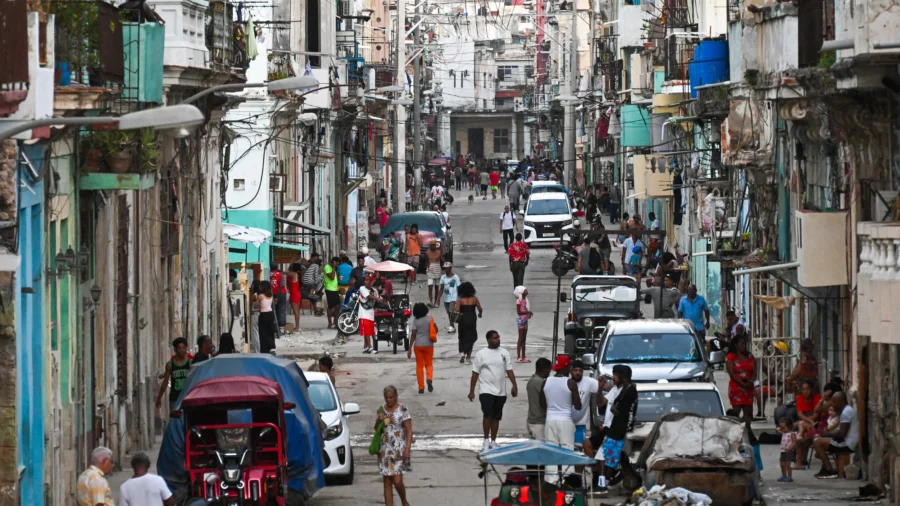
Conditions in Cuba continue to deteriorate, with daily blackouts and severe shortages of food, clean water, and basic medicine. Protests have spread across the island as Cubans increasingly voice their frustration.
Mario Tabares, a former Cuban tennis professional who defected to the United States in 1994, says that the majority of Cubans are ready for regime change.
In a recent interview with The Epoch Times, Tabares described the Castro family as a “cartel” that has been ruling the island for 67 years.
He said the regime has divided families and imprisoned dissidents, which is how they have maintained power for years.
Tabares, once a successful tennis player on the world stage in the early 1990s, escaped his Cuban team during an international tournament in Mexico. He crossed the border in Tijuana and sought asylum in the United States. He now lives in Miami and works as a tennis instructor.
He said that many Cubans expect a military operation similar to the one that captured Maduro in Caracas in January, and that he believes an operation in Cuba would be much easier.
“They have no army. They have nothing,” Tabares said. “They have no chance.”
Life in Cuba
That sentiment is echoed by dissidents and political activists living on the island.In the southeastern town of Caimanera, near the U.S. naval base at Guantanamo Bay, human rights activist Yusmel Acosta says Cubans are exhausted by ongoing shortages and government repression.
“There is no food, and there is nothing to cook with,” he told The Epoch Times in a phone interview. “Gas hasn't reached this area for a very long time now. And because of the electricity issues, many people don't even have the means to cook a meal for their families, for their children.”
But many are afraid to speak out, Acosta said.
“The government, specifically State Security here, has made it clear that anyone who complains, stages a protest, or does anything of the sort will be punished.”
According to Acosta, the Cuban government frequently monitors and intimidates dissidents. Because of his political activism, he says he has faced arbitrary detention, torture, and constant surveillance by the regime.
The only thing the regime has sown among the people, he said, is “fear and deprivation.”
Acosta said many in his hometown quietly hope for a Maduro-style military operation.
“Even here in Caimanera, we can hear, and sometimes even see, the helicopters from the U.S. base when they fly nearby,” he said. “They pass over almost every day, and people start saying, ‘Here they come! They’re finally going to take the island!'”
Another dissident, Julio Cesar Gonzalez, described life in Havana as “utterly chaotic.”
“Cuban society is currently experiencing a catastrophe both spiritually and materially,” Gonzalez told The Epoch Times in a phone interview. “One could almost say that the life of a Cuban is not truly a life at all, but rather a mere struggle for survival.”
The deteriorating conditions in Cuba have also become a growing political issue in South Florida, home to the nation’s largest Cuban exile community.
For Miami-Dade Tax Collector Dariel Fernandez, the current crisis underscores that the communist system is the real obstacle to Cuba’s recovery.
The only way to rebuild Cuba is to end the dictatorship completely, he told The Epoch Times in a recent interview.
Fernandez, a Cuban American who immigrated to the United States 24 years ago in search of freedom, said the meaning of the American dream goes far beyond material success.
“The true American dream is not just to buy a house, buy a car. The true American dream is the freedom that we have in this country,” he said, adding that he hopes Cubans on the island will one day experience that same freedom.
Mounting Pressure
In recent weeks, the U.S. government increased economic pressure on the Cuban regime by imposing new sanctions on state-owned businesses, government agencies, and senior officials.Among the business entities targeted was Grupo De Administración Empresarial S.A. (GAESA), which is estimated to represent about 40 to 70 percent of the island’s economy. GAESA is a business conglomerate operated by the Cuban military.
He accused the United States of fabricating lies and described the indictment as part of a broader effort to justify potential military action against the island.
Meanwhile, USS Nimitz and its strike group arrived in the Caribbean on May 20, fueling speculations that a military operation could be imminent.