


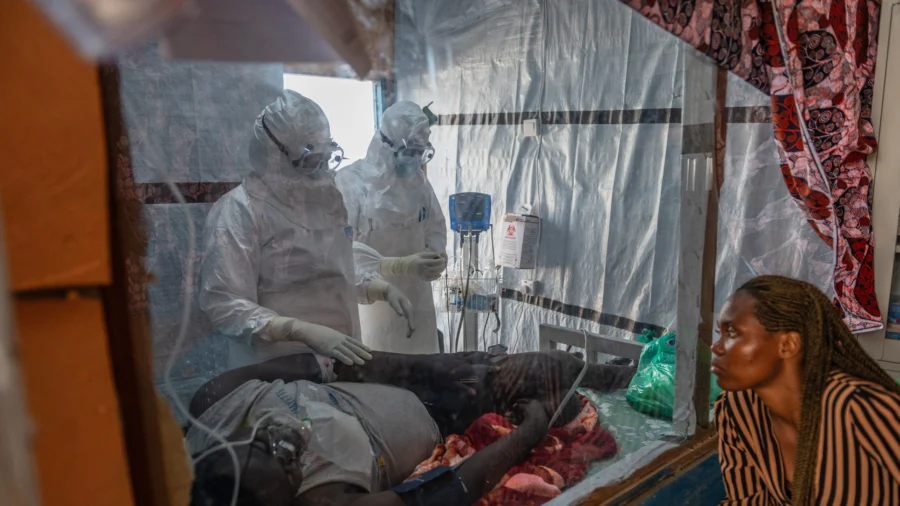
The death toll in the Ebola outbreak in Central Africa has surpassed 2,500, authorities said on Aug. 21.
Officials have confirmed 2,516 deaths, Congo’s government said in an update.
Practically all of the cases and deaths in the outbreak have occurred in Congo, a large nation of around 124 million people that borders the Central African Republic and Uganda, among other countries.
Several deaths were logged in Uganda earlier in the year. No cases have been reported in the United States.
The total number of cases in Congo is up to 5,290, Congolese officials said on Friday.
Preliminary data indicate Ervebo may be effective against Bundibugyo, authorities said this week.
The outbreak was detected in mid-May in Congo, which has dealt with more than a dozen Ebola outbreaks in the past. It is now the second-deadliest in history, behind only an outbreak that started in 2014 in West Africa and left more than 11,000 dead.
New cases have not been reported recently in several portions of Congo, but have appeared in a zone near the Central African Republic, Dr. Jean Kaseya, director-general of the Africa Centers for Disease Control and Prevention, said in a briefing on Aug. 20.
Overall, the outbreak is escalating much faster than previous outbreaks, including the one that began in 2014, Kaseya said. By week 13 of the outbreak, there were 10 times as many cases and seven times as many deaths as in that outbreak.
Trials testing Ebola vaccines developed against other strains, and experimental drugs, are scaling up, Kaseya said. Vaccination of frontline workers has started.
Julien Harneis, the United Nations senior coordinator for Ebola, told reporters Friday that the outbreak “is growing exponentially.”
“The epidemic is spreading to an area that is bigger than France, and the outbreak is growing faster and wider than the Ebola response, and all of this is happening in an area which has had three decades of conflict and is generating huge humanitarian needs,” Harneis said.
The outbreak response has been hampered by multiple factors, including health care workers falling ill and dying, and facilities being attacked by locals, Harneis said.
Workers with nongovernmental groups have been trying to help with surveillance for cases, improve patient care, and ensure the deceased are buried safely.