


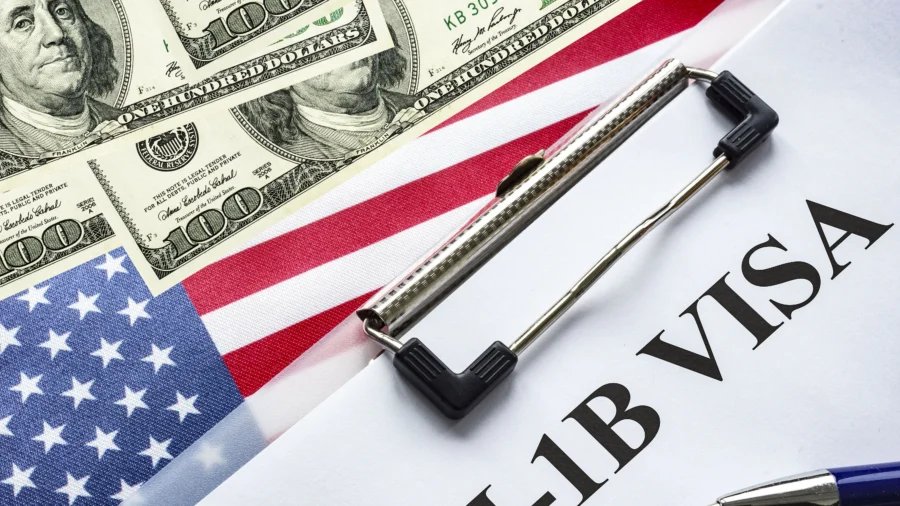
The Trump administration issued a new proposal on Aug. 24 to charge more than $100,000 for new H-1B visas for foreign workers.
It's a measure that builds off President Donald Trump’s temporary fee that was first imposed last year and was set to expire in September. The new rule, posted by the Department of Homeland Security (DHS) in the Federal Register, is set for official publication on Aug. 25 and could be finalized by the end of the year.
According to the proposal, the new fee for H-1B visa applications, including those eligible for advanced degree exemption, would be $103,265 in addition to other fees or payments.
DHS’s new rule would not apply to foreign workers already in the United States on student visas or to renewals of current visas—it applies only to new H-1B applicants.
The proposal further states that the fee is intended to cover a portion of the full cost of providing immigration adjudication and naturalization services.
“The proposed H‑1B fee is intended to provide a powerful, reliable, and predictable revenue tool to address the costs across multiple agencies that oversee the United States immigration system,” the new rule states.
The H-1B program authorizes American employers to hire foreign laborers with training in specialty fields, including engineering, mathematics, architecture, medicine and health, education, law, and accounting. Typically, 65,000 visas are offered annually and another 20,000 for those with advanced degrees. The work permits are approved for three to six years and cost between $2,000 and $5,000.
U.S. industries such as tech, education, and research rely heavily on H-1B visas.
President Donald Trump initially imposed the fee last September when he signed a proclamation requiring the $100,000 fee to be paid before U.S. employers’ petitions for new H-1B visas are processed.
“The large-scale replacement of American workers through systemic abuse of the program has undermined both our economic and national security,” the proclamation read.
The judge said the rule imposed a tax on H-1B visas, and while the president can restrict foreign nationals from entering the country, Congress has the power to impose a tax. According to the judge’s ruling, the temporary fee also violated the Administrative Procedures Act because it was issued without a public comment period before taking effect.
The Trump administration is pushing back on that ruling.
White House spokeswoman Taylor Rogers told The Epoch Times via email: “President Trump has clear legal authority to restrict entry of any class of aliens he determines is not in America’s best interests, and that is exactly what he did.”
“The H-1B program has been abused for decades, and President Trump finally took action to fix it. A federal judge in Washington already upheld a nearly identical order, and the Administration is confident this order will be reversed on appeal,” Rogers said.
The U.S. Chamber of Commerce and the Association of American Universities had sued, arguing that H-1B workers “contribute enormously to American productivity, prosperity, and innovation.”
They claimed the program assists U.S. employers that have domestic labor shortages.
But the judge who upheld Trump’s temporary fee said that how the program’s effects on the economy or national security, “whether positive or negative, are simply not at issue in this case.”
The fee increase is another step the Trump administration has taken to rein in the H-1B program.
The agency is implementing a “weighted selection process” to prioritize higher-skilled and higher-paid foreign nationals as opposed to the current random lottery system.
U.S. Citizenship and Immigration Services said at the time that the random selection process enabled U.S. employers to exploit the system, “flooding the selection pool with lower-skilled foreign workers paid at low wages, to the detriment of the American workforce.”