


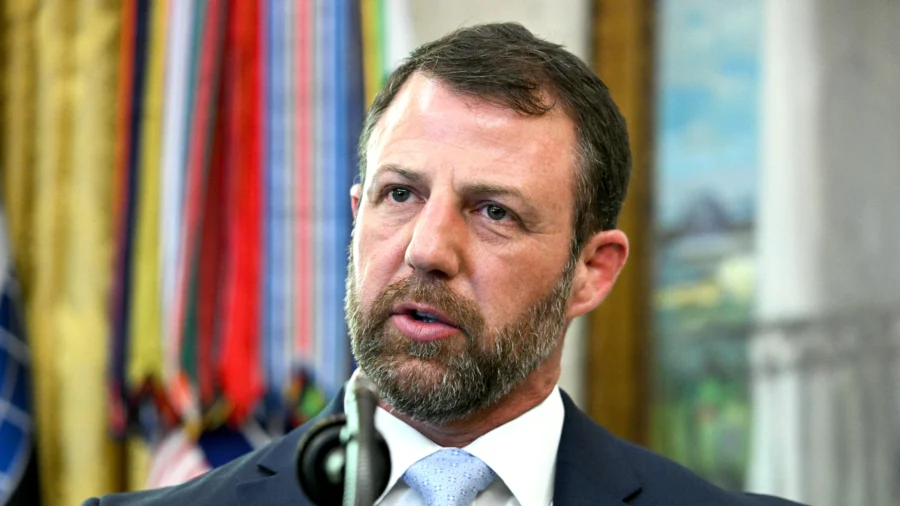
The Department of Homeland Security (DHS) rescinded a policy Tuesday that required the department secretary to personally approve every contract and grant exceeding $100,000.
Secretary Markwayne Mullin issued the reversal across all DHS components, including U.S. Customs and Border Protection (CBP) and U.S. Immigration and Customs Enforcement (ICE). The change ends an earlier directive from former Secretary Kristi Noem that required the secretary’s office handle routine purchasing decisions previously handled at lower levels.
However, contracts and grants above $25 million will still require secretary review.
DHS said the move will “streamline the contract process and empower components to carry out their mission to protect the homeland and make America safe again.” The department told The Epoch Times in a statement that Mullin “re-evaluated the contract processes to make sure DHS is serving the American taxpayer efficiently.”
Mullin signaled the shift at the department during his confirmation hearing this month.
“I’m not a micromanager,” he said, referring to Noem’s policy. “We put people in, we empower them to make decisions. What is required to come up to my level, we'll make decisions."
Noem’s policy, signed shortly after she took office in 2025, sought to tighten oversight of taxpayer dollars at a time when DHS managed billions in contracts for border security, immigration detention, and disaster response.
In September 2025, a Senate Homeland Security and Governmental Affairs Committee review found 1,034 FEMA contracts, grants, or disaster-assistance awards that were pending or delayed. The average approval took three weeks, affecting housing inspections, temporary sheltering, and aid distribution after the July 2025 Texas floods and Hurricane Helene.
The change comes as Mullin seeks to reduce bureaucratic gridlock.
The policy shift does not alter core missions funded through contracts, such as ICE detention operations or CBP’s use of surveillance technology and logistics support. Officials say the streamlined approach will help DHS respond faster to both routine needs and emerging threats.
The policy also resulted in terminating 118 bad contracts and accelerating state-led recovery funding to get money to victims faster, and prevented up to $1.3 billion in external fraud.
Noem left DHS earlier this year after President Donald Trump tapped her for a new hemispheric envoy role focused on regional security.
During his Senate confirmation hearing on March 28, Mullin told senators he would maintain “a very clear line of communication with every one of our agencies’ heads on their authority that you gave to them within their parameters, and we’ll discuss.”
“But we’re also going to be very responsible for the taxpayer dollars,” he added.