


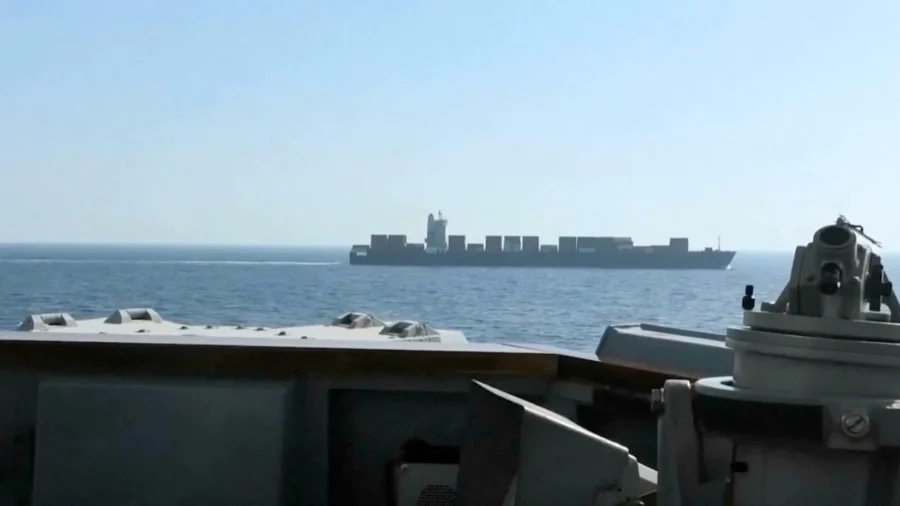
President Donald Trump on Sunday said the U.S. military forcibly seized an Iranian-flagged cargo ship that attempted to bypass a naval blockade earlier in the day.
In an announcement posted on Truth Social, Trump said the ship, called the Touska, attempted to get past the U.S. military blockade that has been in effect since April 13.
“It did not go well for them,” he wrote.
A U.S. Navy destroyer intercepted the cargo ship in the Gulf of Oman and first warned it to stop. When it refused, the U.S. ship “stopped them right in their tracks by blowing a hole in the engineroom,” Trump wrote.
“Right now, U.S. Marines have custody of the vessel,” the president added. “The TOUSKA is under U.S. Treasury Sanctions because of their prior history of illegal activity. We have full custody of the ship, and are seeing what’s on board.”
Iran accused the United States of a ceasefire violation in response to the attack.
According to Iranian state media, military officials described the U.S. action as “maritime piracy” and said that “Iran will respond soon.”
According to the tracking website MarineTraffic.com, the ship is around 964 feet in length and more than 106 feet wide.
The capture of the vessel was made as the Trump administration is working to secure a peace deal with the Iranian regime before a two-week-long ceasefire ends on April 21.
The naval blockade, which is being enforced by U.S. Central Command, targets ships that are entering or exiting Iranian ports and will not impede on the freedom of navigation for ships transiting the Strait of Hormuz, a waterway that links the Persian Gulf with the broader ocean.
Trump said that U.S. negotiators will arrive in Pakistan on Monday evening for another set of talks with Iran. Several hours later, Iran had not confirmed it would attend.
The president also threatened to destroy civilian infrastructure in the country if it doesn’t take the deal that the administration is offering. Tehran has said it is preparing its military during the ceasefire.
Iran’s foreign ministry spokesman, Esmail Baghaei, said Sunday that the U.S. blockade of Iran’s ports and coastline is an act of aggression that violates the shaky Pakistani-mediated ceasefire between the two countries.
By “deliberately inflicting collective punishment on the Iranian population, it amounts to war crime and crimes against humanity,” Baghaei claimed on social media. His comments were made after the Iranian regime’s renewed military actions directed toward shipping, in response to the U.S. blockade, fully reclosed the strategic Strait of Hormuz.
An Iranian general, Seyed Majid Mousavi, commander of the Iranian Revolutionary Guard Corp’s Aerospace Force, said in comments carried by semi-official state media, that Iran’s armed forces are replenishing drone and missile stockpiles during the ceasefire.
“During the ceasefire period, our speed in updating and refilling missile and drone launch platforms is even greater than before the war,” he claimed.
Before the ceasefire was announced, the United States and Israel repeatedly struck Iranian military targets, including defense production facilities that make missiles and drones, and killed dozens of the country’s top leaders. In response, Iran fired rockets and drones at neighboring Gulf Arab states and Israel while it attacked ships in the region and threatened shipping in the Strait of Hormuz.
Since the start of the conflict, the price for a barrel of Brent crude oil reached above $100, although it dropped to $90 during the most recent trading period. West Texas Intermediate crude, meanwhile, has dropped to below $84 per barrel. The American Automotive Association reported Sunday that the average price for a gallon of regular gasoline dropped slightly to $4.04 from $4.05 a day before.