


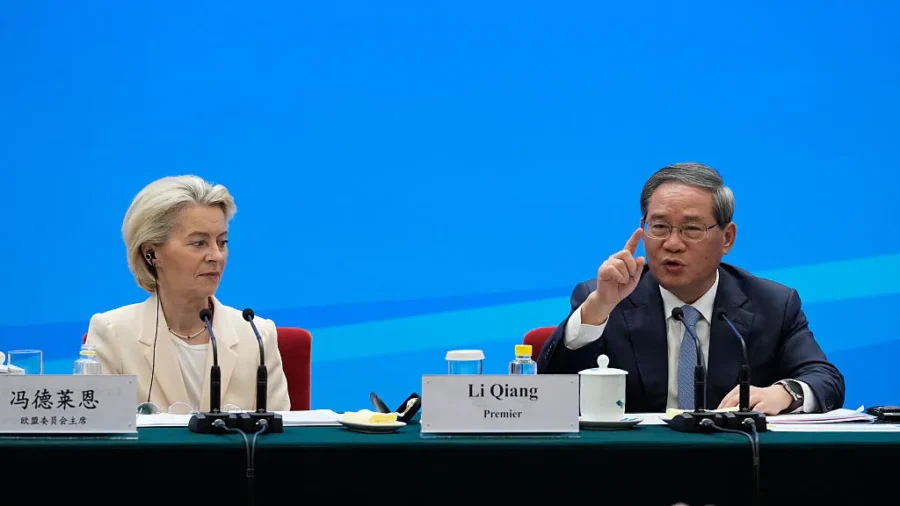
As all EU member states record a trade deficit with China for the first time, the EU warns that it is ready to activate trade defense measures.
She mentioned that Chinese companies receive subsidies that can be as much as eight times those received by similar enterprises in OECD member countries. Over the past five years, European imports from China grew by 45 percent, while EU exports to China declined.
Currently, Europe's trade deficit with China is close to €1 billion ($1.16 billion) per day, having increased by another 10 percent earlier this year.
This year marks the first time that all EU member states are running a trade deficit with China. Some estimates indicate that more than half of European industrial production now faces competition from China.
She said that besides price competition caused by the Chinese regime's subsidies, China controls critical links in European supply chains.
"Our dependence exceeds 80 percent for many critical raw materials, and 90 percent for certain rare earths. We have seen that these dependencies can be used as leverage. We must therefore ensure fair conditions," she said.
While painting a grim picture of the trade imbalance facing Europe, von der Leyen adopted a more cautious tone, still calling China "a major economic partner" for the EU.
"And our position is clear and consistent: reduce risks, not sever ties. But being a partner does not mean accepting permanent imbalances," she said.
The European Commission launched more than 30 trade defense investigations last year, nearly triple the historical average. Von der Leyen added that the measures already taken have protected over 600,000 European jobs, noting, "we are significantly accelerating these investigations."
However, this requires the support of a majority of EU member states.
France takes a far tougher stance on countering China's "overcapacity" and low-price dumping, serving as one of the driving forces behind the EU's push for high tariffs and anti-subsidy investigations.
More countries are also beginning to advocate for stronger trade protection.
On Thursday, the Scientific Council for Government Policy, which provides long-term policy advice to the Dutch government, submitted its research findings to the government, though the briefing covers the whole of Europe.
China's Ministry of Commerce and the European Commission officially launched tariff consultations regarding Chinese electric vehicles in June 2024.
Talks have stalled on and off over the past two years, with relations becoming increasingly tense and negotiations reaching a stalemate.