


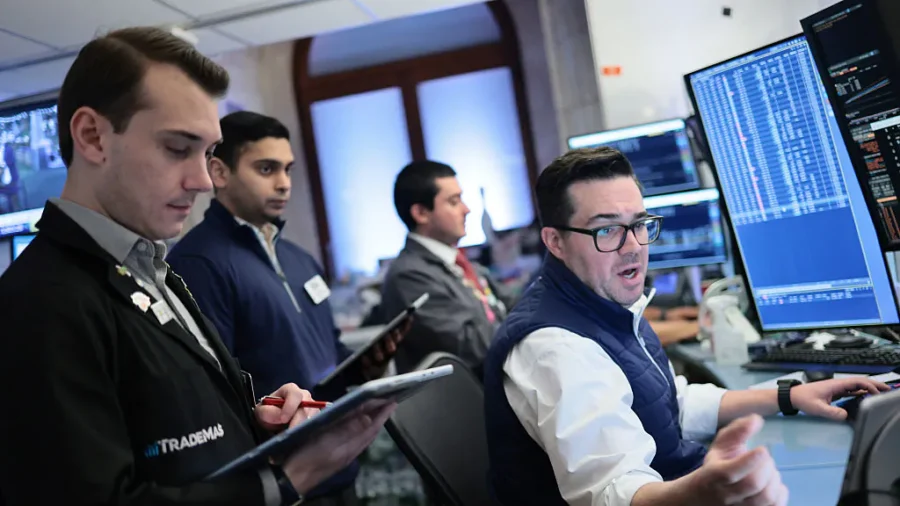
U.S. stocks staged a comeback during the final trading session of March amid the market’s worst quarterly performance since 2022.
The blue-chip Dow Jones Industrial Average surged by 900 points, or 2 percent. The index slumped by 4.7 percent in the first quarter.
The tech-driven Nasdaq Composite Index soared by almost 700 points, or more than 3 percent. The Nasdaq declined by around 8 percent in the January–March period.
The broader S&P 500 climbed by about 150 points, or 2.4 percent. The index tumbled close to 6 percent in the first three months of 2026.
Investors reacted to unconfirmed reports that Iranian President Masoud Pezeshkian said he was open to ending the war on the condition of guarantees.
“If for any reason a deal is not shortly reached, which it probably will be, and if the Hormuz Strait is not immediately ‘Open for Business,’ we will conclude our lovely ‘stay’ in Iran by blowing up and completely obliterating all of their Electric Generating Plants, Oil Wells, and Kharg Island (and possibly all desalinization plants!),” Trump wrote in a March 30 Truth Social post.
“The market does not like uncertainty, and there are a number of uncertainties right now,” Charles Ashley, portfolio manager at Catalyst Funds, said to The Epoch Times in a note.
Assets and War
A major factor in geopolitical strife has been the closure of the Strait of Hormuz, a global chokepoint for oil and gas shipments. While it typically handles about 20 million barrels of oil and petroleum products per day, traffic has essentially come to a standstill because of the conflict.Global energy prices have surged, lifting inflation expectations and sparking concerns about economic growth.
West Texas Intermediate—a benchmark for U.S. oil prices—rocketed 75 percent during the first quarter to $100 per barrel on the New York Mercantile Exchange.

Prior to the Iran war, inflationary pressures were intensifying, including the January and February Producer Price Indexes; wholesale inflation surged by 0.5 percent and 0.7 percent, respectively.
The government bond market has also been “screaming they cannot withstand higher rates,” Mahoney said.
Yields on U.S. Treasury securities traded relatively sideways in the first two months of the year but surged in March. The benchmark 10-year yield had reached as high as 4.44 percent before retreating to around 4.3 percent.
“This is really putting all the problems in front of us with higher inflation, higher rates, more problems with affordability,” Mahoney added.
Precious metals are typically viewed as safe-haven assets during geopolitical and economic uncertainties. However, gold and silver plummeted in March, falling by 8 percent and 9 percent, respectively.
They recovered during the final session of the month. Gold edged up by 3 percent to almost $4,700 per ounce, while silver spiked 6 percent to nearly $75 an ounce.
Metal commodities may have been hammered by a strengthening greenback.
Traders sought shelter in the chief international reserve currency during the war in Iran. Optimism that the U.S.–Iran conflict could be winding down may diminish its risk premium, with the index slipping to about 0.4 percent.
Cryptocurrencies extended their downturn from late last year.
Bitcoin declined by 23 percent in the first quarter to around $68,000, but it may have stabilized after sliding just 0.1 percent in March.
Moving forward, the environment on Wall Street may brighten, says Mahoney.
“We think good news should remain as good news if we can make it through this unscathed,” he said.
“We do believe if there is an off-ramp from this war and ships get moving through the Strait. Then the entire picture can shift.”