


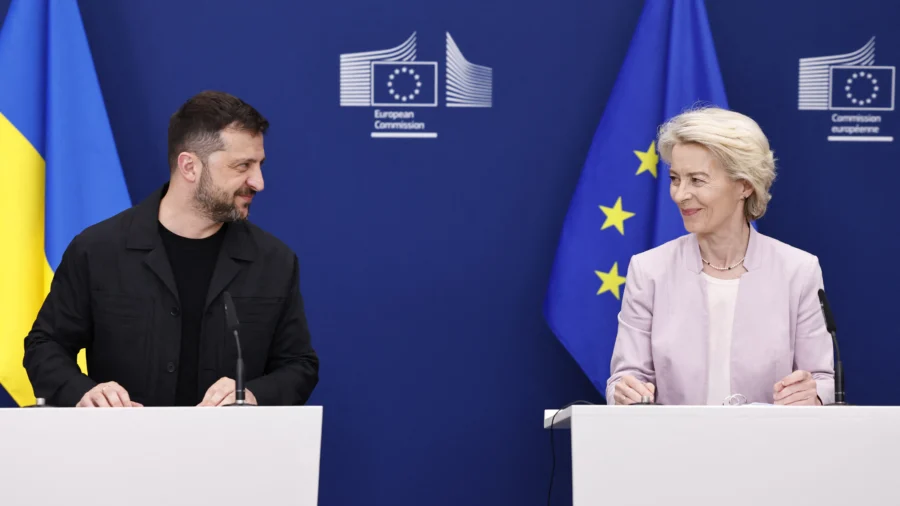
The European Union has agreed to formally open talks with Ukraine and Moldova on the first cluster of issues in the accession process, Ukrainian Prime Minister Yulia Svyrydenko said on Thursday.
"Fantastic news," she wrote on X. "We are one step closer to the EU membership: steadily moving towards our goal."
Moldova's President Maia Sandu also welcomed the news, saying that her government was committed to making the necessary reforms the EU requires of it.
All of the 27 member countries of the bloc voted for the talks to begin, taking the two eastern European nations, both former republics of the Soviet Union, a step closer to membership.
Cyprus, which currently holds the rotating presidency of the EU, said it has begun preparations to formally open negotiation on the first group of negotiating chapters, covering legal and democratic standards, with both countries.
"This marks a significant milestone in their European integration path, and sends a strong message of EU unity and determination," the Cyprus presidency account said on X.
10 Countries in Talks to Join
Joining the EU involves a years-long process run by its executive branch, the European Commission, which assesses 35 sets of criteria, including financial systems, transparency, agricultural regulations, and rights including freedom of speech and religion.Ten countries are currently in accession talks with the EC to join the union. According to the EU’s executive branch, the bloc could welcome new members within four years.
Other countries on the long path to joining are Albania, Bosnia and Herzegovina, Georgia, Kosovo, Montenegro, North Macedonia, Serbia, and Turkey.
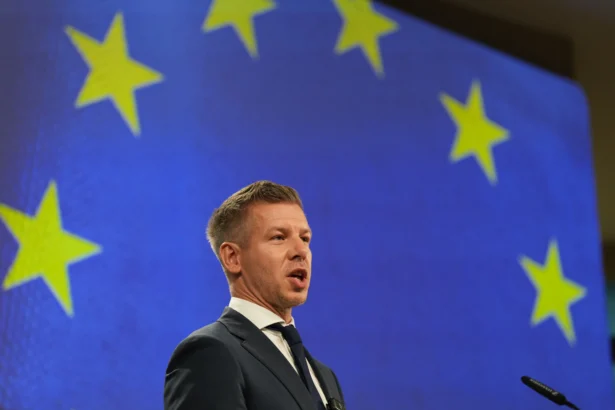
Magyar, who won a national election against his nationalist predecessor, Victor Orban, said on Tuesday that the two countries had reached an agreement on the rights of the 100,000-strong Hungarian minority in Ukraine.
The former prime minister, who often locked horns with Brussels on matters related to Ukraine and immigration, said the EU has “decided that Ukraine will be admitted to the Union as early as 2027.”
Politico reported in February that the EU was "hatching a plan" to give Ukraine partial membership in the bloc and was working on ways around Orban’s veto.
“Hungary’s position is crystal clear: if a country cannot even meet the basic standards, it is not ready for the EU,” he said in a Nov. 22 post on X.
Orban’s Fidesz party, which governed Hungary for 16 years, lost to Magyar’s center-right pro-EU Tisza party in the April election.
Ukraine formally applied for EU membership in 2022, four days after the Russia–Ukraine conflict escalated in February when Moscow launched an invasion, although it first expressed a desire to join the bloc in 1993, just two years after becoming independent following the break-up of the Soviet Union.
'Associate' Membership Proposal
German Chancellor Friedrich Merz recently proposed granting Ukraine associate EU membership, which he said could help facilitate a deal to end the war with Russia.Zeleneskyy rejected Mertz’s proposal as unfair, insisting that Ukraine needs full membership.
“There can be no complete European project without Ukraine, and Ukraine’s place in the European Union must also be complete — full and equal,” Zelenskyy said in a post on X.
Moldova Continuing 'Necessary Reforms'
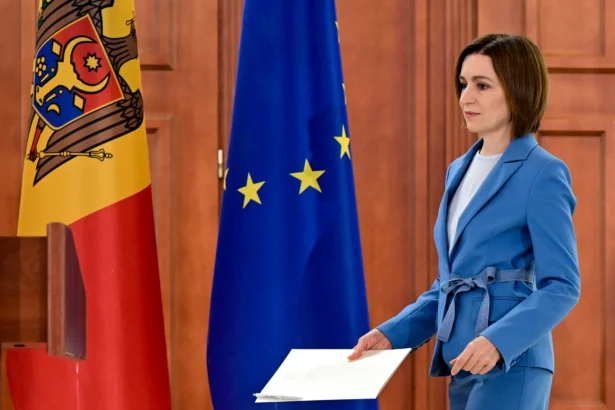
Sandu won a contentious Moldovan presidential race in 2024 beset by allegations of interference by Russia—a claim denied by Moscow.A former adviser for the World Bank, the pro-EU Sandu—who first took office in 2020—is a vociferous critic of Putin and a supporter of neighboring Ukraine.
Moldova has a significant minority Russian population, with the Kremlin’s influence on its affairs continuing after the breakup of the USSR.
Moldovans voted narrowly in favor of securing the country’s EU path in 2024, with the country beginning the formal application process just after Ukraine in March 2022.
Sandu said in a statement reported by local media Moldpres, "We have seen significant commitments for our country’s economy on behalf of private companies and development banks. For us, this is the best proof that the European path delivers results: investment, development, jobs."
"We are continuing the necessary reforms, including the difficult ones—the justice reform, which we will see through to the end, and now also the local public administration reform," her statement added. "We are consistent in our reform efforts and quite determined in the process of European integration."
Following the EC’s release of its latest annual enlargement report, Commission Vice-President Kaja Kallas said in a November 2025 statement: “Joining the EU remains a fair, tough, and merit-based process. But new countries joining the EU by 2030 is a realistic goal.”
“Expanding the EU is in our best interest,” Kallas said. "It’s a long-term investment in our security, economy, and global edge. Through enlargement Europe can grow its geopolitical power."