


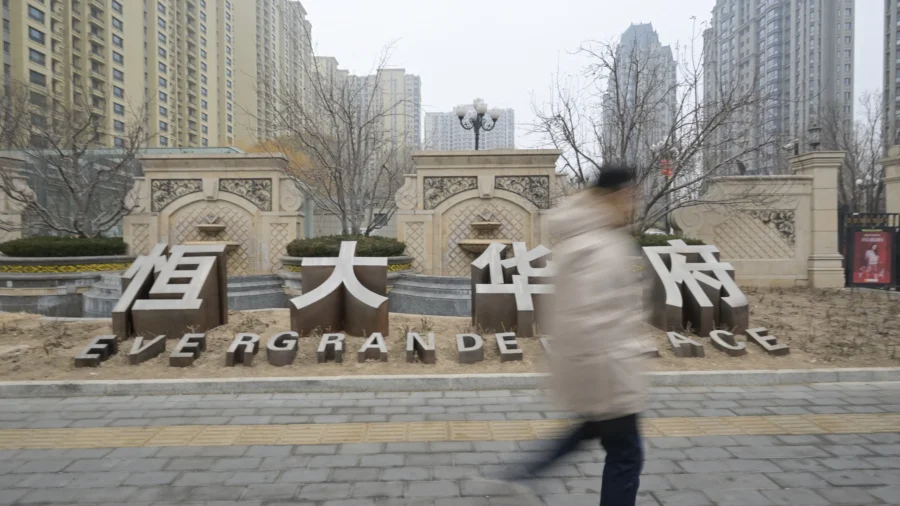
On Aug. 20, Xu Jiayin, founder of China Evergrande Group, was sentenced to life imprisonment for offenses including fraud and embezzlement. Evergrande Group and Evergrande Real Estate were fined a total of $2.21 billion.
However, Evergrande’s story is far from over.
Evergrande’s total liabilities stand at approximately $336 billion, consisting mainly of three parts: debts to suppliers, loans from financial institutions, and house payments from home buyers.
Under the Chinese system, buyers of new builds must pay down payments and sign mortgage contracts with banks before construction even begins.
Even if developers stall construction and leave properties unfinished "rotten-tail" buildings in China, the mortgage contracts signed between buyers and banks remain valid.
If buyers choose to stop paying their mortgages, they face risks such as lawsuits by banks, being placed on blacklists for dishonest debtors, and personal credit bankruptcy.
To date, Evergrande has left behind hundreds of thousands of housing units across over 100 cities. This impacts the housing rights and life savings of millions of families. Many buyers carry decades of mortgage obligations while facing the long-term dilemma of having no home to live in and frozen assets.
Seeing Xu end up with life imprisonment and his personal assets confiscated, the first reaction of most buyers on Weibo was that it was "satisfying" and "well-deserved."
However, their most core demand remains "ensuring housing delivery," hoping to get the homes that belong to them.
Topics such as "What should Evergrande unfinished property owners do" trended on Weibo, prompting widespread discussion among netizens. Because the scheduled delivery homes cannot be moved into, buyers have no choice but to continue renting outside. Paying thousands or even over 10,000 RMB ($1,400+) every month for mortgage and rent simultaneously has completely crushed the cash flow of many families.
One netizen posted: "For many ordinary people who spent their life savings to buy Evergrande's unfinished properties, their lives have long been sentenced to life imprisonment.
"After the debt crisis exploded, it was millions of ordinary citizens who had to foot the bill.
"The government sold the land and collected the money, and the banks issued loans without taking a loss. Only the common people spent real gold and silver to buy homes, got tied down with decades of mortgages, and ended up with no house."
U.S.-based economist Huang Dawei told the Chinese version of The Epoch Times that the $2.21 billion fine imposed on Evergrande Group and Evergrande Real Estate is not compensation for Evergrande home buyers, but will ultimately go into the state treasury.
He believes that Evergrande's actual losses have been borne jointly by home buyers, suppliers, and investors. These confiscated funds actually have nothing to do with home buyers, suppliers, or investors.
"The authorities' current verdict is more of a political gesture, but for investors and true victims, it carries virtually no special meaning," he said.
"When real estate was rising, the government squeezed down to the very last copper coin through land transfer fees, land transfer taxes, and layers of exploitation. When the real estate market bubble bursts, given the CCP's political model, the government will not absorb any of the losses."
He said that the CCP might occasionally use a few commercial banks to conduct asset restructurings, which in reality just waives debts, while the final victims will not receive reimbursement.
He indicated that according to the order of bankruptcy liquidation, general suppliers rank at the very bottom. Yet Evergrande owes suppliers over $148 billion, involving over 10,000 small and medium-sized enterprises. Many small construction teams and material suppliers suffered broken capital chains and went bankrupt directly because a single invoice could not be redeemed.