


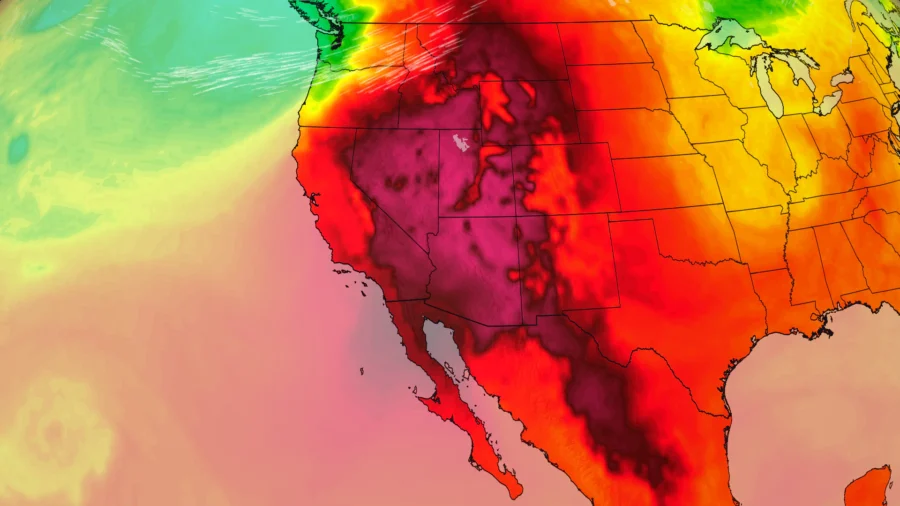
A dangerous, near-record heat wave will grip much of the Western United States through the weekend, pushing temperatures above 110 degrees and raising wildfire risks in several states.
Extreme or near-record temperatures are also forecast for the Great Basin, Desert Southwest, and Four Corners regions. Desert communities will face the hottest conditions, with little relief expected throughout the weekend.
Farther north, gusty winds and low humidity will increase the risk of wildfires. Critical fire weather conditions are expected on Saturday in parts of Montana, Idaho, Wyoming, Utah, Oregon, and Nevada, according to the National Weather Service Weather Prediction Center.

Forecasters warn the dangerous heat could also stretch beyond the weekend.
Parts of the West face an elevated risk of extreme heat on Aug. 7 and Aug. 8, with the threat expanding across much of the country through Aug. 13, according to the National Weather Service Climate Prediction Center.
Continued heat and dry conditions could also worsen wildfire risks in areas with active or recently contained fires.
These warnings follow months of intense heat and escalating wildfire activity across the West this summer. Fires spread rapidly in June and July as hot, dry, and windy conditions plagued Utah, Arizona, Colorado, and New Mexico, according to the National Oceanic and Atmospheric Administration (NOAA).
Nationwide, firefighters were battling 85 large fires as of Thursday, including nine new large fires reported over the previous days.
“A total of 27,038 firefighters and support personnel are engaged in nationwide fire activity, including 587 crews, 1,615 engines, and 200 helicopters,” the NIFC said.
Staying Safe in Extreme Heat
People in affected areas should remain in air-conditioned spaces when possible, drink plenty of water, and avoid strenuous activity during the hottest part of the day, according to NWS safety guidance.Anyone in the outdoors should drink water frequently and take regular breaks in the shade.
The agency also recommends staying in air-conditioned buildings overnight and checking on relatives and neighbors, especially those who live alone.
People without air conditioning should find a nearby cooling center or arrange to stay with family or friends who have reliable cooling.
Heat exhaustion can cause heavy sweating, weakness, dizziness, nausea, headache, or faintness. Anyone experiencing those symptoms should be moved to a cooler place, covered with cool, wet cloths, and offered small sips of water.
NWS urges people to seek medical care if the person vomits, symptoms worsen, or the illness continues for more than an hour.
Heat stroke causes confusion, slurred speech, or loss of consciousness. A body temperature above 103 degrees can signal heat stroke—a life-threatening emergency.
Call 911 immediately and cool the person with wet cloths or a cool bath while waiting for help.
Children, people with disabilities, and pets should never be left in parked vehicles, even for a moment or with the windows open. A child trapped in a hot vehicle can die within minutes, the NWS said.