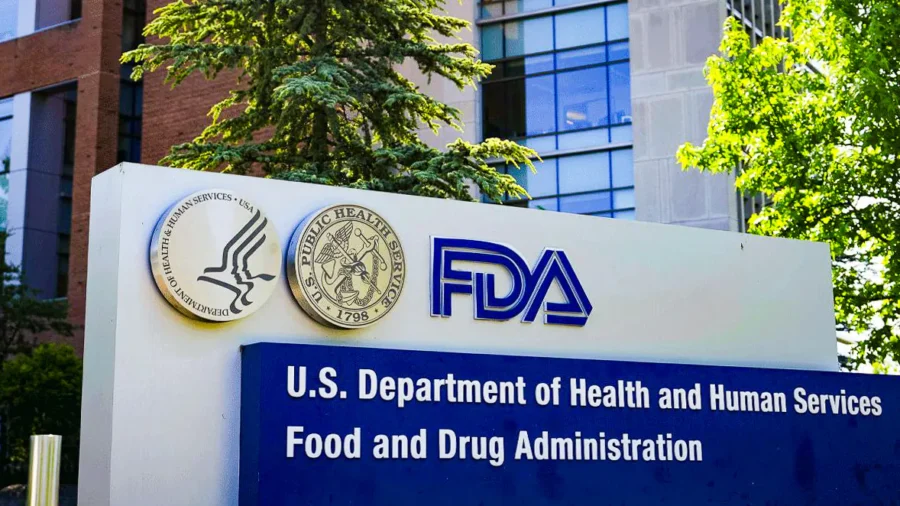
The Food and Drug Administration announced on July 21 that a former pharmaceutical executive will direct its drug evaluation center.
Dr. George Tidmarsh, an adjunct professor at Stanford University, will lead the FDA’s Center for Drug Evaluation and Research (CDER), the FDA
said in a statement.
Tidmarsh was president and CEO of La Jolla Pharmaceutical Company from early 2012 until late 2019, during which time the company secured FDA approval of a hormone called angiotensin II for patients suffering from shock. He also founded and served as CEO of Horizon Pharma Inc., helping to shepherd a drug for rheumatoid arthritis through the FDA approval process.
He also held senior positions at multiple other pharmaceutical firms, according to
his biography on Stanford University’s website.
In all, Tidmarsh helped develop seven drugs that were later approved by the FDA, according to the agency.
“Dr. Tidmarsh is an accomplished physician-scientist and leader whose experience spans the full arc of drug development—from bench to bedside,” Dr. Marty Makary, the FDA’s commissioner, said in a statement.
“His appointment to lead CDER brings exceptional scientific, regulatory, and operational expertise to the agency. I look forward to working with him to strengthen our drug review programs, foster innovation, and advance cross-agency initiatives that improve health outcomes for the American public.”
Tidmarsh did not respond to a request for comment by the time of publication.
Makary was nominated by President Donald Trump and required confirmation from the Senate. However, the directors of various FDA centers do not require Senate confirmation.
Makary previously
tapped Dr. Vinay Prasad to direct the FDA’s Center for Biologics Evaluation and Research, which handles vaccines and other biological products, after the center’s director, Dr. Peter Marks, resigned, citing disagreements with Health Secretary Robert F. Kennedy Jr.
Dr. Patrizia Cavazzoni, who was director of CDER, resigned after seven years in office, just before Trump took office.
Dr. Jacqueline Corrigan-Curay has been CDER’s acting director.
Tidmarsh’s Views on FDA
Tidmarsh has not yet reacted to the development, but he has offered views in the past on how the FDA should be run.Tidmarsh
wrote on LinkedIn after Trump was elected to a second term that “the new FDA needs to remove harmful, useless drugs from the market.” He singled out desiccated thyroid extract, which he described as “an unapproved, crude pig tissue extract that is proven worse than synthetic thyroid hormone and harmful.”
Tidmarsh
said in a recent podcast appearance that he met Makary in 2024 at a panel discussion at Stanford University and that he supported the push by Makary to review substances approved by the FDA decades ago, such as talc.
“Think of how much science and data have changed since the 1980s,” he said.
In the panel discussion, Tidmarsh criticized how the FDA deals with speech from drug manufacturers that goes beyond labels for drugs, citing
a report from journalist Lee Fang.
“This discrepancy shows that FDA may apply free speech regulation at a whim and inconsistently,”
said Tidmarsh, who was serving as the panel’s moderator. He offered a similar view in a blog post,
writing that in recent years there has been an “uneven application of basic clinical trial data interpretation” that “calls into question the impartiality and credibility of the FDA.”
CDER’s Past and Future
CDER has about 5,000 workers and an annual budget of $1 billion. CDER oversees drugs, including ensuring labels are up-to-date.
It’s the division that approved OxyContin and other opioids, approvals that researchers
say did not meet standards outlined in federal law. Makary
said in a recent viewpoint that the FDA’s approval of OxyContin for chronic pain was “illegal” and “one of the worst self-inflicted wounds of U.S. health care.
An FDA spokesperson declined to say whether the FDA would be taking any action concerning opioids.
The number of opioid overdose deaths in the United States
skyrocketed from the thousands in 1999 to 81,806 in 2022, according to the National Institute of Drug Abuse, and officials have termed the issue a crisis.
The Center for Drug Evaluation and Research also approved the abortion drug mifepristone in 2000, a drug Kennedy has
directed officials to investigate.