


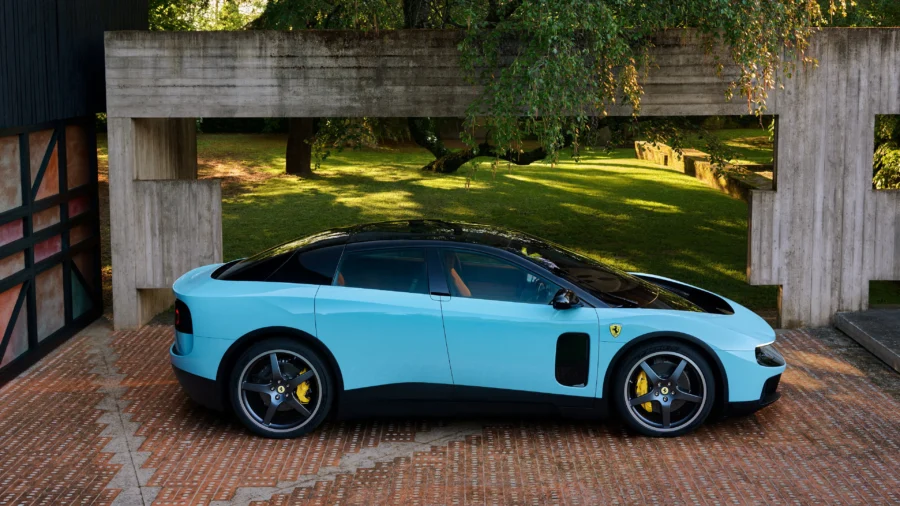
Ferrari, a brand long synonymous with roaring red race cars, has unveiled its first fully electric vehicle—and not everyone is impressed.
The Italian carmaker introduced the Luce, which means “light” in Italian, on May 25 at a launch event in Rome. Ferrari described the name as one that “evokes clarity and direction.”
Designed with input from former Apple design chief Jony Ive and Australian industrial designer Marc Newson, the Luce comes in three colors: light blue, yellow, and the iconic “Ferrari red.” The car is priced at 550,000 euros, or about $640,000.
The four-door, five-seat EV is a sharp departure from the two-door, two-seat combustion-engine sports cars traditionally associated with Ferrari. Its upper body is dominated by glass, while the aluminum exterior and minimalist interior emphasize rounded corners, another break from Ferrari’s long-established aggressive design language.
Without a combustion engine to produce Ferrari’s signature roar, the Luce uses what the company calls an “external amplification system” that projects a sound of a roaring Ferrari engine, either inside the cabin or outward onto the street.
The six-figure price tag also places the Luce far above the typical price range for European EVs. The Tesla Model Y, Europe’s best-selling electric vehicle, for example, generally sells for a fraction of the Luce’s price.
Reaction online was similarly divided. While some technology and design fans praised the minimalist approach by Ive and Newson, others quickly flooded social media with memes and jokes roasting the Luce’s appearance.
Some users on X compared it to the Nissan Leaf, a much cheaper EV with a somewhat similar blue-and-black color scheme. Others turned to AI tools such as ChatGPT and Grok to generate images of what they thought a Ferrari EV should have looked like: more aerodynamic, more stylish, and lower to the ground.
Speaking on a Cleo Abram podcast aired on May 25, Newson said he expected criticism, arguing that the current cultural mood is highly nostalgic.
“Critics are part of the process when you want to innovate,” Newson said. “It’s normal, especially in an era where the nostalgic approach is very high.”
“Everybody is looking at the past, not at the future, which makes our jobs as designers very difficult,” he added.
Ferrari is not the first luxury automaker to move into electric vehicles. Porsche unveiled a fully electric concept car in 2015 and brought it to market four years later as the Taycan. Rolls-Royce created an experimental electric concept as early as 2011, though it did not unveil its first production EV, the Spectre, until 2022. Cadillac introduced the Lyriq, a battery-electric midsize luxury crossover, in 2020.
But Ferrari’s entry comes at a moment when some of the biggest automakers have scaled back, delayed, or canceled their EV programs because of weaker-than-expected demand.
General Motors, for example, announced in October 2025 that it would cut shifts producing the Cadillac Lyriq and end production of its BrightDrop electric vans. Ford stopped production of the F-150 Lightning pickup in December 2025, citing lower-than-expected sales.
In March, Volvo discontinued the EX30 in the United States, just two years after the SUV’s debut there. Honda also said it was canceling three EVs it had planned to manufacture in the United States: the 0 Series SUV, the 0 Series Saloon, and the electric version of the Acura RSX.
The pullback has extended into the higher end of the market as well. Lamborghini scrapped plans for its first EV, the Lanzador, because of weak demand. Porsche’s flagship K1 SUV, initially planned as a fully electric vehicle, is now expected to launch with gas and plug-in hybrid options instead.
McLaren, Ferrari’s long-standing Formula One rival, has said it’s not interested in going electric, at least for now.
In an interview published in April by British magazine Autocar, McLaren CEO Nick Collins said the company would launch an electric car only “when our customers want one,” and that “the market doesn’t want one yet.”