


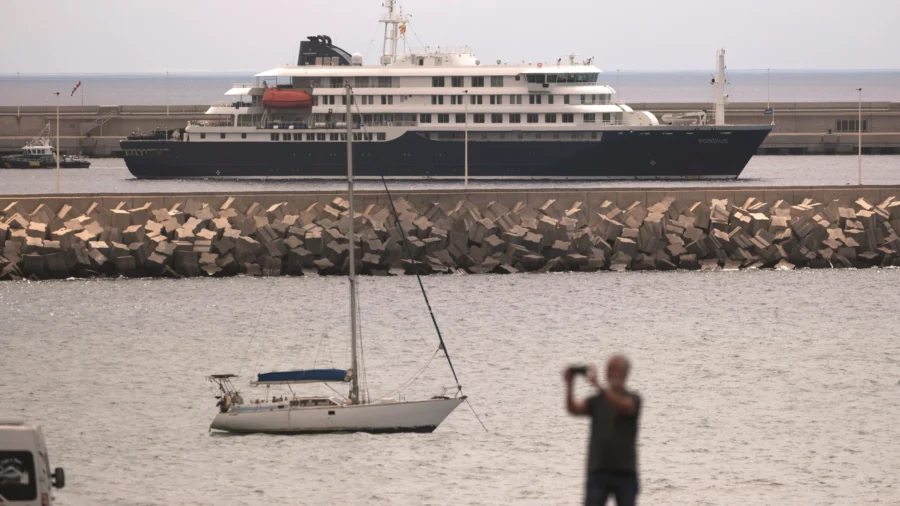
A French woman sickened in a hantavirus outbreak linked to a cruise ship is fighting for her life at a Paris hospital, where doctors have placed her on a life-support machine that breathes for her while her lungs and heart struggle to recover.
The woman is one of 11 total reported cases tied to the MV Hondius—nine of which have been confirmed—in the first hantavirus outbreak ever recorded on a cruise ship.
Dr. Xavier Lescure, an infectious disease specialist at Bichat Hospital in Paris, said the patient has developed severe lung and heart complications from the disease. The life-support device the patient is currently on pumps blood through an artificial lung, providing it with oxygen and returning it to the body. It is hoped that the device relieves enough pressure on the lungs and heart to give them some time to recover.
3 Confirmed Outbreak-Related Deaths
Three people have died in the outbreak, including a Dutch couple that the World Health Organization believes was the first to be exposed to the virus. Argentine officials have said the pair, who had spent several months traveling in Argentina and neighboring South American countries before boarding the ship, may have encountered infected rodents during a bird-watching trip that included a stop at a garbage dump.
Argentina's health ministry said on Tuesday that it is sending a team of scientific experts to investigate the landfill and other locations the couple visited, though local officials in the province where the cruise departed have disputed that theory.The latest confirmed case is a Spanish passenger who tested positive after being evacuated from the ship and is currently under quarantine at a military hospital in Madrid, according to Spain's health ministry.
WHO Director-General Tedros Adhanom Ghebreyesus says there shouldn’t be fears of a broader spread at this time. "At the moment, there is no sign that we are seeing the start of a larger outbreak," he said.
Evacuation of All Passengers Complete
The MV Hondius completed the evacuation of all passengers and most of its crew Monday night at Tenerife, with personnel in full-body protective suits and breathing masks escorting 87 passengers and 35 crew members ashore.Two flights carrying Dutch nationals, passengers from Australia and New Zealand, and Filipino crew members landed overnight in Eindhoven, where all were placed into quarantine, according to the Dutch government. The ship is now sailing back to Rotterdam, where it will be cleaned and disinfected, according to ship operator Oceanwide Expeditions.
3 Seattle & King County Residents Potentially Exposed
Closer to home, the public health department of Seattle & King County announced on Tuesday that three county residents were potentially exposed to the Andes strain of hantavirus connected to the Hondius outbreak, according to a county press release.Two of them were seated near a sick cruise passenger on an airplane—the passenger was removed before takeoff and later tested positive. A third King County resident was aboard the ship itself and is currently being monitored at the national quarantine center at the University of Nebraska Medical Center. All three are asymptomatic, the county said.
"I know the current news about hantavirus may be scary," said Dr. Sandra J. Valenciano, health officer and acting director for Public Health Seattle & King County. "Even though these individuals do not show signs of illness, we have strong contact tracing and monitoring in place. The risk of this virus spreading to residents of King County is low at this time."
Hantavirus typically spreads through contact with rodent droppings, urine, or saliva and is not easily passed between people. However, the Andes strain detected in this outbreak is the only known type of hantavirus capable of person-to-person transmission—though that form of spread is rare and typically requires prolonged, close contact with someone who is acutely ill, according to King County Public Health. There is currently no cure or vaccine for hantavirus, though the WHO says early detection and treatment can improve survival odds.