

FTC Targets Deceptive ‘Made in USA’ Claims, Issues Warnings to Companies

The FTC has issued a series of warning letters to companies accused of falsely advertising goods as 'Made in USA.'
Published: 7/11/2025, 11:00:34 PM EDT
FTC Targets Deceptive ‘Made in USA’ Claims, Issues Warnings to Companies
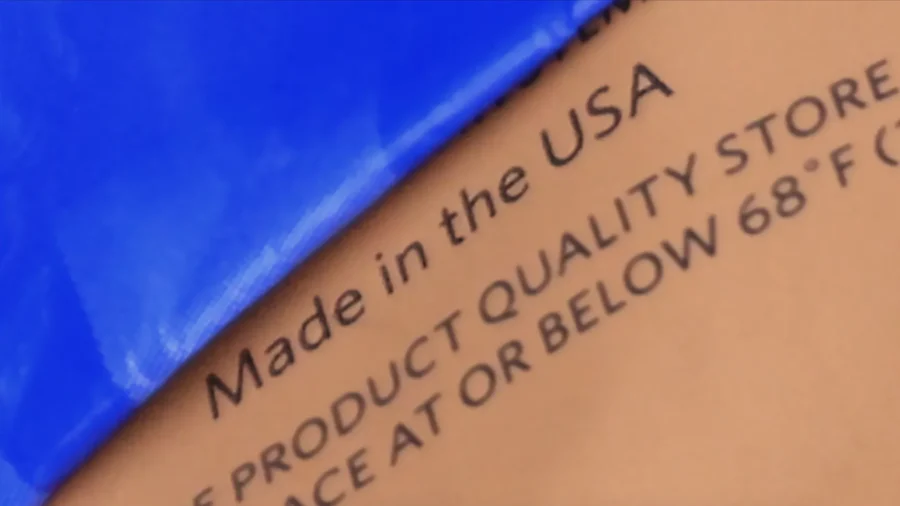
"Made in the USA" label on the packaging of a food product on July 11, 2025. (Cynthia Cai/NTD)
As consumer demand for American-made products grows, the Federal Trade Commission (FTC) has issued a series of warning letters to companies accused of falsely advertising goods as “Made in USA.” This past week, the agency notified four manufacturers, along with Amazon and Walmart, over potentially misleading claims made by third-party sellers on their platforms.

The move is part of the FTC’s enforcement push during July’s “Made in the USA” month, which is aimed at ensuring that products marketed with U.S.origin labels are genuinely made in the United States. There's also a broader wave of consumer lawsuits targeting misleading origin labels, as well as increasing national security concerns.

“‘Made in the USA’ is not just a slogan—it’s a sign that a product connects us to the workers and businesses that make America great,” said FTC Chairman Andrew N. Ferguson in a press release.

“Consumers want to have confidence that when they buy something labelled ‘Made in the USA’ they are actually supporting American workers and the American economy. Companies that falsely claim their products are ‘Made in the USA’ can expect to hear from the FTC,” he said.

FTC Issues Warnings

The FTC has sent warning letters to Americana Liberty (a flagpole retailer), Oak Street Manufacturing, LLC (a footwear maker), Pro Sports Group LLC (a football equipment supplier), and USA Big Mountain Paper Inc. (a personal care company). The agency expressed concern that some of these companies’ products may be fully imported or contain substantial foreign content, casting doubt on the legitimacy of their Made in USA claims.

The letters reminded companies that “Made in USA” claims must meet the “all or virtually all” federal standard, meaning that nearly every component and step of production must take place in the United States.

Each company was given five days to respond with substantiating evidence. Failure to do so could result in violations of Section 5 of the FTC Act and the Made in USA Labeling Rule, and could trigger legal action such as subpoenas, federal lawsuits, permanent injunctions, and civil penalties of up to $53,088 per violation.

Amazon and Walmart were also cautioned about third-party sellers using their platforms to advertise products as “Made in USA” when they potentially aren’t, which would violate both federal regulations and the companies’ own seller policies.

Legal Issues, National Security Concerns

The FTC’s enforcement actions also come amid a broader wave of consumer lawsuits targeting misleading origin labels.
According to Top Class Actions, companies such as Paul Mitchell, Mielle Organics, Goya Foods, Pure Leaf (PepsiCo), McCormick, and Reynolds Wrap are all facing legal challenges for allegedly misrepresenting products as American-made while using significant foreign-sourced ingredients or components. Plaintiffs argue these claims mislead consumers under the pretense of domestic manufacturing.
In what the FTC called the largest ever Made in USA case, Williams-Sonoma was ordered to pay a $3.17 million civil penalty in 2024 for violating the FTC Made in USA Order.

“Williams-Sonoma claimed its products were made in the United States even though they were made in China,” said former FTC Chair Lina M. Khan at the time. “Williams-Sonoma’s deception misled consumers and harmed honest American businesses. Today’s record-setting civil penalty makes clear that firms committing Made-in-USA fraud will not get a free pass.”

Beyond consumer deception, national security concerns are intensifying. On July 10, Congressman Pat Harrigan (R-N.C.) called for a criminal investigation into GNC, which is owned by China’s state-run Harbin Pharmaceutical Group and operates 85 stores on U.S. military bases.
“Not only is @GNCLiveWell owned by the Chinese Communist Party, they’ve been selling ‘Made in America’ supplements made with Chinese ingredients on U.S. military bases,” Harrigan posted on July 10 on X. “Our troops risk everything for this country—the least we can do is keep the CCP out!”
In a press release, Harrigan cited findings from Exiger, a firm specializing in financial crime and national security risk. The firm reported that GNC imported more than 100 million pounds of ingredients from China while continuing to advertise that 96 percent of its products are made in the United States.
“This never should’ve been allowed,” stated Congressman Harrigan. “A company controlled by the Chinese Communist Party, with a track record of fraud, a compromised network, and access to our troops’ personal data, is operating inside American military bases. These aren’t just red flags, this is a five-alarm fire—and I will not stand by while it burns.”

The company also allegedly used a manufacturer that falsified thousands of customs declarations to evade U.S. tariffs, suffered a data breach by the Clop ransomware gang in 2023, and remains vulnerable with hundreds of unresolved cybersecurity flaws. Exiger also noted that, under Chinese law, GNC is obligated to provide data to the Chinese Communist Party upon request.

In response, Harrigan introduced the Military Installation Retail Security Act, a bill that would ban companies controlled by China, Russia, Iran, or North Korea from operating on U.S. military installations.

“The bill was prompted by GNC’s continued access to military installations despite being fully owned by China’s state-run Harbin Pharmaceutical Group,” Harrigan stated.

As of publication, the four companies that received FTC warning letters have not responded to NTD's requests for comment.