

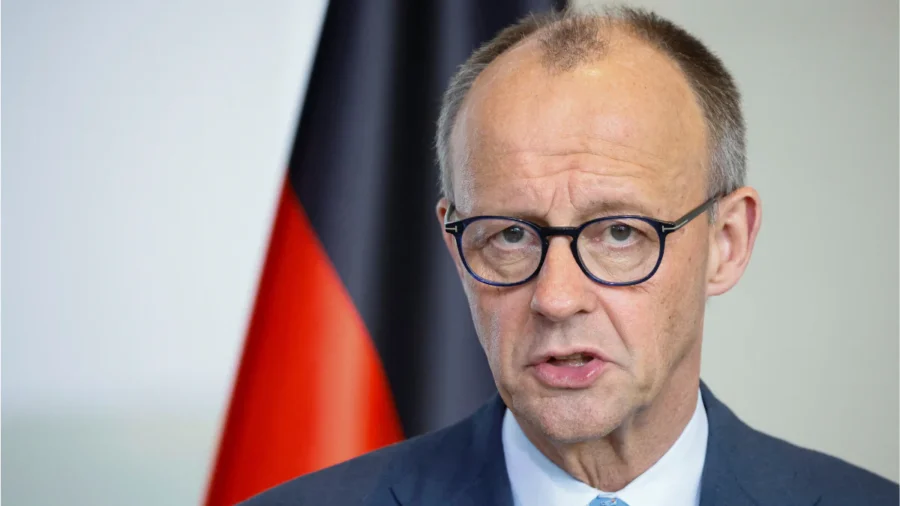
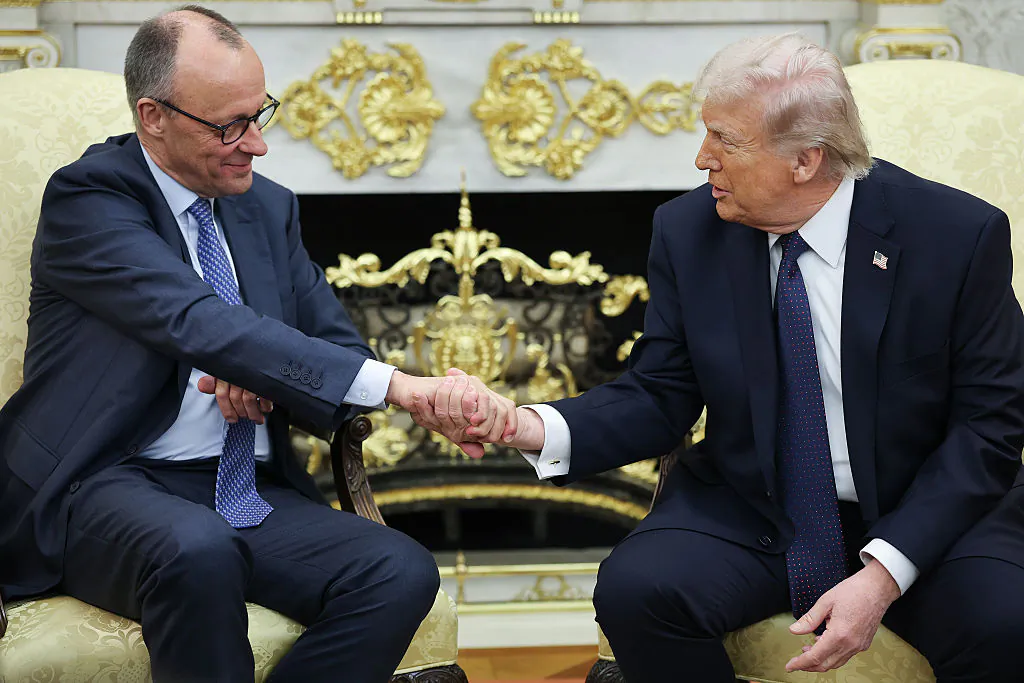
German Chancellor Friedrich Merz on April 29 said that he is on good terms with U.S. President Donald Trump, despite Merz’s recent remarks about the Iran war and Trump’s criticism of the German chancellor.
“From my perspective, my personal relationship with the U.S. President remains good,” Merz told reporters. “I simply had doubts from the start about what was begun with the war in Iran. That is why I have made that clear.”
On April 27, the German chancellor said that the United States had been “humiliated” by Tehran after U.S. officials agreed to travel to Pakistan for peace talks.
“The Iranians are obviously very skilled at negotiating, or rather, very skilful at not negotiating, letting the Americans travel to Islamabad and then leave again without any result,” Merz said during a talk to students in Marsberg, Germany.
“An entire nation is being humiliated by the Iranian leadership, especially by these so-called Revolutionary Guards. And so I hope that this ends as quickly as possible,” he added.
The U.S. president also criticized Merz in a Truth Social post on April 28, saying that the German chancellor “thinks it’s OK for Iran to have a Nuclear Weapon.”
“He doesn’t know what he’s talking about! If Iran had a Nuclear Weapon, the whole World would be held hostage. I am doing something with Iran, right now, that other Nations, or Presidents, should have done long ago. No wonder Germany is doing so poorly, both Economically, and otherwise!”
Merz has said that Iran must not have a nuclear weapon.
Germany’s Economic Concerns
The German chancellor also on April 29 articulated his worries over the economic impact of the Iran war.“In Germany and Europe we are suffering from the consequences, such as the closure of the Strait of Hormuz,” said Merz.
“This has a direct impact on our energy supply and a huge impact on our economic performance,” he said, adding that Berlin and Washington were in communication with each other.
Germany ‘Stepping Up’
Trump has criticized NATO allies for not sending naval support to help open the Strait of Hormuz, which carries the traffic of about a fifth of the world’s oil. The strategic waterways has remained virtually shut since early March, causing disruption to energy supplies and market insecurity.Since then, the Department of War (DOW) said that it was working closely with European allies, notably Berlin, to get NATO allies to step up with their defense strategies and responsibilities.
In a series of posts on X, Under Secretary of War Elbridge Colby said that Germany was now “taking a leading role” in this.
“After years of disarmament, Berlin is stepping up,” Colby said. “The DOW is already working closely with European allies, especially Germany, to accelerate this transition to NATO 3.0.”
Colby cited Germany’s new military strategy document, quoting General Carsten Breuer, who wrote in the document’s foreword: “The Military Strategy reflects the idea that, as the largest economy in Europe … Germany must and will assume a leading role within NATO—also at the military level.
“It represents a paradigm shift and underpins our ambition to play an active and substantial role.”
The strategy also says that Germany will take on “additional burdens,” including “targeted strategic responsibility for Europe at the conventional level.”
“This increases Germany’s strategic weight for our Allies, particularly for the United States.”