

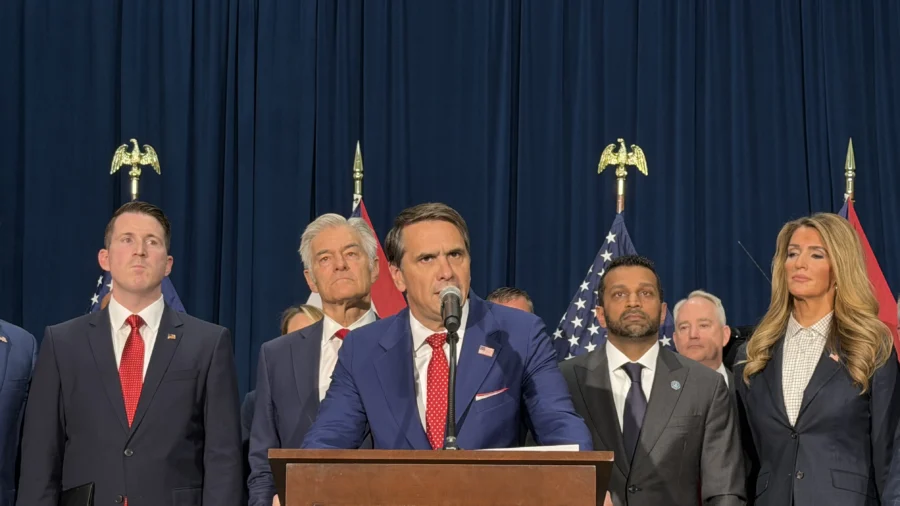
COLUMBUS, Ohio—The Department of Justice (DOJ), along with state and other federal officials, announced new charges on June 4 against nine defendants accused of more than $42 million in fraud, highlighting Ohio’s efforts to partner with federal authorities and clamp down on fraud.
Acting U.S. Attorney General Todd Blanche, FBI Director Kash Patel, and others discussed the cases and outlined steps they are taking to not only hold fraudsters accountable but also prevent fraud in the first place.
Vehicles from the Ohio State Highway Patrol and FBI served as a backdrop, along with U.S. and Ohio flags and signage reading, “Fighting Fraudsters/Justice for You.”
“Ohio is leading the charge in the fight against fraud, and some states should take notice,” Blanche said.
“Working closely with Ohio officials, the Department of Justice dismantled a sophisticated Medicaid fraud scheme that exploited taxpayers to fund exotic cars and lavish lifestyles. By holding these fraudsters accountable and partnering with the FBI on a robust Most Wanted fraudster list, we are pursuing fraud more aggressively than ever. No fraud scheme is beyond our reach.”
In response to a question from The Epoch Times, Blanche said prosecutors are working hard to seize assets and money from fraudsters.
“We're getting cars,” he said. “We're getting jewelry. We're getting homes. We're getting cash, but we're catching it at the end. Obviously, money is spent along the way; we're not going to be able to recover everything … [but] it is a priority to, when we go after somebody, to make sure we do everything we can to get their ill-gotten gains.”
Authorities are working hard to “not only arrest the bad guy, but also to get every single dime that they made off of this,” Blanche said.
“We have to create a disincentive that should not be worth it for them,” he said. Before the recent enforcement crackdown, he said, the moneymaking potential for scammers was “unlimited.”
President Donald Trump created the DOJ’s National Fraud Enforcement Division in January to “combat the rampant and pervasive problem of fraud in the United States.”
The division is targeting federal criminal and civil laws broken in connection with federal government programs and federally funded benefits. That unit is also setting national enforcement priorities and proposing legislative action and regulatory reforms.
Assistant Attorney General Colin McDonald, who leads the division, said: “The war against fraud has come to Ohio—and we plan to leave no doubt as to who will win.”
Ohio Attorney General David Yost said the Trump administration has supported that effort more than any he has worked with during his nearly 16 years of fighting fraud in the Buckeye State.
“Through my eight years as auditor of state, and almost eight years now as attorney general … I have never had the level of interest and support from the federal government under any administration that you’re witnessing here today,” he said.
Andrew Ferguson, Federal Trade Commission chairman, said that Ohio's Medicaid Fraud Control Unit, attached to Yost’s office, “is one of the ‘gold standard’ control units for fighting fraud in the United States, and that is a credit to his leadership.” Ferguson also helps Vice President JD Vance lead Trump’s anti-fraud task force.
Just before the news conference, Ohio Secretary of State Frank LaRose signed a data-sharing agreement that gives the DOJ National Fraud Enforcement Division “access to corporate registrant data held by the state of Ohio,” McDonald said. The division will analyze that data “to quickly identify ownership links between clinics, labs, and billing entities that fraudsters use and hide behind,” he said.
Dr. Mehmet Oz, administrator of the Centers for Medicare and Medicaid Services, said information-sharing is key to stopping scams. His agency has asked all 50 states to revalidate autism therapy providers “and other high-risk categories” of Medicaid programs.
“Every single state has agreed by this Friday … to provide us with a specific plan,” he said.
In addition, Small Business Administrator Kelly Loeffler announced nationwide prosecutions in the COVID-19 pandemic Paycheck Protection Program, which she called “one of the most defrauded federal programs in American history.”
“Our agency delivered $1.2 trillion that was meant for small businesses, of which the Office of Inspector General deemed $200 billion was stolen, including right here in Ohio,” Loeffler said.
Her agency suspended loans for 140,000 borrowers from California, Minnesota, and Maine, totaling $9 billion. She also said action was taken against 27,000 Ohio borrowers who were tied to $1.1 billion in alleged Paycheck Protection Program fraud.
In just the past month, the agency referred 560,000 borrowers to the DOJ and Treasury to start collections and prosecutions for $22 billion in alleged schemes against that program.
Federal officials encouraged Ohioans and citizens in other states to contact state or federal officials if they see signs of possible fraud.
The state of Ohio has used an online fraud reporting system for more than a decade, which allows people to report potential fraud anonymously.
“The truth is, we need all hands on deck in every state,” McDonald said. “The National Fraud Task Force, the Department of Justice, and the Fraud Division will work collaboratively with anyone who is committed to ending fraud in America and saving the taxpayers’ money.”
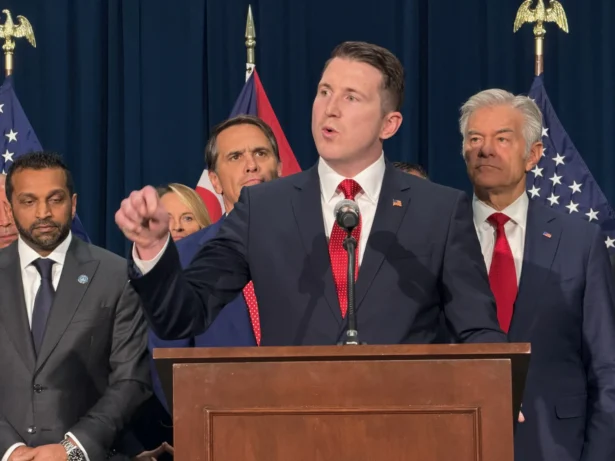
On June 1, the division announced criminal charges against 15 defendants in Minnesota for fraud schemes that targeted more than $90 million in taxpayer dollars.
“The fraud here in Minnesota is shocking,” McDonald said at the time he announced the charges. “Our cases today involve seven different state-managed Medicaid programs that have been systematically pilfered by fraudsters who treated Minnesota-run programs as their personal piggy bank.”
The same day as the Ohio news conference, the DOJ released a report showing that in a three-week span, the National Fraud Enforcement Division’s Health Care Fraud Unit has secured six federal jury trial convictions in cases totaling $1.1 billion in fraudulent funding.
“What sets the Fraud Division apart is not only our ability to proactively detect, investigate and dismantle fraud schemes before they cause further harm, but the depth and skill of the trial lawyers who carry those cases across the finish line," McDonald said in a statement.
“The American people should rest assured that we are prepared to seek accountability at trial for health care fraudsters, whether for a $1 million fraud in Michigan or a $1 billion fraud in South Florida.”