


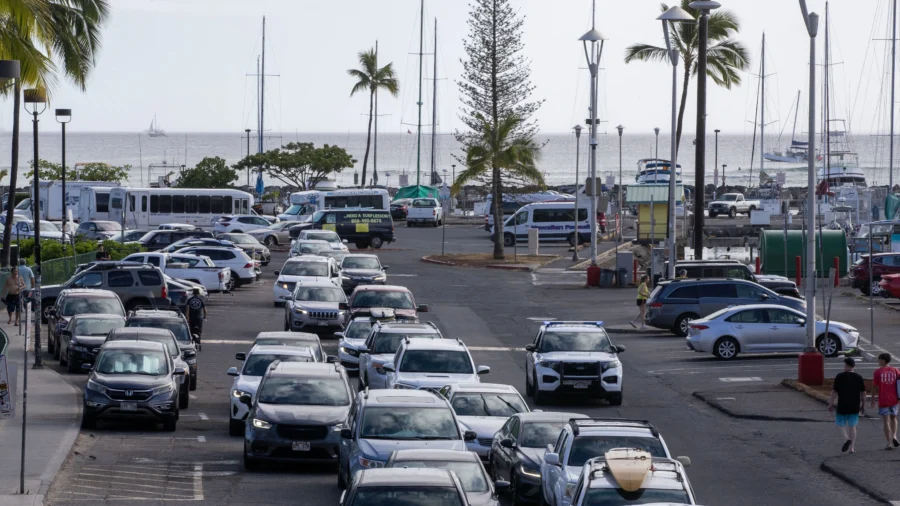
Tsunami waves started arriving in Hawaii after 6:30 p.m. local time on Tuesday night after a 8.8 magnitude earthquake six hours earlier off eastern Russia.
The biggest waves of 4 feet were recorded in Haleiwa on Oahu’s northwest shores and Kahului Beach on Maui island.
Live webcams on the islands of Kauai and Oahu, home to the capital city of Honolulu, showed parts of Hawaii’s coastline with receding sea levels as the tsunami approached.
Ahead of the impact, Gov. Josh Green told residents that the tsunami was expected to hit all of Hawaii’s islands just after 7 p.m. local time on July 29.
“I wanted to remind people, this is not just like a wave that comes off the shore ... a 3-foot wave [that] smacks down on the beach. This is a longitudinal wave with great force, driving through the shoreline and into land. That's why we ask people to evacuate very far back.”
According to records, this is the highest tsunami observation in open water ever recorded in the Northern Pacific at Midway Atoll.
“You can expect a tsunami wave to hit the state, and it will not just hit one beach,” Green said at a 5 p.m. press conference ahead of impact. "It will wrap around the islands very likely, therefore causing a wave in Hilo … and Hawaii and on Maui. You have to be safe.”
“The impact is at great speed,” he explained. “Any structure that gets loose and strikes an individual could take them out, and people could drop quite easily with the force of that kind of wave. So again, people have to really distinguish the waves we are accustomed to on the coast every day versus a tsunami. It's a different beast altogether.”
Authorities also said that it could be up to half an hour from first contact for all of the other islands to feel the effect.
They urged all Hawaiian residents and visitors to remain in their safe space until the all clear was officially given.
As of 6 p.m., multiple sirens had already gone off around the archipelago as people fled to higher ground. Green told those in high-rise buildings to evacuate vertically to at least the fourth floor.
Hawaii’s state government is in communication with all levels of government from local to federal as the wave approaches. All sea ports have been closed and all ships were ordered away from land by the Coast Guard.
Meanwhile, federal and state resources are being staged to deploy, and shelters are opening across the state.
"We were immediately in contact with our congressional delegation,” Green said. "We also are prepared to continuously have our [emergency operations centers] activated on all of the islands. The mayors are in charge. We've been in constant communication with them as well. So everyone is prepared. Everyone is ready for what may come, but there is always some uncertainty about the size of the wave.”
Authorities also confirmed that the Federal Emergency Management Agency was preparing to assist Hawaii with any damage.
Hawaii has been in this situation before, according to Green. He referred to a tsunami that hit his state in March 2011 after a 9.0 earthquake was registered in Japan. The tsunami was 7 feet high and hit Maui, causing $7.5 million in damage but resulted in no casualties because, as he said, “we were thoughtful and smart and calm.”