


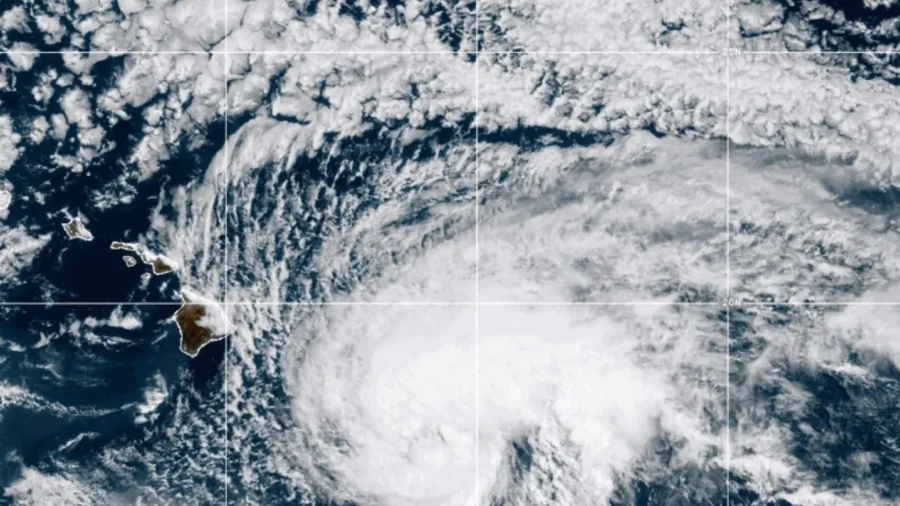
HONOLULU—Tropical Storm Lala is expected to strengthen to a hurricane before reaching Hawaii’s Big Island this weekend, forecasters said Friday, bringing heavy rains that can cause destructive flooding and strong winds that can fuel wildfires.
The National Hurricane Center said Lala should be at hurricane strength by the time it approaches the Big Island Saturday.
If it makes landfall there, it would be the first to hit the island since 1871. Back then, according to a University of Hawaii atmospheric scientist’s research of newspaper accounts, a Category 3 hurricane hit the northeast corner of the island, said Vanessa Almanza, a meteorologist with the National Weather Service in Honolulu.
“First time since satellites,” Almanza said. “The latest forecast has it very close to the southern tip of the Big Island.”
A hurricane warning was issued for the Big Island, and a tropical storm warning was in effect for Maui County, which includes the islands of Maui, Molokai, Lanai and Kahoolawe.
Officials and residents braced for Lala regardless of whether Hawaii takes a direct hit. Shelters were scheduled to open, and various events were canceled.
“It doesn’t take landfall to create destruction,” Almanza said. “A lot of the impacts are felt outside of the hurricane.”
The National Hurricane Center predicted 8 to 12 inches of rainfall totals across Maui and the Big Island, with maximum totals as high as 25 inches in some spots on the Big Island. Four to 6 inches were expected across the island chain.
The center also warned that the storm could cause “life-threatening flooding and mudslides, especially in areas of steep terrain,” along with a dangerous storm surge and ocean swells “likely to cause life-threatening surf and rip current conditions.”
Officials Urge Taking the Storm Seriously
State Rep. Jeanné Kapela, who represents communities that are in the storm’s possible track, traveled to the Big Island from Honolulu on Friday morning and called for people to be on alert.The southern end of the island is remote and rural but growing in population because of its affordability. Kapela said she was especially worried about people who live off the grid in unpermitted structures. The area’s agriculture includes coffee and cattle.
“We’re encouraging residents to take this storm seriously, remain vigilant, and get somewhere safe before conditions deteriorate,” she said in a text message to The Associated Press as her flight took off. “We’re hopeful the storm moves through quickly, but we’re preparing for whatever comes.”
Green urged residents to be ready: “If you feel now that your house doesn’t have a great roof or might not be able to withstand hurricane force winds, then first things first you go to a family or friend’s house and you kind of hunker down there.”
Kapela also noted that many parts of the state are still reeling from devastating flooding in March, saying, “We know how quickly heavy rain and flooding can impact our rural communities.”
Brian Miyamoto, executive director of the Hawaii Farm Bureau, said growers are always concerned when there is a threat of a lot of water in a short amount time. But those still recovering from the spring floods, including on Oahu’s North Shore, were worried about suffering more damage.
Wildfire Risks Increase During Windy Weather
As winds ramped up across the islands, there were no red flag warnings in place but Almanza said the dry and breezy conditions would still elevate fire concerns.In 2023 the Maui town of Lahaina burned during extreme winds amid a hurricane passing far to the south of Hawaii.
“Since the fire, everybody is way more aware of weather in general and our environment and things that are happening,” said Archie Kalepa of Lahaina, who is well known in the area for his surfing, paddling and other ocean skills and has been watching the storm closely.
As of Friday afternoon, Tropical Storm Lala was located about 275 miles east-southeast of South Point, Hawaii, according to the National Hurricane Center. It had maximum sustained winds of 65 mph and was moving toward the west-northwest at 14 mph.
The wind speed threshold for a Category 1 hurricane is 74 mph.
“I wouldn’t be afraid of what’s to come, just be prepared,” said Steven Businger, the University of Hawaii professor whose research found information about the hurricane that hit the Big Island 155 years ago.
Lala has the potential to make landfall with damaging winds, he said, but its path was trending south with every forecast.
“The Big Island is furthest south and furthest east, so it has the greatest probability of having a hurricane hit,” he said. “However, historically Kauai has seen the most landfalls.”
Kauai, which is several islands northwest up the archipelago from the Big Island, saw Hurricane Iniki make landfall as a Category 4 hurricane in 1992. That, like this year, was an El Nino year. Pacific hurricane activity increases during El Nino, a warming of the Pacific near the equator that affects weather patterns across the globe.
Iniki, the last hurricane to make landfall in Hawaii, was following a southern trajectory before it turned up and hit Kauai, the governor said.
“It did $3 billion worth of damage. It destroyed thousands of homes, and it did kill six people,” he said. “So we just can never know if a storm is going to turn.”