


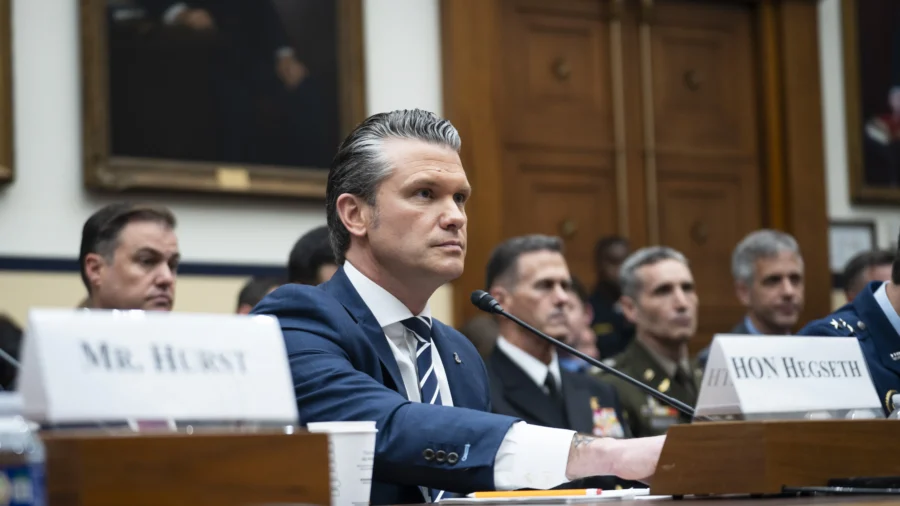
Secretary of War Pete Hegseth testified before the House Armed Services Committee today in support of President Donald Trump’s fiscal year 2027 budget request.
Trump announced a $1.5 trillion proposal last week, which is the largest ask in U.S. history.
“We're rebuilding a military that the American people can be proud of, one that instills nothing less than unrelenting fear in our adversaries and the utmost confidence in our allies,” Hegseth said on April 29. “We fight to win in every scenario.”
When asked about the Iran conflict, Hegseth described the funding proposal as a "war-fighting budget."
While conceding that Iran hasn’t "broken yet," Hegseth added that its nuclear facilities have been obliterated.
“We're watching 24/7 so we know where any nuclear material is,” he said.
The most recent peace proposal from Iran requires an end to the war and an end to the U.S. blockade in the Strait of Hormuz in exchange for Iran halting its maritime tolls through the channel while postponing discussions on its nuclear program.
Iran has not given up their nuclear ambitions and still has thousands of missiles, according to Hegseth.
"The war left us at exactly the same place we were before," Rep. Adam Smith (D-Wash.) alleged.
The Operation Epic Fury conflict stems from President Donald Trump pre-emptively striking Iran on Feb. 28, alongside Israeli Prime Minister Benjamin Netanyahu's Israeli Defense Forces.
At the House Armed Services Committee, Hegseth was flanked by Chairman of the Joint Chiefs of Staff General Dan Kain and Acting Under Secretary of War Comptroller Jay Hurst.
Hurst estimated that the total cost of Operation Epic Fury is $25 billion.
“Most of that is munitions,” Hurst told the committee. “Part of that is obviously Operations and Maintenance and equipment replacement.”
Rep. Mike Rogers (R-Ala.) chairs the House Armed Services Committee along with ranking member Smith.
Hegseth further told the committee that $71 billion of the proposed budget is allocated for nuclear modernization.
“Our nuclear triad underwrites everything,” he said. “This budget grows our force by almost 50,000 with additional troops into the force that we believe we can recruit.”
The U.S. nuclear triad is made of land-based intercontinental ballistic missiles, submarine-launched ballistic missiles, and strategic bombers.
Hegseth described needing funding to continue transforming Pentagon operations from a bureaucratic model to a business model.
“Because of the austerity of the Biden administration, we traded off maintenance and traded off quality of life to try to fund other things operationally,” he said. “This budget stops that cycle and both invests in sustainment and modernization, which is critically important.”