


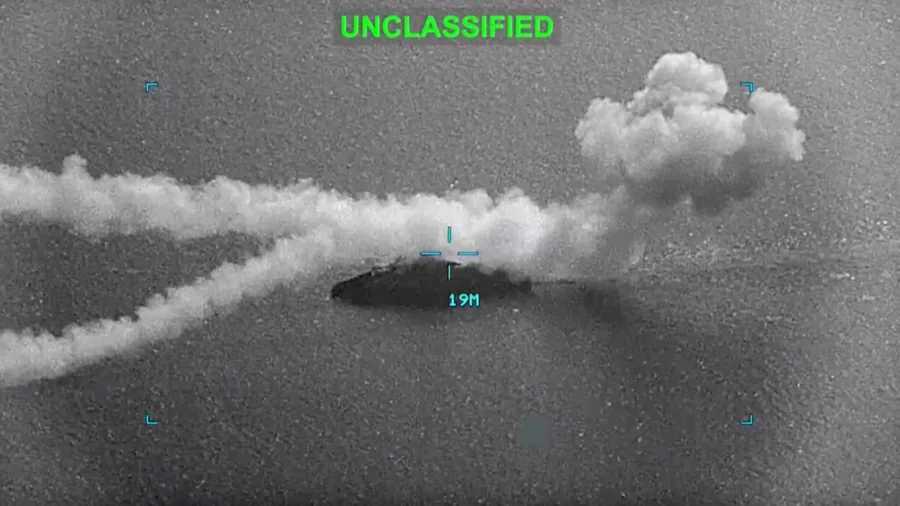
The Pentagon said a U.S. Navy submarine struck and sank an Iranian warship off the coast of Sri Lanka, marking what officials described as the first time an American submarine has sunk an enemy vessel with a torpedo since World War II.
Secretary of War Pete Hegseth told a March 4 press briefing that the ship was destroyed in the Indian Ocean during the ongoing U.S.–Israel campaign against Iran.
"An American submarine sank an Iranian warship that thought it was safe in international waters,” Hegseth said.
"Instead, it was sunk by a torpedo—quiet death—the first sinking of an enemy ship by a torpedo since World War Two.
"Like in that war, back when we were still the War Department, we are fighting to win."
Speaking at the same briefing, Chairman of the Joint Chiefs of Staff Gen. Dan Caine said that the fast-attack submarine used a single Mark 48 torpedo to sink the Iranian vessel, describing it as an "incredible demonstration of America's global reach."
Caine added that, over the next 24 to 48 hours, the U.S. military would continue to strike Iranian infrastructure and naval capability.
Earlier, Sri Lankan officials reported that one of Iran’s newest naval vessels, the frigate IRIS Dena, sank off the southern coast of the island nation after issuing a distress call.
Sri Lankan Foreign Minister Vijitha Herath told parliament that authorities received the emergency signal early on March 4.
"Around 5:08 this morning, the navy and the coast guard received a distress message from a ship belonging to the Iranian navy called IRIS Dena," Herath said. "About 30 sailors have been seriously injured. Reports say there were about 180 people on board that vessel."
Sri Lanka’s navy and air force launched a joint search-and-rescue operation after the distress signal.
"We are hopeful we can rescue more people and will continue [operations] until we are sure," a Sri Lankan navy spokesperson said.
Officials said 32 people who had been aboard the vessel were rescued while several bodies were recovered from the sea.
The Dena, a frigate commissioned by Iran in recent years, was the centerpiece of a two-ship international tour in 2023, making port calls in countries including South Africa and Brazil. It sailed alongside support ship IRIS Makran, a converted oil tanker.
Operation Epic Fury
The sinking comes amid Operation Epic Fury, a joint U.S.–Israel military campaign against Iran that began on Feb. 28.“I stand before you today with one unmistakable message about Operation Epic Fury," Hegseth said on March 4. "America is winning decisively, devastatingly, and without mercy.”
Hegseth said the United States and Israel were rapidly establishing full air superiority over Iran.
“Starting last night and to be completed in a few days, in under a week, the two most powerful air forces in the world will have complete control of Iranian skies, uncontested airspace,” he stated.
“It means we will fly all day, all night, day and night, finding, fixing, and finishing the missiles and defense industrial base of the Iranian military.”
Hegseth added that Iran’s military forces had already suffered major losses.
Iranian leader Ali Khamenei and other top officials were killed in the strikes.
Iran has since retaliated with missile and drone attacks targeting Israel, Gulf states, and U.S. assets in the region.
Hegseth said at Wednesday's briefing that Iran still has the ability to fire some missiles and attack drones, and that he expects Iran's proxies will continue to target U.S. embassies, bases, and other soft targets. As the mission continues, Hegseth said, "We will find them, and we will kill them."