


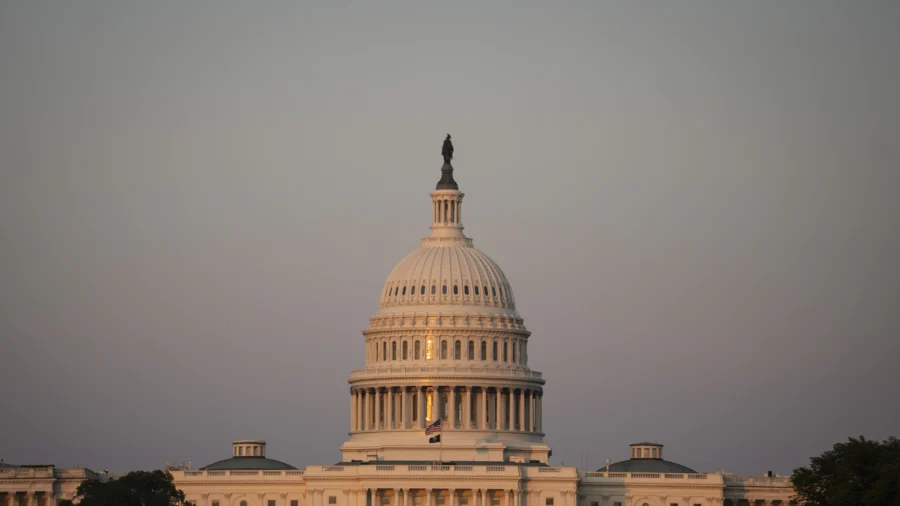
The House of Representatives on Tuesday passed a short-term funding measure, punting the government funding deadline to December.
The bill, which extends the appropriations deadline from Sept. 30 to Dec. 4, passed the House in a 220–205 vote.
It will need final approval by the Senate. Senate Majority Leader John Thune (R-S.D.) has indicated that Senate Republicans are considering their own stopgap funding measure.
While the funding deadline still lies months out, the decision to delay the process is unsurprising in an election year.
Six Democrats backed the Republican-led package.
The stopgap had been advanced by the House earlier on Tuesday as part of a package that also wraps in the National Defense Authorization Act (NDAA)—a critical defense policy bill—alongside legislation to ban members of Congress and their immediate family from stock market trading.
It passed in a 214–211 vote, a victory for House Speaker Mike Johnson (R-La.), who had fielded threats of a mutiny against the rule in the hours leading up to the vote.
That mutiny briefly manifested during the Tuesday vote, when a contingent of conservative lawmakers threatened to tank the bill on the House floor by withholding their votes for several minutes.
Several of the holdouts, including Reps. Lauren Boebert (R-Colo), Anna Paulina Luna (R-Fla.), and Tim Burchett (R-Tenn.), expressed concern at the lack of offsets in the $95 billion boost detailed in the budget resolution.
The House’s current budget reconciliation framework seeks $95 billion in military funding.
Many of the holdouts have also long pushed for House leaders to pressure the Senate to pass the Safeguarding American Voter Eligibility (SAVE) America Act.
The legislation is highly favored by President Donald Trump, who has marketed the bill as a “common sense” measure to require photo ID to register to vote and ensure that only eligible voters cast ballots.
Critics of the bill say that it would make it harder for Americans on both sides of the political aisle to vote, imposing strict requirements that would require most Americans to have either a U.S. passport or a copy of their birth certificate to vote.
House conservatives have pushed for Johnson to force Senate action on the issue.
Meanwhile, Democrats in the Senate have vowed to oppose the bill, while its prospects with the upper chamber’s Republicans are unclear.
In view of these difficulties, Republicans are also pursuing passage of a grant-style program that would provide rewards for states who pursue programs similar to the SAVE America Act.
The House passage of the rule sets the stage for a vote on the bill’s contents.
The rule contains language that would add the SAVE America Act to the must-pass NDAA, a procedure known as MIRVing.
The approval of the rule paves the way for a series of votes Tuesday night on amendments to the NDAA.
The $1.15 trillion legislation would allocate almost $1.1 trillion to the Department of War, more than $41.14 billion to the Energy Department to manage the nation’s nuclear arsenal, and $11 billion to other defense-related activities. It wraps in a 3.6 percent pay raise for all military members.
The House procedural vote comes a week after Senate Democrats blocked a procedural vote to advance the NDAA in the upper congressional chamber.
Democrats have said that the resumption of hostilities in Iran was a reason behind their opposition to the procedural vote.
However, Senate Republicans and Democrats have failed to reach an agreement on top-line defense and non-defense spending levels.