


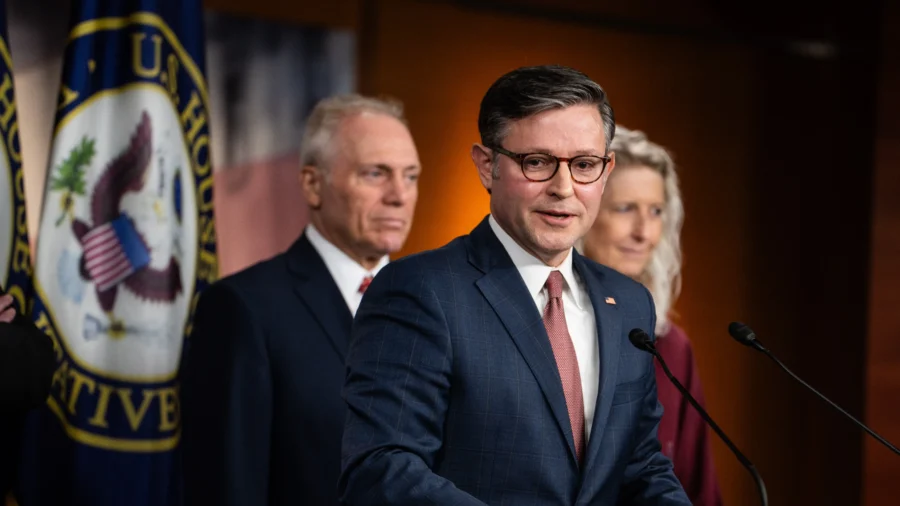
House Speaker Mike Johnson (R-La.) addressed the ongoing Department of Homeland Security (DHS) funding lapse, revealing a partisan leverage strategy that prioritizes securing the border.
“Through a targeted and narrow reconciliation process, we will fully fund the agency, including Immigration and Customs Enforcement (ICE) and Customs and Border Protection (CBP) for three years,” Johnson said. “This is great news for every American who supports secure borders and safe communities and chaos-free airports.”
A reconciliation package, also known as a reconciliation bill, is a legislative maneuver used to fast-track budget bills that would bypass the demands of Democratic members of Congress because it only requires a simple majority vote in the 53-47 Senate.
Democrats have said the White House DHS plan does not restrict U.S. Immigration and Customs Enforcement (ICE) agents enough.
Their demands include increased identification for federal officers and higher use of judicial warrants.
However, after bipartisan negotiations stalled, Senate Majority Leader John Thune (R-S.D.) said Democrats will now get “none of that."
“In the coming days, the House will be working closely with the Senate as they commence the reconciliation process,” Johnson said.
The Senate passed the Homeland Security Essential Services Act on March 27 by voice vote.
It funds the Transportation Security Administration (TSA), the U.S. Coast Guard, the Federal Emergency Management Agency (FEMA), the Cybersecurity and Infrastructure Security Agency (CISA), and the U.S. Secret Service (USSS).
However, zero new funding is provided for ICE and CBP in the Senate measure.
Johnson views the partial funding bill as an attempt to isolate and defund immigration enforcement by separating it from the rest of the DHS's agencies.
“There's a concern on our side that if you do the bulk of the Department first, before that, that they could be left out,” Johnson said of ICE and CBP. “We can't allow for that. So, we're working through that.”
The shutdown entered its second month last week since the DHS funding lapse began on Feb. 13.
As a short-term solution to airport backlogs, President Donald Trump signed an executive order on March 27 to pay TSA agents who had not received a check.
“If you want zero funding for border security, that means [the border] reopens,” Johnson added. “That's what that means. That's the reality. The sequencing's important and the language of the legislation is important as always.”